
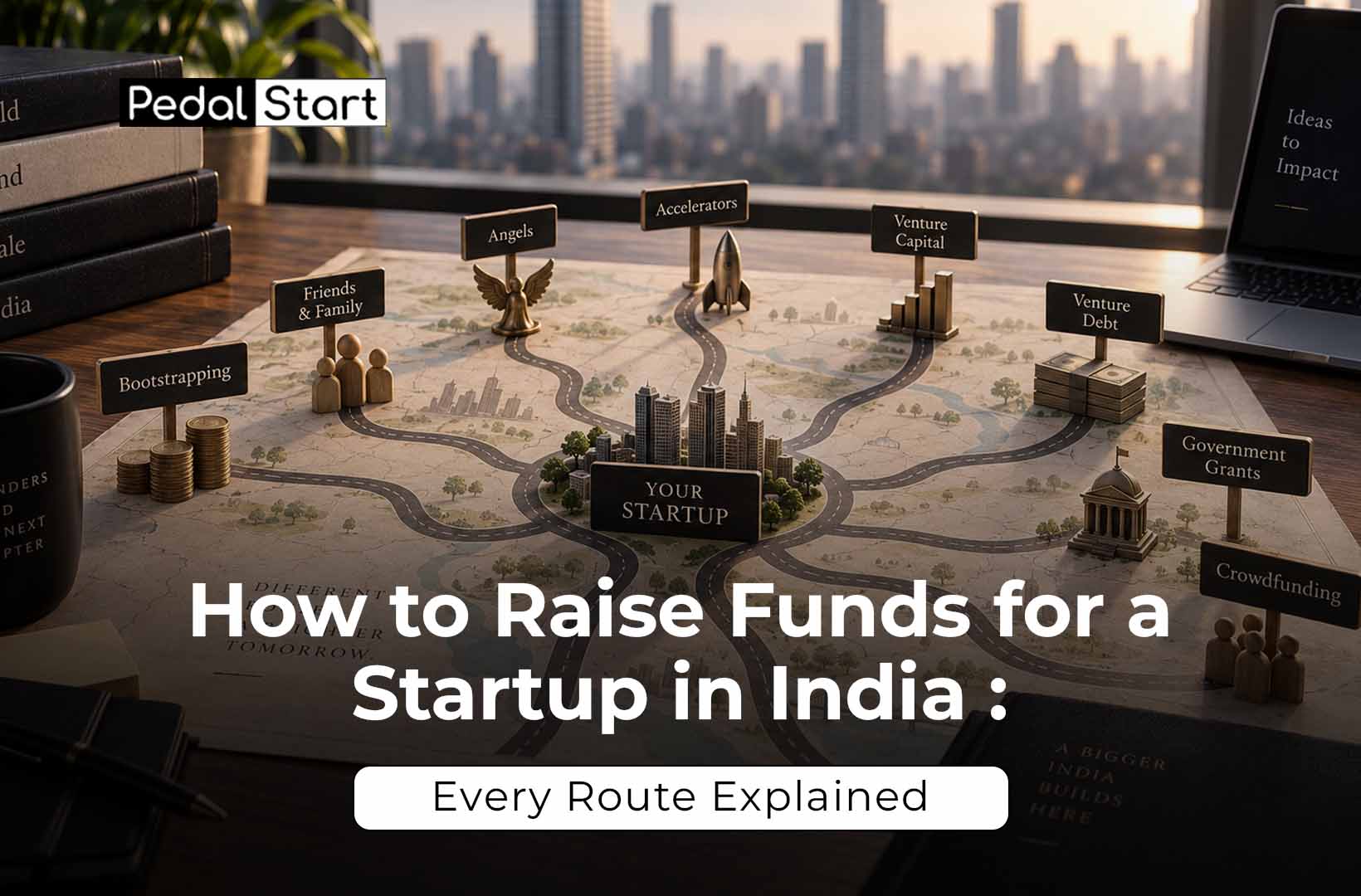
There is no single way to raise funds for a startup. There are many.
Bootstrapping, friends and family, angels, accelerators, venture capital, venture debt, government grants, crowdfunding. Each suits a different stage, a different kind of business, and a different founder.
The mistake most first-time founders make is assuming raising money means one thing: pitching a VC. It does not.
This guide maps every route to fund a startup in India. What each one is, when it fits, and what it costs you. Where a route deserves a deeper look, we link to a full guide on it.
India now has over 2.1 lakh government-recognised startups, and the ways to fund them have never been wider. Here is the full picture.
What does raising funds actually mean?
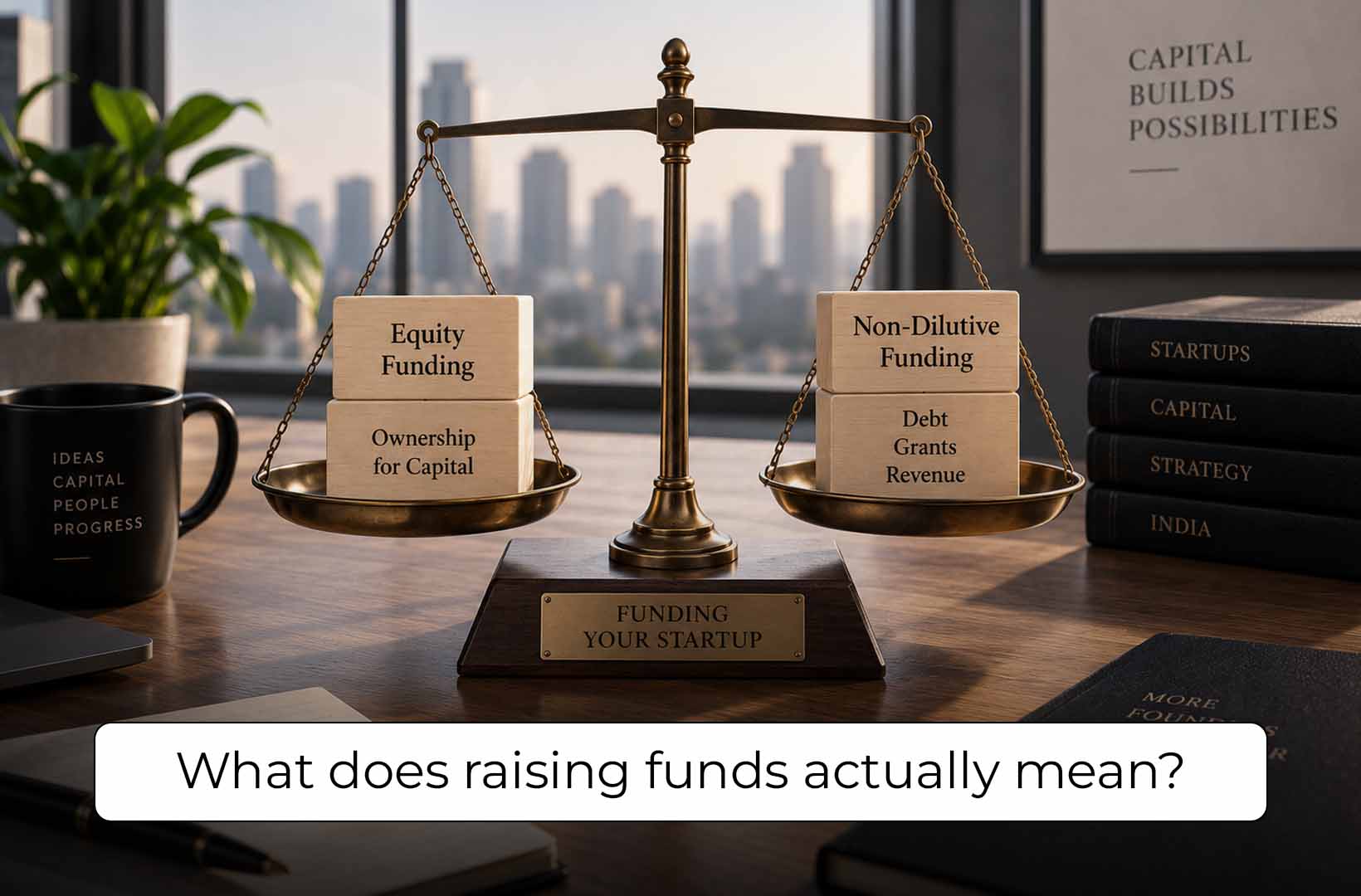
Raising funds means bringing outside money into your startup to build and grow it.
That money comes in two broad shapes. Equity funding, where you give up a share of ownership in exchange for capital. And non-dilutive funding, where you get money without giving away any of the company, through debt, grants, or revenue.
Most founders think only of equity. But the best-funded startups often use a mix, and knowing the full menu is what lets you choose well.
The main ways to raise funds for a startup
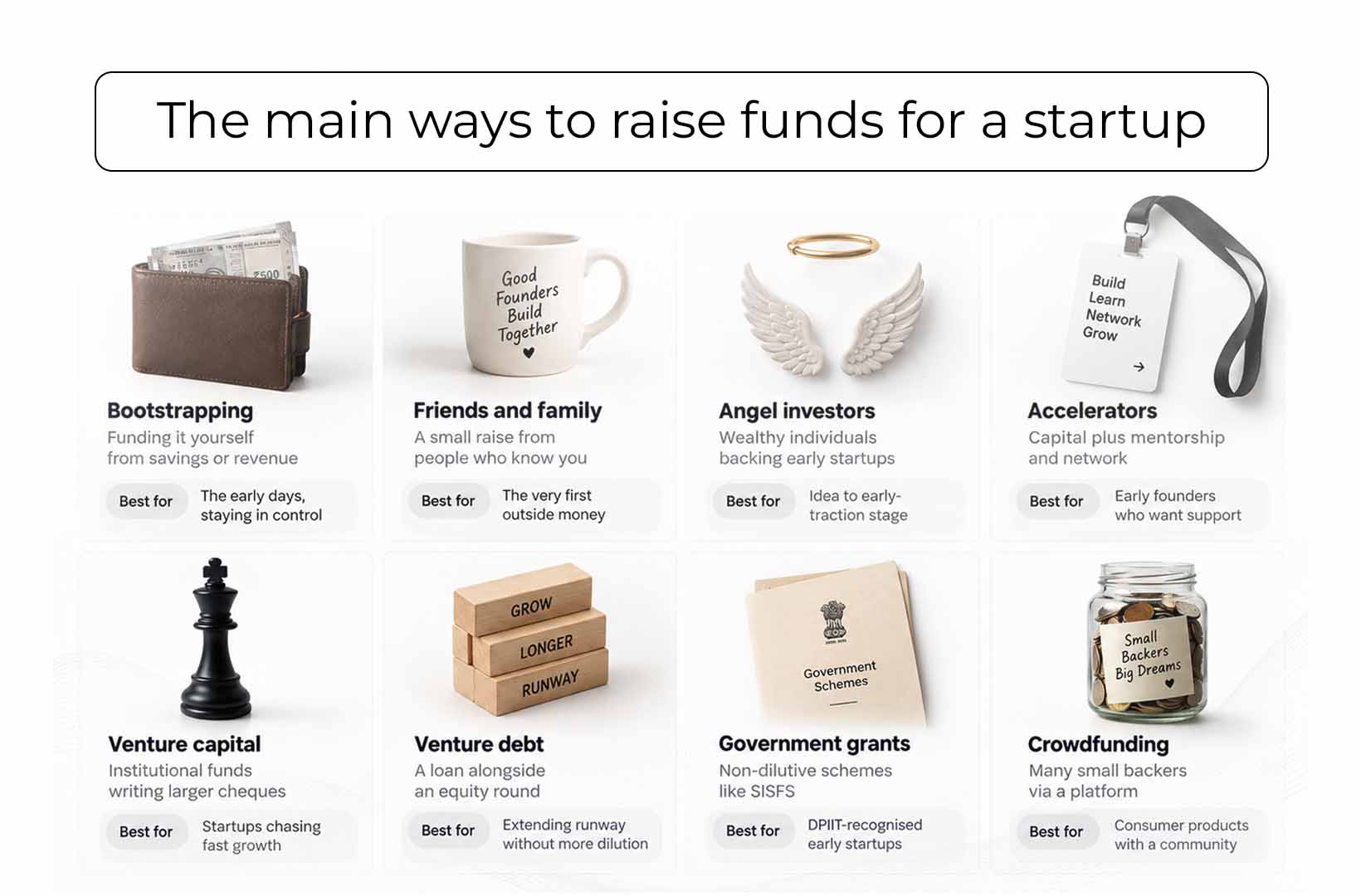
Here are the main routes, and where each one fits.
Route | What it is | Best for |
Bootstrapping | Funding it yourself from savings or revenue | The early days, staying in control |
Friends and family | A small raise from people who know you | The very first outside money |
Angel investors | Wealthy individuals backing early startups | Idea to early-traction stage |
Accelerators | Capital plus mentorship and network | Early founders who want support |
Venture capital | Institutional funds writing larger cheques | Startups chasing fast growth |
Venture debt | A loan alongside an equity round | Extending runway without more dilution |
Government grants | Non-dilutive schemes like SISFS | DPIIT-recognised early startups |
Crowdfunding | Many small backers via a platform | Consumer products with a community |
Bootstrapping and friends and family
The first money in a startup is often the founder's own.
Bootstrapping means funding the business from your savings or its early revenue. You keep full control and full ownership. The trade-off is slower growth and personal risk.
Friends and family is the next step. A small, informal raise from people who back you personally, not your metrics. It is quick and trusting, but mixing money and relationships needs clear terms to avoid trouble later.
Both suit the earliest stage, before you have enough proof for outside investors.
Angel investors and angel networks
Angel investors are wealthy individuals who put their own money into early startups. They are often the first professional money after friends and family.
They write smaller cheques than funds, decide faster, and often bring useful experience and contacts. Increasingly, they invest together through angel networks and syndicates, which pool many angels around a single deal.
For a founder, a network can be easier to reach than chasing individual angels one by one.
Our guide on how the India angel investment network works explains the route in full, and how to invest in startups in India covers the same from the investor's side.
Accelerators and incubators
An accelerator gives you capital, mentorship, and access to investors, in exchange for a small equity stake and your time in a structured programme.
For an early-stage founder, the value is not only the cheque. It is the operating support and the investor network that come with it, which can shorten the path to your next raise.
PedalStart is one such accelerator, backing founders at the idea, pre-seed, and seed stages with capital, mentorship, and investor access.
Venture capital: pre-seed to seed and beyond
Venture capital is institutional money. Funds raise capital from their own investors and deploy it into high-growth startups.
VC comes in stages. Pre-seed and seed are the earliest, where a startup raises its first institutional rounds to build the product and find product-market fit. Later rounds fund scaling.
VC brings large cheques and strong networks. But it also brings expectations: fast growth, and eventually an exit.
We cover the earliest rounds in depth in our pre-seed funding roadmap and in what investors really look for before they write a cheque.
Non-dilutive funding: grants, venture debt, and revenue
Not all funding costs you equity. Non-dilutive routes let you raise money while keeping your ownership intact.
Government grants. India runs several schemes for recognised startups, including the Startup India Seed Fund Scheme, which offers early grants to DPIIT-recognised companies. This is close to free capital, though it is competitive and comes with paperwork.
Venture debt. A loan taken alongside or after an equity round, used to extend runway without giving up more shares. It suits startups with some revenue or a recent raise.
Revenue-based financing. You receive capital and repay it as a share of monthly revenue. It fits businesses with steady, predictable sales, like many D2C and SaaS brands.
Crowdfunding
Crowdfunding raises small amounts from many people through an online platform.
It comes in a few forms. Reward-based, where backers pre-order your product. Equity-based, where they get a small ownership stake. And donation-based, for social causes.
It works best for consumer products with a story and a community. And it doubles as a way to prove demand before you build.
How do you choose the right route?
The right way to raise funds depends on three things: your stage, your kind of business, and how much control you want to keep.
At the idea stage, bootstrapping, friends and family, angels, and accelerators fit best. As you grow and need larger cheques, VC becomes the main route. If you have revenue and want to avoid dilution, venture debt, revenue-based financing, and grants are worth a hard look.
A fast-scaling tech startup and a steady, profitable D2C brand should not raise the same way. Match the money to the business
Before you raise: getting ready
Whichever route you pick, investors and lenders check the same fundamentals.
Know how much you need and why, tied to a clear runway and set of milestones. Understand the dilution each round causes, so you do not give away too much too early. And have your basics in order before anyone asks.
Our guides on startup burn rate and runway, equity dilution, and the due diligence checklist cover what to prepare before you start.
Where to start
There is no best way to raise funds for a startup. There is only the right way for your stage and your business.
Start by being honest about where you are.
If you have an idea and early conviction, look at bootstrapping, angels, and accelerators. If you have traction and need to scale, look at VC. If you have revenue and want to protect ownership, look at the non-dilutive routes.
The founders who raise well are not the ones who chase every option. They are the ones who pick the route that fits, prepare properly, and know exactly what they are trading for the money.
Key takeaways
There are many ways to raise funds for a startup: bootstrapping, friends and family, angels, accelerators, VC, venture debt, grants, and crowdfunding.
Funding is either dilutive (you give up equity) or non-dilutive (debt, grants, revenue). The best-funded startups often mix both.
The right route depends on your stage, your type of business, and how much control you want to keep.
Early stage suits angels and accelerators, scaling suits VC, and revenue-stage businesses can use non-dilutive routes.
Whatever you choose, know how much you need, understand the dilution, and get fundraise-ready first.
Frequently asked questions
How do startups raise funds in India? Through a mix of routes: bootstrapping, friends and family, angel investors, accelerators, venture capital, venture debt, government grants, and crowdfunding. The right one depends on the startup's stage and type.
How can I raise funds without giving up equity? Through non-dilutive routes: government grants like the Startup India Seed Fund Scheme, venture debt, and revenue-based financing. These give you capital without taking ownership.
How much equity do you give up when raising funds? It varies by round, but early rounds commonly cost a founder somewhere around 10 to 25% each. Understanding dilution before you raise is essential.
Do you need revenue to raise funds for a startup? Not always. Angels and pre-seed investors often back strong teams and ideas before revenue. But most non-dilutive routes, like venture debt, do want some revenue or a recent raise.
What government schemes help fund startups in India? The Startup India Seed Fund Scheme offers early grants to DPIIT-recognised startups, alongside other central and state programmes.