

Quick commerce has become the fastest-growing retail format India has ever seen.
It is now a $10 billion-plus market, with more than 30 million people ordering every month, and it already accounts for around 15% of all e-commerce in the country. Growth is running near 150% a year, according to Redseer.
But behind the boom sits the question almost everyone asks. How do these companies actually make money delivering a packet of milk in ten minutes?
This guide answers that. What quick commerce is, how the model works, if it makes money, and, most of all, what the whole shift means for founders building startups and the investors backing them.
What is quick commerce?
Quick commerce, often shortened to q-commerce, delivers everyday essentials in ten to twenty minutes.
Groceries, snacks, personal care, medicines, and increasingly much more, brought to your door almost instantly, ordered through an app.
It sits apart from regular e-commerce. Online shopping delivers a wide range of products over one to several days, from large central warehouses. Q-commerce does the opposite: a narrow, fast-moving range, delivered in minutes, from tiny local hubs called dark stores.
In short, e-commerce is built for choice. Quick commerce is built for speed.
How does the dark store model work?
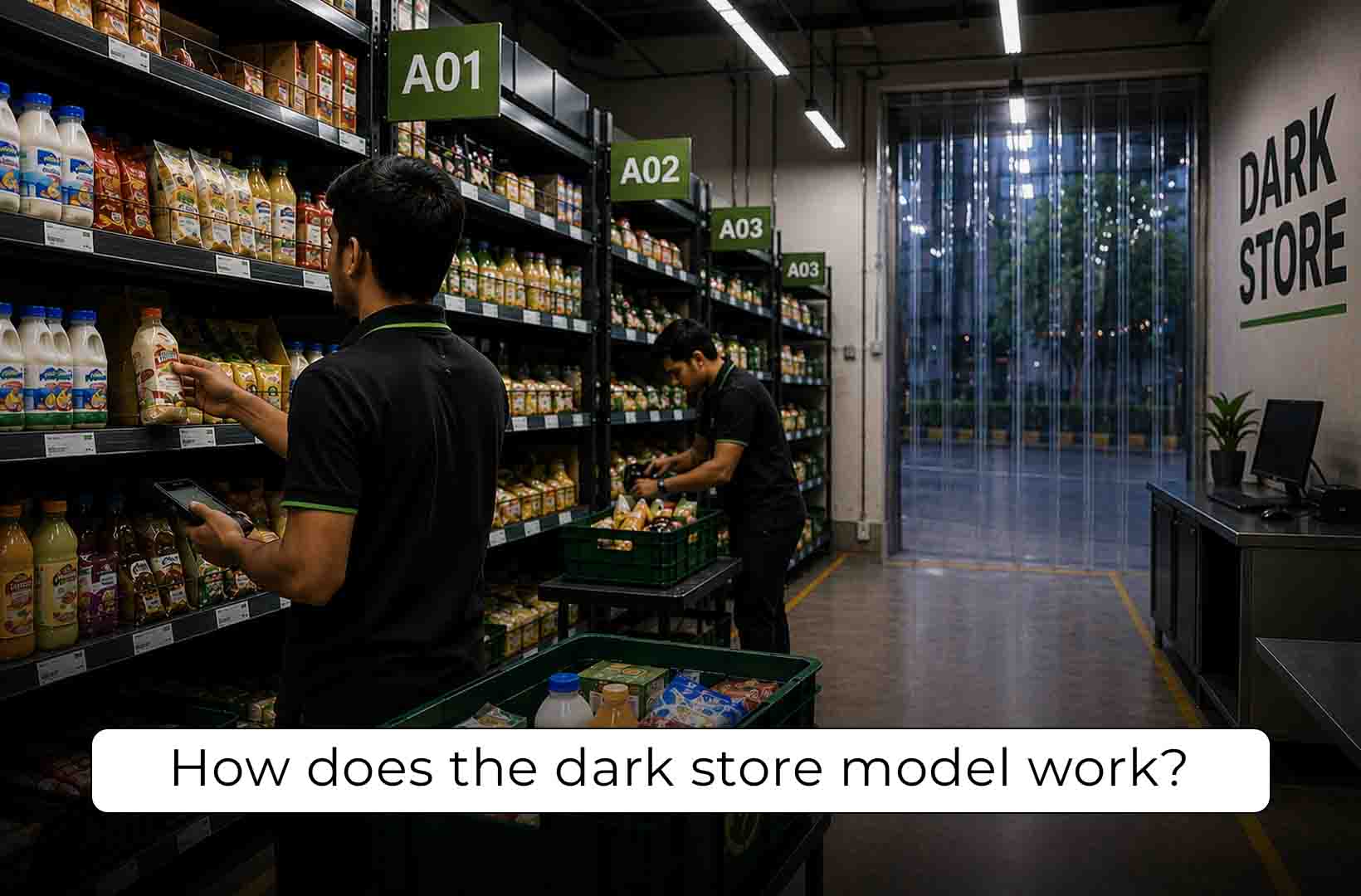
The whole thing runs on dark stores. These are small warehouses, not shops.
A dark store is a compact space, often 3,000 to 6,000 square feet, placed inside a neighbourhood so it can reach customers within a two- to three-kilometre radius. No aisles to browse and no walk-in customers. Just shelves, pickers, and delivery riders.
When you order, the app has already mapped the fastest route through the store. A picker grabs your items in a couple of minutes, a rider is assigned, and the short distance does the rest.
India had roughly 2,500 dark stores in 2025. That number is expected to roughly triple by 2030 as the model spreads beyond the big cities.
Speed comes from being close, not from moving faster. A dark store two kilometres away is what makes ten minutes possible.
How does quick commerce actually make money?
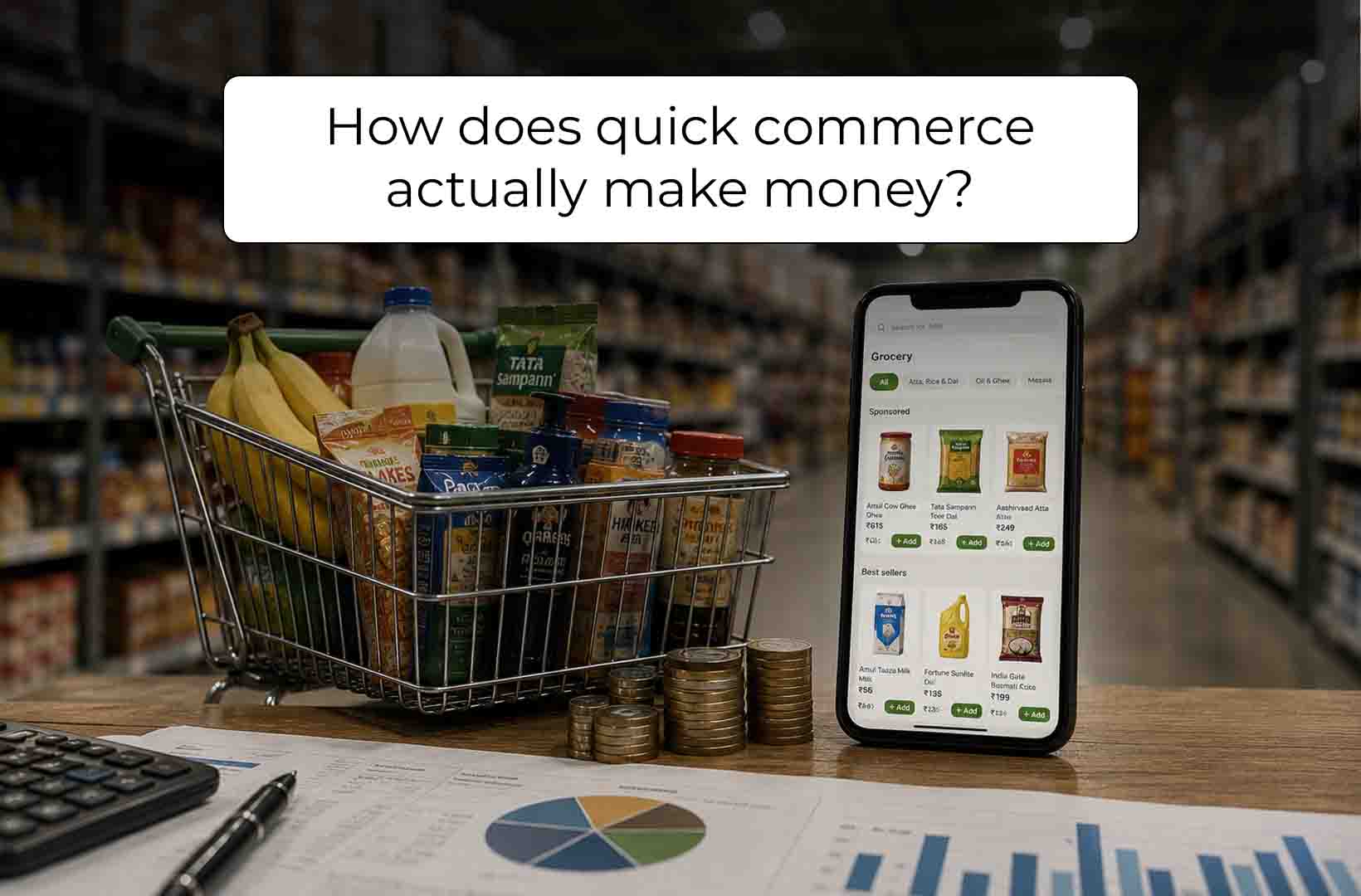
This is the question everyone asks. The honest answer is that most players do not make money yet.
The margin on groceries is thin. A few rupees on a packet of milk, after paying for the store, the rider, and the discounts, does not cover the cost of the order. So where does the money come from?
Three levers matter.
Bigger baskets. The more you order at once, the better the economics. Average order values have climbed to around ₹460, and higher-value categories like beauty and personal care help a lot.
Advertising. This is the one people miss. A big share of the profit does not come from groceries at all. It comes from brands paying to appear at the top of the app, the way they pay for a supermarket shelf. These platforms make real money selling attention.
Density. A dark store handling 1,000-plus orders a day spreads its fixed costs thin and starts to work. One handling a few hundred loses money.
So who is actually profitable? Right now, mostly the leader. Blinkit is closest to breaking even and has become its parent company's biggest business. Its rivals were still posting heavy losses through 2025 as they spent to expand.
The research firm Bernstein called 2026 another year of discovery, not profits. The opportunity is huge, but the path to making money is still being worked out.
Why does it work in India when it failed elsewhere?
Ten-minute delivery was supposed to be a cautionary tale. In Europe and the US, funded players like Getir and Gorillas burned through billions and folded.
In India, the same model is thriving. Three things explain it.
Cheap, dense delivery. Delivery labour in India costs a fraction of Western rates. And Indian cities are dense, so one dark store can serve a large number of customers within a short radius. The maths that broke in London works in Mumbai.
Existing habits. Indians have always shopped in small, frequent trips to the local store, rather than one big weekly haul. Quick commerce simply digitised a behaviour that was already there.
A specific customer. For a time-pressed, urban, salaried shopper, paying a small fee to get essentials in ten minutes is an easy trade. That customer, mostly in the metros, drives the bulk of the demand.
What quick commerce means for founders and brands
Here is the part that matters if you are building a company. Quick commerce has quietly become one of the most powerful launchpads for new consumer brands in India.
For decades, the hardest part of building a brand here was distribution. Getting onto shelves across the country took years and deep pockets. Quick commerce collapsed that.
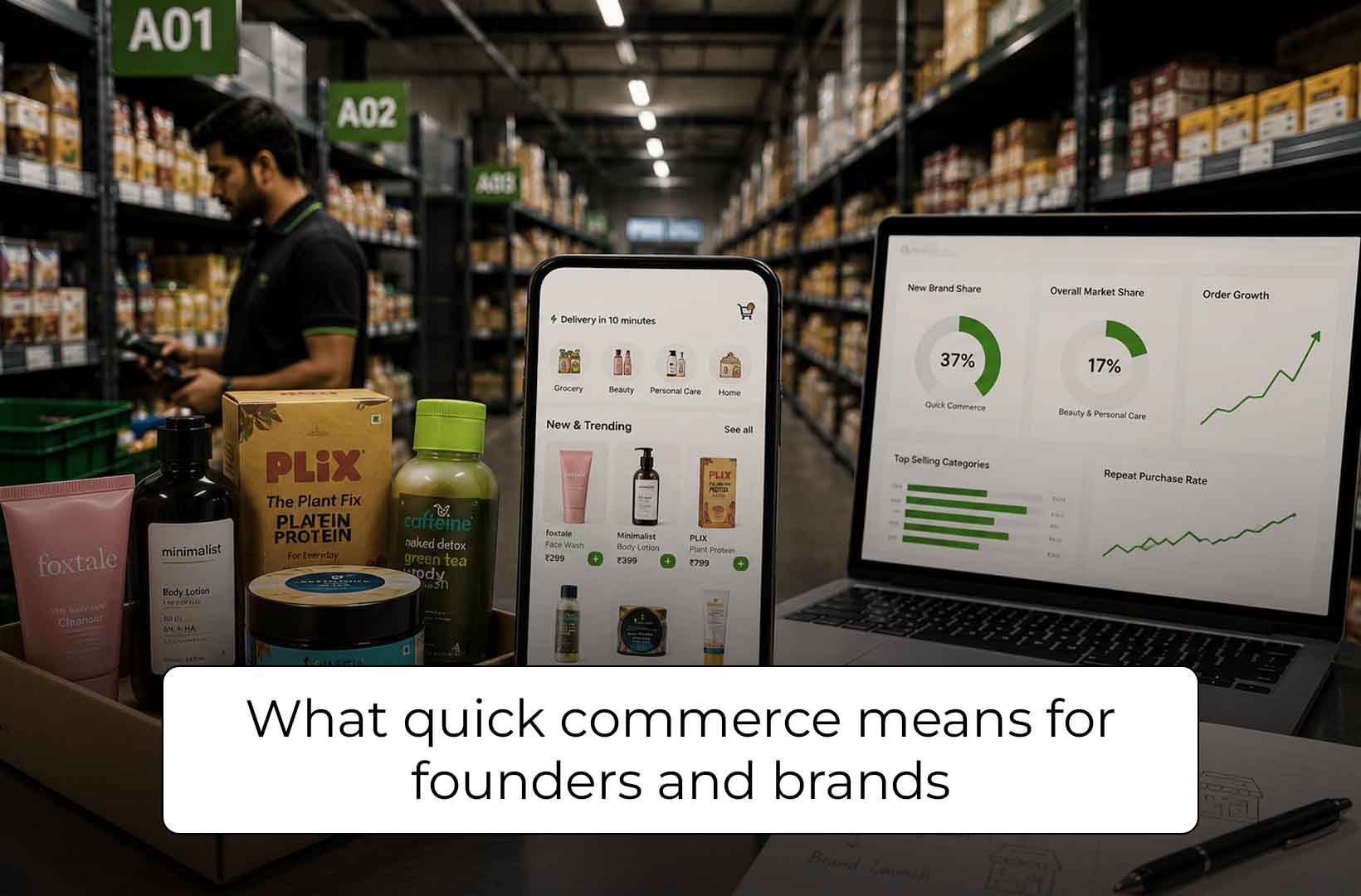
A new brand can now reach millions of customers through these apps, with no distributor network at all. And the data shows small brands winning shelf share they never could before.
Digitally-native brands hold around 17% of the beauty and personal care market overall. But on quick commerce, they take about 37% of it, per Redseer. The fast shelf rewards new brands more than old ones did.
The opportunity is not only in building brands. It is also in the picks and shovels around the model: the software that runs dark stores, the supply and logistics that feed them, and the startups helping kirana stores plug into the system.
Whole categories that were not viable before are viable now.
What early-stage investors look for in the quick-commerce era
For investors, this shift has changed what a good consumer startup looks like.
Riding the trend is not enough. A brand that only sells on these apps is renting someone else's shelf. The platform owns the customer, sets the terms, and can raise its cut whenever it likes. That platform dependence is the single biggest risk.
So the questions worth asking are the ones that decide any consumer business.
Does the brand have real margins, or is it alive only on discounts? Do customers come back, or were they bought once with a coupon? Is there a reason to exist beyond a listing on an app?
At PedalInvest, this is the lens we bring to consumer startups building in and around quick commerce. The winners will have genuine unit economics and a reason to exist off the platform too. It is the same thing investors look for in any early-stage business.
Will quick commerce replace the kirana store?
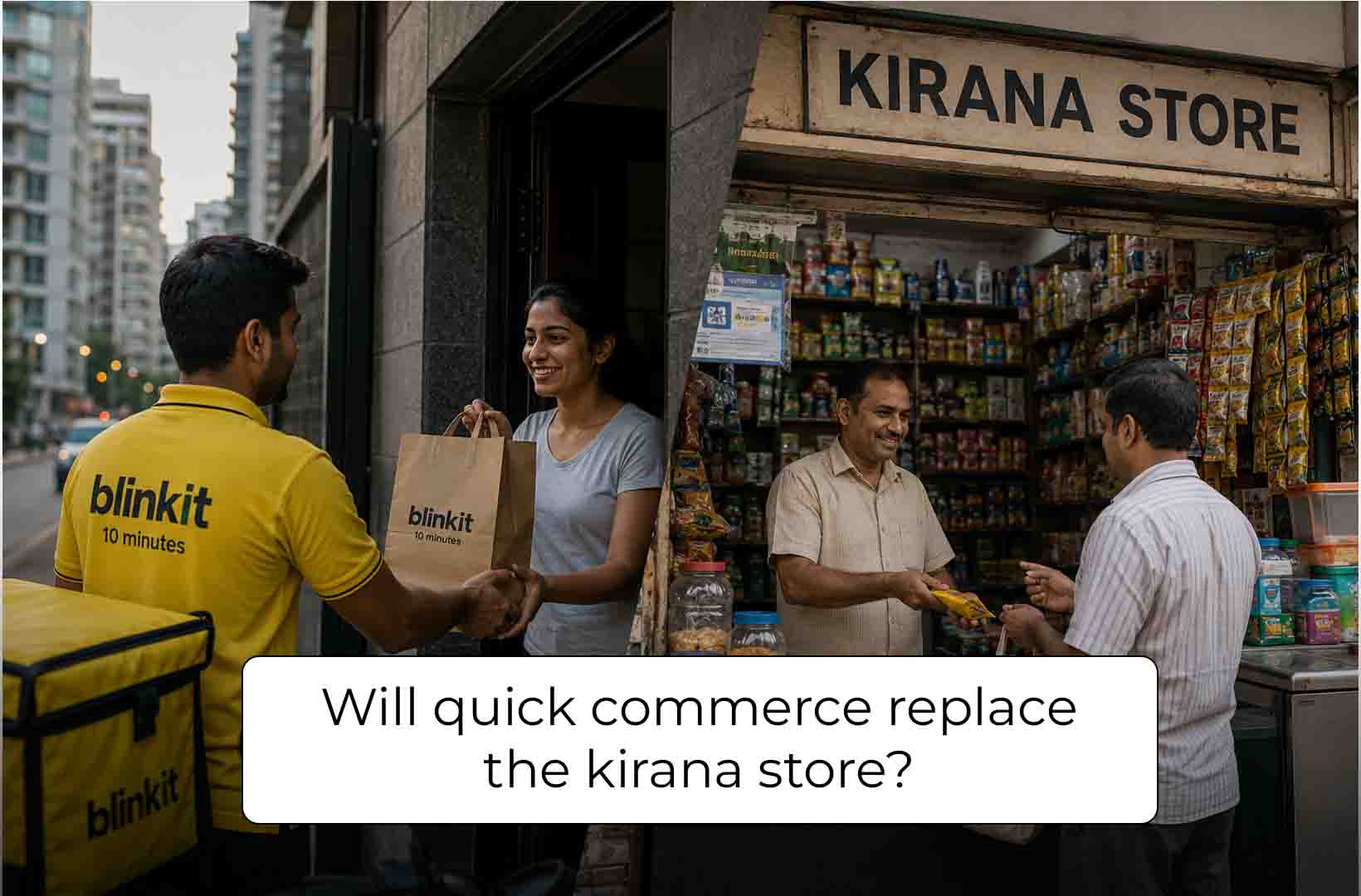
Probably not, and the data is clear on why.
Kirana stores, India's neighbourhood shops, still handle around 90% of the country's grocery spending. Even with everything quick commerce is projected to gain, that number is expected to fall only to about 86% by 2030.
The reason is that India is not one market. In the metros, a salaried shopper happily pays a fee for ten-minute delivery. In smaller towns, where the average basket is ₹100 to ₹200 and saving ₹10 is worth a short walk, the kirana still wins.
Quick commerce is taking the high-value, impulse, and top-up purchases in the big cities. The kirana keeps the rest.
There is also a growing middle path, where platforms partner with kirana stores instead of replacing them, using their shelves for fulfilment. Regulators are watching too, as traders' bodies raise concerns about deep discounting and foreign funding.
The simple version
Quick commerce is real, it is huge, and it is growing faster than any retail format India has seen. But it is not a money machine yet. The leader is near profit, and the rest are still spending to get there.
For a founder, the takeaway is not to chase the giants. It is to see the shift they created. A new brand can reach customers overnight, whole categories are suddenly viable, and there is a growing stack of businesses to build around the model.
For an investor, the discipline does not change. Look past the trend to the unit economics, and back the brands that would survive even if the fast shelf disappeared.
The ten-minute delivery is the headline. The real story is everything now being built because of it.
Key takeaways
Quick commerce is India's fastest-growing retail format, a $10 billion-plus market with 30 million monthly users and around 15% of all e-commerce.
It runs on dark stores, small local warehouses that make ten-minute delivery possible.
Most players are not profitable yet. The money comes from bigger baskets, advertising, and dense, high-volume stores.
It works in India, where it failed abroad, thanks to cheap, dense delivery and existing small-basket shopping habits.
For founders, it is a powerful launchpad for new brands. For investors, platform dependence is the risk to watch.
Frequently asked questions
How does quick commerce make money? Mostly through advertising and larger baskets, not the thin margins on groceries. Brands pay to appear on the app, and busy, high-volume dark stores spread their fixed costs.
Is quick commerce profitable in India? Not for most players yet. Blinkit is closest to breaking even, while its main rivals were still posting losses through 2025 as they expanded.
What is a dark store? A small warehouse, not a shop, placed inside a neighbourhood to fulfil online orders. It has no walk-in customers, only pickers and riders, and it is what makes ten-minute delivery possible.
Why does quick commerce work in India but failed in the West? Cheap delivery labour, dense cities where one store serves many customers, and a long habit of small, frequent grocery trips that the model simply digitised.
Will quick commerce kill kirana stores? Unlikely. Kiranas still hold around 90% of grocery spending, expected to fall only to about 86% by 2030, as they keep winning in smaller towns and price-sensitive baskets.