
A co-founder leaves in month three and keeps their entire equity stake.
That is the default outcome in India when there is no vesting schedule in writing. The person who stops showing up owns the same share as the person who spends the next four years building. Nothing in company law prevents it.
It is the most common founder-destroying mistake we see, and the document that prevents it is the one founders are most likely to skip.
What is a founders agreement?
A founders' agreement, also called a co-founder agreement, is a private contract between the people starting a company. It records who owns what, who does what, what happens to equity if somebody leaves, and how disagreements get settled.
It is enforceable in India as an ordinary contract under Section 10 of the Indian Contract Act, 1872, provided it has offer, acceptance, lawful consideration, and free consent.
It is not filed with the Registrar of Companies. Nobody checks that you have one, which is exactly why it gets postponed.
What clauses does it need?
Nine, and they are listed here in order of how much damage they do when missing rather than in the order a lawyer would draft them.
Clause | What it settles |
Equity split | Who owns what percentage, and on what basis |
Vesting and leaver | How equity is earned over time, and what happens if somebody exits early |
IP assignment | That the company owns the code, brand, and designs, not the individuals |
Roles and time commitment | Who is responsible for what, and whether it is full-time |
Decision-making and deadlock | Who decides, and what happens when nobody can agree |
Confidentiality | What founders cannot disclose, during and after |
Non-compete and non-solicit | What a departing founder cannot do next |
Exit and termination | Notice periods, right of first refusal, treatment of vested and unvested shares |
Dispute resolution | Arbitration seat, governing law, escalation process |
Which clauses will Indian law not enforce?
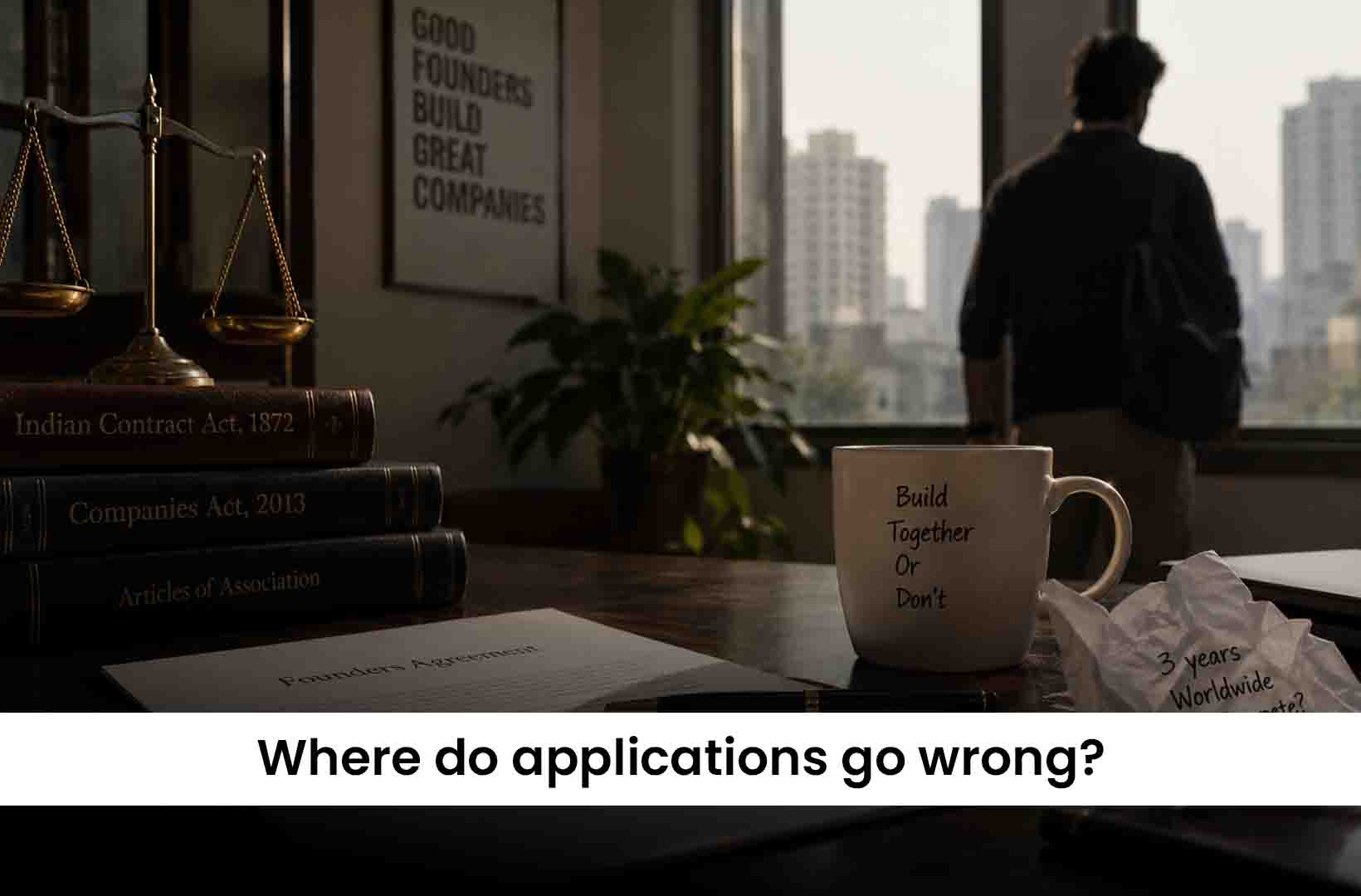
Two things catch founders who use a template written for another country.
Broad non-competes are void. Section 27 of the Indian Contract Act, 1872 voids any agreement that restrains a person from exercising a lawful profession or trade. A clause saying a departing founder cannot work for a competitor anywhere in the world for three years is not merely aggressive. It is unenforceable the moment somebody challenges it.
What survives is narrow drafting tied to a legitimate business interest: a defined period, a defined geography, a defined activity. Most imported templates contain the opposite.
The Articles override the agreement. The Companies Act, 2013 and your Articles of Association take precedence over anything in a private founders agreement that conflicts with them.
The practical consequence is specific. Share-related terms bind the company only when they are also written into the Articles. A founder who signs a vesting clause and assumes the company is bound by it has not achieved that yet.
What do founders get wrong?
No vesting at all
The default failure. Without a vesting schedule, a founder who leaves in month three keeps everything, and the remaining founders carry the company for somebody who is no longer in it.
The convention is four years with a one-year cliff. Nothing vests until the first anniversary; then it accrues monthly.
Exempting the CEO from vesting
The founder who argues they should be exempt because they started the company is, on a cap table, the single largest leaver risk on it.
Indian investors in 2026 expect four-year vesting on every founder, including the CEO. Deviations get accepted only with written justification, substantial pre-incorporation contribution or capital infusion, and rarely without a discount on valuation.
A 50-50 split with no tiebreaker
Equal splits are common and often correct when both founders are full-time and contributing equally. The problem is not the split; it is the absence of a mechanism for what happens when two people disagree, and neither can win.
This is reportedly the most frequent cause of founder disputes after a Series A in India. The fix is simple: name a tiebreaker for operational decisions, or write in a deadlock mechanism such as an independent director with a casting vote.
Our guide on equity split for co-founders covers how to arrive at the percentages themselves.
Using a template written for another country
Beyond the Section 27 problem, foreign templates reference company law that does not apply here, use instruments India does not recognise, and assume a corporate structure that differs from a private limited company.
No IP assignment
Without an assignment clause, the company may not own the code, the brand or the designs its founders created. That surfaces during diligence, and it is one of the most common reasons an early-stage round stalls. Our guide on what investors check during diligence covers what else gets examined.
When should you sign it?
At the idea stage, or immediately before incorporation.
The reason is not legal; it is human. Signing early fixes equity, roles, and vesting while everybody still agrees and nobody has a reason to argue. Every month that passes adds another contribution somebody feels should be recognised, and the conversation gets harder rather than easier.
The worst time to draft one is during a dispute, which is when most founders finally attempt it.
At PedalStart, this is among the first documents we ask to see, and its absence tells us something about how the company has been run.
What if you are a solo founder?
No co-founder agreement is needed, but three documents still are.
A founder-to-company IP assignment, so the company owns what you built. An employment or services agreement between you and the company. And a vesting schedule once outside investors come in, which they will ask for.
Those deliver the same protections a co-founder agreement would.
The short version
A founders agreement is a two-hour conversation that prevents a two-year problem.
Sign it before incorporation. Put vesting on every founder, including whoever runs the company. Assign the IP. Name a tiebreaker if there are two of you.
And do not download a template written for Delaware. The non-compete inside it will not survive a challenge here, and the share terms will not bind your company unless they also sit in your Articles.
Key takeaways
A founders agreement is enforceable in India as an ordinary contract under Section 10 of the Indian Contract Act, 1872, and is not filed with the ROC.
Section 27 of the same Act voids broadly drafted non-competes. Narrow, time-limited, geography-limited clauses tied to a legitimate business interest are what survive.
The Companies Act and your Articles of Association override conflicting clauses. Share terms bind the company only when written into the Articles too.
Four-year vesting with a one-year cliff is expected for every founder, including the CEO. Exemptions raise questions during diligence.
Without vesting, a founder who leaves in month three keeps their full stake.
Frequently asked questions
Is a founders agreement legally binding in India?
Yes. It is enforceable as an ordinary contract under Section 10 of the Indian Contract Act, 1872, provided it has offer, acceptance, lawful consideration, and free consent. It is not filed with the Registrar of Companies.
What should a founders agreement include?
Nine core clauses: equity split, vesting and leaver provisions, IP assignment, roles and time commitment, decision-making and deadlock, confidentiality, non-compete and non-solicit, exit and termination, and dispute resolution.
Can I use a founders agreement template?
A template is a reasonable starting point if it was written for Indian law. Foreign templates commonly contain non-compete clauses that Section 27 of the Indian Contract Act voids, and reference company law that does not apply here.
When should co-founders sign it?
At the idea stage or immediately before incorporation, while everybody still agrees and has little reason to dispute the terms. Signing early fixes equity, roles, and vesting before money complicates the conversation.
Is a founders agreement the same as a shareholders agreement?
No. A founders agreement governs the relationship between co-founders. A shareholders agreement governs the relationship between founders and outside investors. They are independent contracts serving different purposes.
What happens if a co-founder leaves without a vesting clause?
They keep their full equity stake. Nothing in Indian company law prevents it, which is why vesting is the clause whose absence causes the most damage.
Do solo founders need one?
Not a co-founder agreement, but they do need a founder-to-company IP assignment, an employment or services agreement with the company, and a vesting schedule once outside investors come in