

Why 50/50 Splits Become Difficult Later
A large number of startups begin with equal ownership between founders.
But as the company starts operating, differences naturally emerge. One founder may move full-time immediately while the other takes longer. One person may handle fundraising and hiring while the other focuses only on product. In some cases, one founder becomes significantly more involved than expected while another slowly disengages.
This is where many co-founder conflict startup situations begin.
The issue is rarely the percentage itself. It is the feeling that contribution and ownership stopped matching somewhere along the way.
That is why conversations around Equity Split for Co-Founders need more thought in the beginning than most teams initially give them.
What Determines a Fair Equity Split
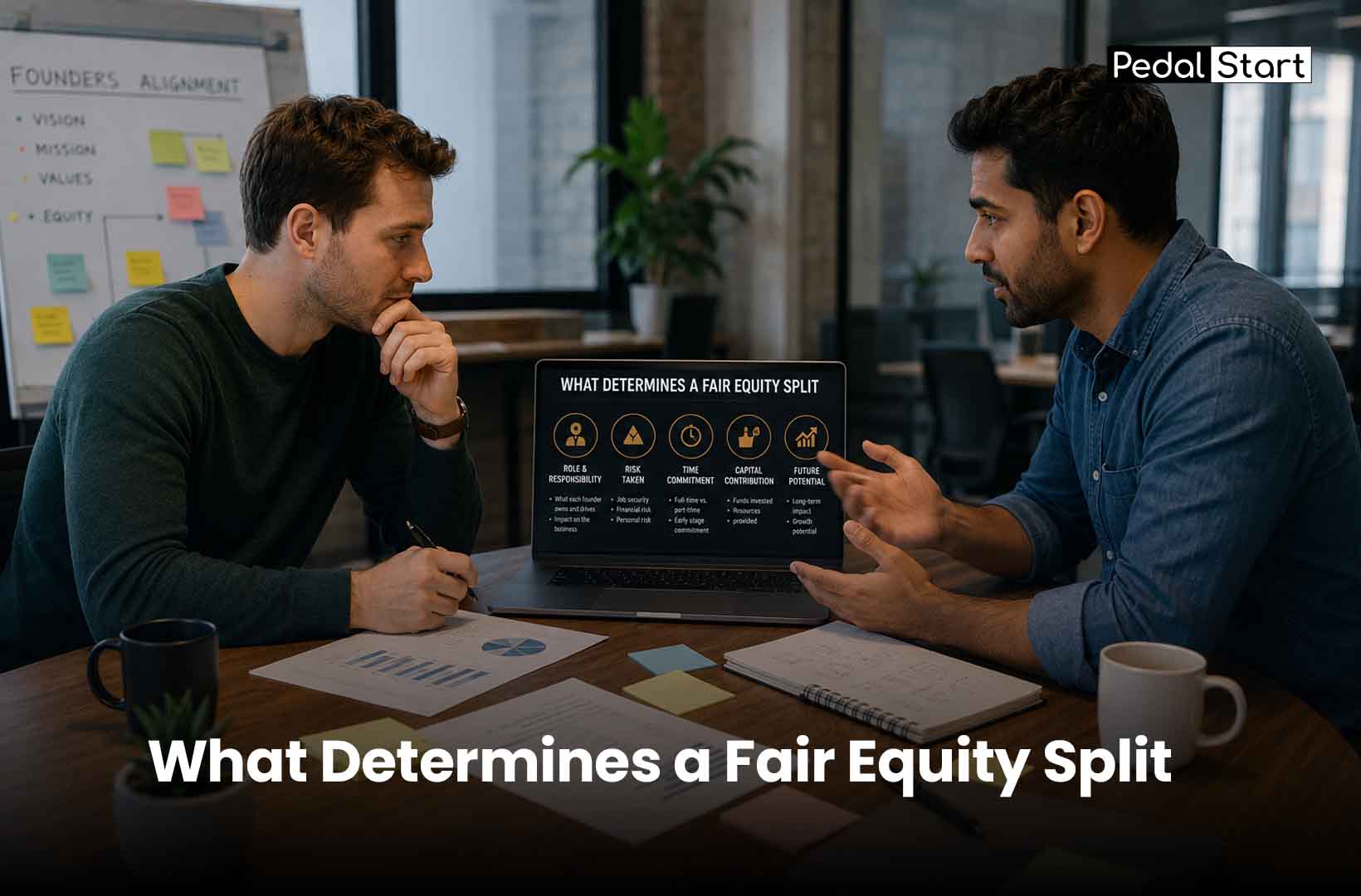
There is no universal formula for dividing equity.
A fair split depends on multiple factors working together.
The first is role and responsibility. A founder leading product, team building, fundraising, and strategy will usually carry a different operational load than someone contributing part-time in a limited capacity.
Risk also matters. Leaving a stable job, relocating, or committing financially to the startup changes the equation.
Time commitment becomes important very quickly. A founder working full-time from day one is taking a very different bet compared to someone contributing nights and weekends.
Capital contribution can influence ownership too, especially in the early days when the company has limited resources.
These discussions are uncomfortable because they force founders to talk honestly about expectations. But avoiding the conversation creates far bigger problems later.
For many teams, the challenge is not deciding the numbers. It is learning how to approach equity negotiation founders conversations without damaging trust.
Vesting Schedules Explained Simply

One of the most important concepts in founder equity India conversations is vesting.
A standard vesting schedule co-founder structure is four years with a one-year cliff.
Here is what that means in practice.
Suppose a founder owns 20 percent equity.
If they leave before completing one year, they leave with nothing. That is the cliff.
After completing one year, a portion of the equity becomes theirs. The remaining amount continues vesting gradually over the next three years.
This protects the company if a founder exits early.
Without vesting, someone could leave after a few months and still continue owning a large percentage of the company despite no longer contributing.
Many early-stage teams skip this because they feel awkward introducing legal structures between friends. Later, this becomes one of the biggest sources of founder disputes.
Co-Founder Agreement Essentials

A proper co-founder agreement startup document does much more than define ownership percentages.
It sets expectations clearly while the relationship is still healthy.
Some important areas that should always be covered:
IP Assignment
Any work created for the startup should belong to the company, not individual founders.
Exit Clauses
The agreement should define what happens if a founder leaves voluntarily or is asked to exit.
Roles and Responsibilities
Even if responsibilities evolve later, having initial clarity avoids confusion early on.
Vesting Terms
The vesting structure should be documented formally.
ESOP Pool
Future employee stock allocation should be discussed early instead of becoming a surprise during fundraising.
Many founders delay these conversations because they feel too formal for an early friendship-driven startup. In reality, clarity protects relationships.
Understanding the Early Startup Cap Table

A startup cap table early stage usually looks simple in the beginning, but it changes quickly after fundraising.
At the earliest stage, ownership is typically divided among founders.
As the company grows, an ESOP pool gets added for future employees. Angel investors may come in during the first funding round, which dilutes founder ownership further.
For example:
Founder A: 45%
Founder B: 35%
ESOP Pool: 10%
Angel Investors: 10%
This structure keeps evolving with every round raised.
Founders who understand dilution early usually make better long-term decisions during fundraising conversations.
How to Have the Hard Conversation

The equity discussion becomes difficult when founders approach it emotionally instead of structurally.
The healthiest way to approach how to split equity startup conversations is to discuss contribution, expectations, and long-term commitment openly before numbers enter the discussion.
Questions that help:
Who is working full-time?
Who is taking financial risk?
Who owns which responsibilities?
What happens if someone leaves early?
How will future decisions be made?
These conversations are uncomfortable for almost every founding team.
Avoiding them usually creates larger issues later when pressure increases inside the business.
Common Equity Mistakes Indian Startups Make

Several early-stage teams repeat the same mistakes.
Giving equal ownership without discussing contribution expectations is one of the biggest.
Skipping vesting structures is another.
Some startups also create very small ESOP pools early on, which becomes a hiring problem later.
In a few cases, founders dilute themselves too aggressively in early fundraising rounds because they do not fully understand the long-term impact on ownership.
Many of these issues are preventable with early planning and open discussions around equity distribution startup decisions.
A Simple Equity Split Framework

A useful way to approach a startup equity calculator exercise is to score contribution areas separately.
Founders can assign weight to:
Time commitment
Operational involvement
Industry expertise
Capital invested
Network and fundraising support
Long-term role in the company
For example:
Founder A may contribute full-time effort, fundraising responsibility, and product leadership.
Founder B may contribute technical expertise while staying part-time initially.
The split does not have to be equal to be fair.
What matters is whether everyone understands why the structure exists and agrees to it early.