
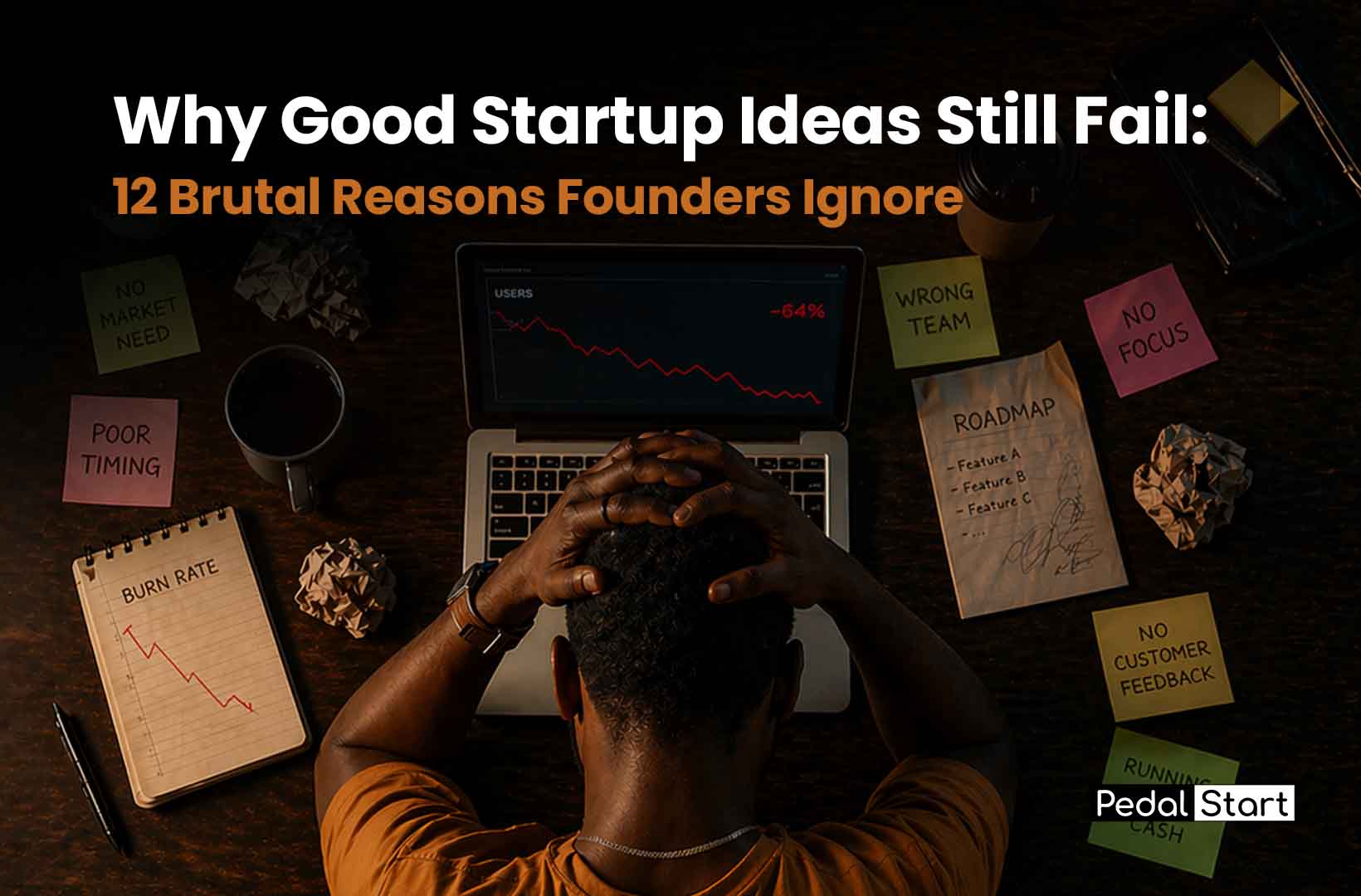
You can have a strong idea, a clear vision, even early excitement from people around you, and still watch the startup business impede within months.
That gap between a “good idea” and a working company is where most founders get surprised. The idea feels solid in isolation. The market, however, reacts very differently when money, behaviour, and execution enter the picture.
Over time, you start noticing a pattern. It’s not that founders don’t work hard. It’s that they underestimate a few fundamentals that determine whether a startup survives. This is where most startup mistakes begin.
Why Good Startup Ideas Fail

A good idea creates interest but it does not necessarily create a business.
What founders often miss is that ideas are only the starting point. The real work begins when that idea is tested against user behaviour, pricing sensitivity, and real-world constraints.
Many founders spend weeks refining the concept but very little time validating how it fits into a user’s daily life. That disconnect shows up quickly after launch.
This is one of the core answers to what causes startup failure. The idea may be sound, but the translation into reality is weak.
Top Reasons Behind Startup Failure

If you look closely, most failures come down to a handful of repeated patterns.
1. Building for assumption, not behaviour
Founders design products based on what they think users need, not what users consistently do.
2. Scaling before stability
Pushing marketing or hiring before the product has strong user retention leads to unnecessary burn.
3. Ignoring feedback that contradicts the idea
When early users show disinterest, founders sometimes double down instead of re-evaluating.
4. Weak distribution thinking
A good product without a clear path to reach users struggles to gain traction.
5. Lack of pricing clarity
If users are not willing to pay, the business model needs rework, not justification.
6. Overcomplicating the product
Adding features too early often dilutes the core value proposition.
7. Hiring too fast
Early teams that grow without clear roles create confusion instead of speed.
8. Founder misalignment
Differences in vision or effort between co-founders slow down decision-making.
9. No clear metrics
Without tracking the right numbers, progress becomes difficult to measure.
10. Running out of capital without learning
Burning money without improving the product or distribution is a common failure pattern.
11. Copying without context
What works in one market or segment may not translate directly to another.
12. Losing focus
Trying to solve too many problems at once weakens execution.
These are the common mistakes that kill startups, and most of them are preventable.
Lack of Product Market Fit

This is where things break down more often than founders expect.
You might have users. You might even have growth. But if users are not coming back or not willing to pay, something is missing.
Product market fit is not about launching successfully. It is about sustained demand. Users should feel the absence of your product if it disappears.
Without this, growth becomes expensive and short-lived.
A practical way to test this is simple. Talk to your users regularly. Understand why they use your product, what they ignore, and what they replace it with.
Fixing this early is one of the most important steps to avoid startup failures.
Poor Execution and Team Issues

Even with a clear idea, execution determines outcomes.
Early-stage teams often struggle with prioritisation. Everything feels important, which leads to scattered effort.
The difference between teams that move forward and those that stall is clarity. What are you solving right now, and what can wait?
Team structure also plays a role. Early hires need to be adaptable, able to handle multiple responsibilities rather than narrow roles.
Misalignment within the founding team creates another layer of friction. If decisions take too long or priorities keep shifting, progress slows down.
Execution is not about speed alone. It is about direction.
Financial Mismanagement in Startups

Money does not usually run out suddenly. It drains over time through small decisions that don’t seem critical individually.
Hiring ahead of need, spending on marketing without clear returns, or building features that don’t improve retention all add up.
Understanding your burn rate and runway is essential. Every expense should connect to either learning or growth.
This is where many startup business failures become visible. The product may still have potential, but the company runs out of time to realise it.
Financial discipline early on gives founders room to experiment and improve.
How to Avoid Startup Failure

If you’re thinking about how to avoid startup failure, focus on a few fundamentals.
Stay close to your users. Regular conversations will tell you more than dashboards alone.
Keep the product simple. Solve one problem well before expanding.
Track the right metrics. Retention, engagement, and revenue matter more than vanity numbers.
Be disciplined with capital. Spend where it leads to learning or growth.
Build a team that can adapt. Early stages require flexibility more than specialisation.
And most importantly, be willing to change direction when the data demands it.