
Most founders treat GST registration as a box to tick after incorporation. Investors treat it as a signal.
When you raise a round, your GST history is one of the line items on an investor's startup due diligence checklist, sitting alongside your cap table and bank statements. Gaps there create questions you do not want to answer in the middle of a raise.
So getting GST right early is not about pleasing the tax department. It is about keeping your company clean enough to fundraise without friction.
This guide covers when a startup needs GST registration, the faster process that went live in late 2025, what is exempt, and the compliance habits that keep your books investor-ready.
Quick answer: A startup needs GST registration once turnover crosses ₹40 lakh (goods) or ₹20 lakh (services), or the moment it sells inter-state, lists on an e-commerce platform, or hits another mandatory trigger. Registration is free, fully online, and now approved in about three working days for most low-risk applicants. |
Do startups actually need GST registration in India?
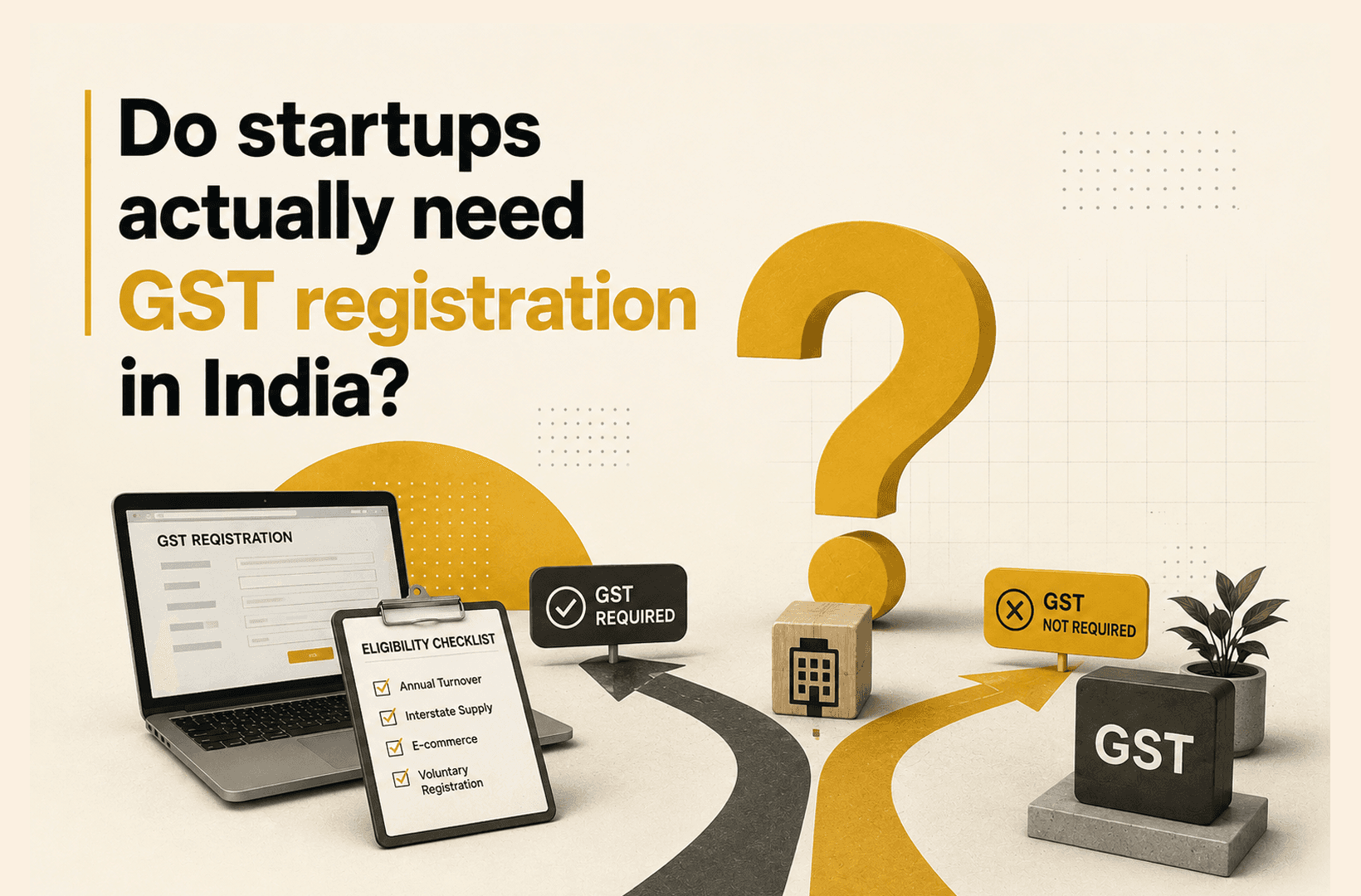
Not every startup needs it on day one. You must register once your aggregate turnover crosses the threshold, or the moment your business activity triggers a mandatory-registration rule, no matter how small you are.
Aggregate turnover is measured across your PAN on an all-India basis. It includes taxable supplies, exempt supplies, and exports, and it excludes the GST you collect.
If your turnover crosses the limit even once during a financial year, you have 30 days to apply for registration. Miss that window and the penalty clock starts, which we cover further down.
What is the GST registration threshold for startups?
The threshold is ₹40 lakh for businesses supplying goods and ₹20 lakh for service providers in most states. Special category states apply lower limits.
Supply type | Most states | Special category states |
Goods | ₹40 lakh | ₹20 lakh |
Services | ₹20 lakh | ₹10 lakh |
These limits have applied since the GST Council's 32nd meeting decision, effective 1 April 2019.
One caveat worth checking for your own state: special category thresholds are not uniform. Several states, including Jammu & Kashmir and Assam, opted for the higher ₹40 lakh and ₹20 lakh limits, while states like Manipur, Mizoram, Nagaland, and Tripura stay at ₹10 lakh. Confirm your state's current figure on the official GST portal before you plan around it.
When is GST mandatory even below the threshold?
Some activities require registration from your first rupee of turnover, regardless of any limit. If any of these apply, you register first and worry about turnover later.
• Inter-state supply of goods (selling to a buyer in another state)
• Selling through e-commerce operators such as Amazon or Flipkart
• Casual taxable persons and non-resident taxable persons
• Businesses liable to pay tax under the reverse charge mechanism
• TDS or TCS deductors under GST
• Agents supplying goods or services on behalf of another person
• Suppliers of online services from outside India to Indian consumers
Key takeaway: If you sell physical goods across state lines or list on a marketplace, you register before you cross any turnover limit. |
There is a nuance for service providers. Small service providers below the ₹20 lakh limit can still make inter-state supplies without registering, under a notified exemption. Goods sellers do not get that relief.
The new GST registration process for startups
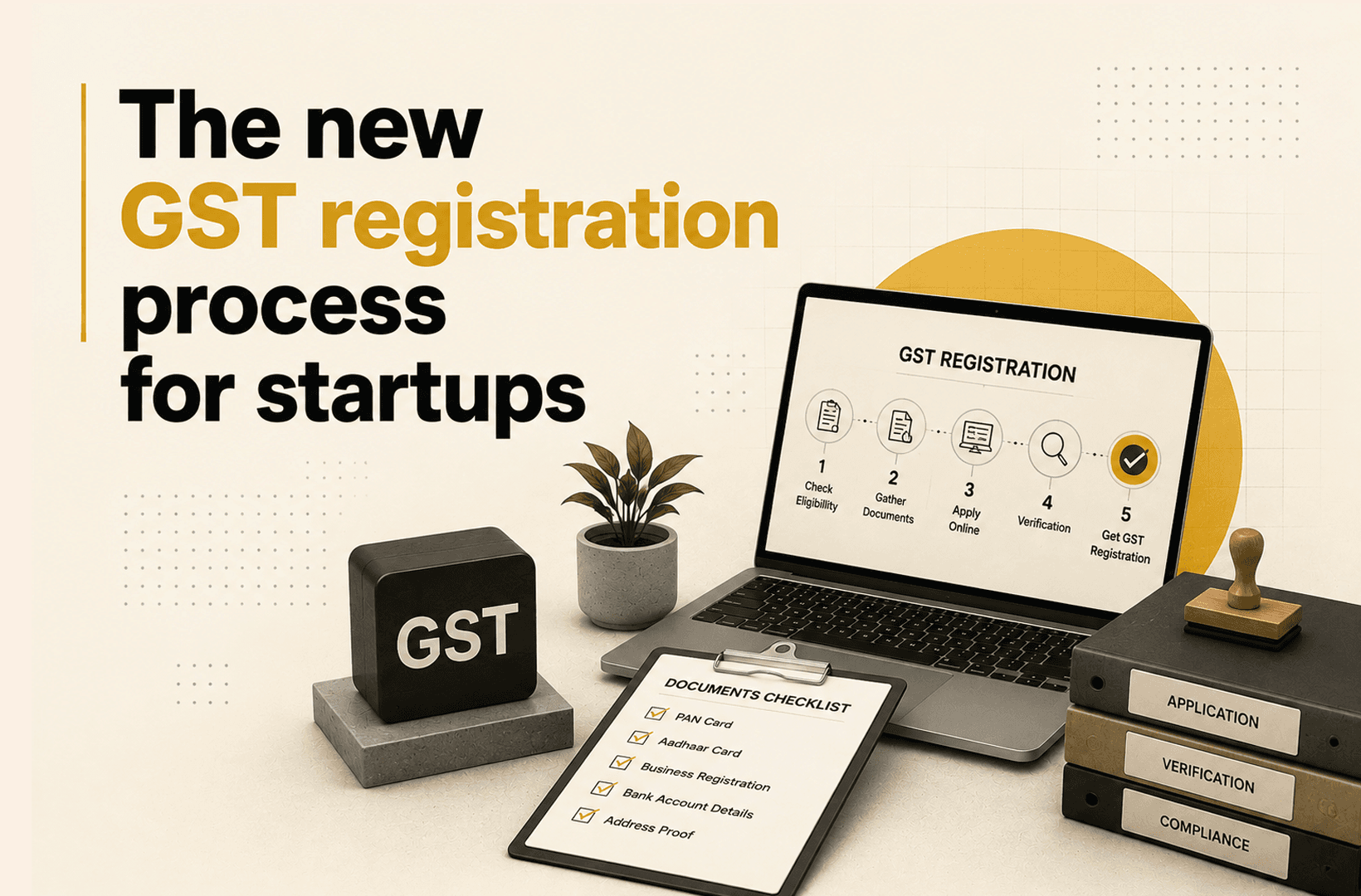
GST registration is free and fully online at gst.gov.in. Since 1 November 2025, most low-risk applicants receive automated approval within three working days.
This faster route is the Simplified GST Registration Scheme, approved at the GST Council's 56th meeting and notified under the CGST Rules. It is voluntary and open to two groups: applicants the system flags as low-risk, and applicants who self-assess that their monthly output tax on supplies to registered businesses will not exceed ₹2.5 lakh. The government expects it to cover roughly 96% of new applicants.
Approval leans on Aadhaar-based e-KYC and data-driven risk checks. If your application is flagged, a jurisdictional officer reviews it and may ask for documents or physical verification.
Here is the flow for a new GST registration for startups:
Step | What happens |
1 | On gst.gov.in, fill Part A with PAN, mobile, and email to generate a Temporary Reference Number (TRN) |
2 | Complete Part B within 15 days: business details, promoters, principal place of business, bank details, and HSN or SAC codes |
3 | Complete Aadhaar e-KYC for promoters and the authorised signatory |
4 | Submit the application and receive an Application Reference Number (ARN) immediately |
5 | Low-risk applicants get their GSTIN by email or SMS within three working days; flagged cases go to officer review |
The documents you keep ready:
• PAN of the business and of promoters
• Aadhaar of promoters and the authorised signatory
• Passport-size photographs
• Proof of the principal place of business (rent agreement plus a recent utility bill, or ownership proof with a self-declaration)
• Bank account proof
• Incorporation certificate, partnership deed, or LLP agreement, based on your entity
• Digital signature (DSC) for companies and LLPs
Two details trip up founders here. Many startups run from a home address and get rejected for weak proof, so upload both a rent agreement and a utility bill even for residential premises. And under a GSTN advisory dated 20 November 2025, valid bank account details linked to your business PAN must be added within 30 days of registration or before you file your first GSTR-1, whichever comes first.
Miss that bank-details deadline and the fallout is heavy: suspended registration, blocked return filing, restrictions on e-invoicing, and denied Input Tax Credit.
The simplified route is also optional and reversible. If you opt into the Rule 14A 3-day scheme and later want out, you can withdraw through the portal using Form REG-32, a facility GSTIN made easier to use from 1 April 2026.
Key takeaway: Registration is quick now, but bank proof within 30 days is not optional. Missing it can freeze a fresh GSTIN. |
How GST 2.0 changed the rates your startup charges
From 22 September 2025, India moved to a simpler rate structure. The 12% and 28% slabs are gone. Most goods and services now sit at 5% or 18%, with a 40% slab reserved for luxury and sin goods.
| Old structure | New structure (GST 2.0) |
Slabs | 0%, 5%, 12%, 18%, 28% | 0%, 5%, 18%, 40% |
Standard rate | 18% | 18% |
Merit rate | 5% | 5% |
Luxury/sin | 28% (plus cess) | 40% |
The reform was approved at the 56th GST Council meeting on 3 September 2025 and notified in mid-September. Reports on the transition noted that almost all items in the old 12% slab shifted down to 5%, while most of the 28% slab moved to 18% and a small share climbed to the new 40% tier.
For a founder, the practical effect is cleaner. Fewer slabs mean fewer classification disputes and simpler invoicing. It also means your pricing and billing systems need to reflect the correct current slab, not a rate you memorised in 2023.
GST exemptions and the Composition Scheme for small startups
If your turnover sits below the threshold and no mandatory trigger applies, you can operate without registering. For small businesses that want lower compliance, the Composition Scheme is the other option.
The Composition Scheme lets eligible small businesses pay tax at a flat rate on turnover and file less often. The turnover ceilings are ₹1.5 crore for goods (₹75 lakh in special category states) and ₹50 lakh for service providers.
Business type | Composition rate |
Manufacturers and traders | 1% |
Restaurants not serving alcohol | 5% |
Eligible service providers | 6% |
The trade-off is real. A composition taxpayer cannot claim Input Tax Credit, cannot make inter-state outward supplies, and cannot sell through e-commerce operators. Compliance drops to a quarterly payment (CMP-08) and an annual return (GSTR-4).
Key takeaway: The Composition Scheme cuts paperwork but blocks Input Tax Credit and inter-state sales. That makes it a poor fit for most funded startups selling B2B, across states, or online. |
Is GST registration enough for a startup company?
No. Registration gives you a GSTIN, and it also starts a clock. Once registered, you must file returns every period, issue GST-compliant invoices, and keep records, even in months with zero revenue.
This is the single most common misread among founders. A GSTIN is a beginning, not a finish line.
What registration commits you to:
• Return filing. You file GSTR-1 and GSTR-3B on schedule. If turnover is zero, you still file nil returns. Skipping them triggers daily late fees.
• Compliant invoicing. Every invoice carries your GSTIN, HSN or SAC codes, and the correct CGST, SGST, or IGST split.
• Input Tax Credit hygiene. Your ITC depends on vendors filing correctly, since credit shows up only when their invoices match in GSTR-2B.
• The right filing frequency. Startups with turnover under ₹5 crore can opt into the QRMP scheme to file quarterly while paying monthly.
The system has also grown less forgiving. From December 2025, returns older than three years past their due date can no longer be filed at all, so a backlog you meant to clean up later can become permanent. And since January 2026, the portal runs hard validations that can block a GSTR-3B outright when Input Tax Credit figures do not match, rather than flagging the error for later.
There is also a common mix-up with Startup India. DPIIT recognition under Startup India is a separate process. GST registration is not required to get DPIIT recognition, and DPIIT recognition does not exempt you from GST once your operations cross the line into mandatory territory.
Two things founders confuse as one: • GST registration is a one-time step. • GST compliance is a monthly or quarterly habit, and it is the part that keeps you penalty-free and audit-ready. |
What founders get wrong after registering (and the penalties)
The costliest GST mistakes for startups are simple: not registering on time, and not filing after registering. Both are avoidable, and both show up in due diligence.
Mistake | Consequence | Fix |
Skipping nil returns | Late fee of ₹20 per day for nil returns, ₹50 per day otherwise, plus 18% annual interest on dues | File GSTR-1 and GSTR-3B on time even at zero revenue |
Registering late after crossing the threshold | Penalty of 10% of tax due, minimum ₹10,000; up to 100% for deliberate evasion | Register within 30 days of becoming liable |
Weak address proof | Application rejected or a clarification notice | Upload rent agreement and utility bill; add a self-declaration for owned premises |
Using a junior team member's PAN or Aadhaar as signatory | Invalid or delayed application | Use an authorised signatory's credentials |
Ignoring vendor filing status | Blocked Input Tax Credit and a cash-flow hit | Reconcile GSTR-2B and prefer compliant vendors |
Penalty and late-fee figures here follow the GST Act and current CBIC provisions. Rates and caps change, so confirm the live numbers before you rely on them.
Should your startup register for GST voluntarily?
Voluntary registration makes sense if you sell to businesses, want to claim Input Tax Credit, or need credibility with larger clients. It adds ongoing compliance work, so weigh it against your stage.
The case for registering early:
• You can claim Input Tax Credit on your own purchases and software
• B2B clients and investors read a GSTIN as a sign of a real, compliant business
• You can sell inter-state and through marketplaces without a scramble
• You avoid a rushed registration the day you cross the threshold
The case for waiting: filing obligations begin immediately, and every missed deadline carries a fee.
A rough rule. A pre-seed, business-to-consumer startup below the threshold with no interstate sales can wait. A B2B SaaS company billing clients across states, or any startup, should register early so the books are clean when a term sheet appears.
This is the unglamorous groundwork that decides how smoothly a raise goes. PedalStart works with pre-seed and early-stage founders on getting fundraise-ready, from mentorship to investor access, so the fundamentals are in place before a round.
Frequently asked questions
Is GST registration free?
Yes. There is no government fee to register on the GST portal. You only pay if you hire a professional to handle it.
How long does GST registration take now?
About three working days for low-risk applicants under the simplified scheme that started on 1 November 2025. Applications flagged for verification take longer.
Is GST registration required for Startup India or DPIIT recognition?
No. DPIIT recognition and GST are separate. You may still need GST for your operations, based on turnover and activity.
Can a startup handle GST on its own?
Yes, for simple cases. A professional becomes worth it once invoicing, Input Tax Credit reconciliation, and multi-state filing get involved.
What is a GSTIN?
It is your 15-digit, PAN-based GST identity, issued free on registration. It goes on every invoice you raise.
Getting GST-ready before a raise
Clean GST records are part of a broader fundraising-readiness picture that also includes your cap table, incorporation documents, and financial statements. Investors check all of it together.
PedalStart works with early-stage founders on getting that whole picture in order before a raise, alongside investor introductions and cohort-based guidance. If a round is on your horizon, it is a useful next step.
Sources and references
Figures and rules in this guide are drawn from the following official sources. Confirm the latest position before acting, since GST provisions are revised often.
• GST Portal, for registration, the Simplified Registration Scheme, and GSTN advisories: gst.gov.in
• Central Board of Indirect Taxes and Customs (CBIC-GST), for the Act, rules, and rate notifications: cbic-gst.gov.in
• GST Council, for the 32nd and 56th Council meeting decisions and rate rationalisation: gstcouncil.gov.in
• Press Information Bureau, for the GST 2.0 rate reform announcement (September 2025): pib.gov.in
Figures in this guide reflect the GST 2.0 rate reforms effective 22 September 2025, the Simplified GST Registration Scheme effective 1 November 2025, and GSTN advisories issued into early 2026. GST rates, thresholds, and penalties are revised periodically by the GST Council and CBIC. Verify current numbers for your state and business on the official portal at gst.gov.in before acting.