
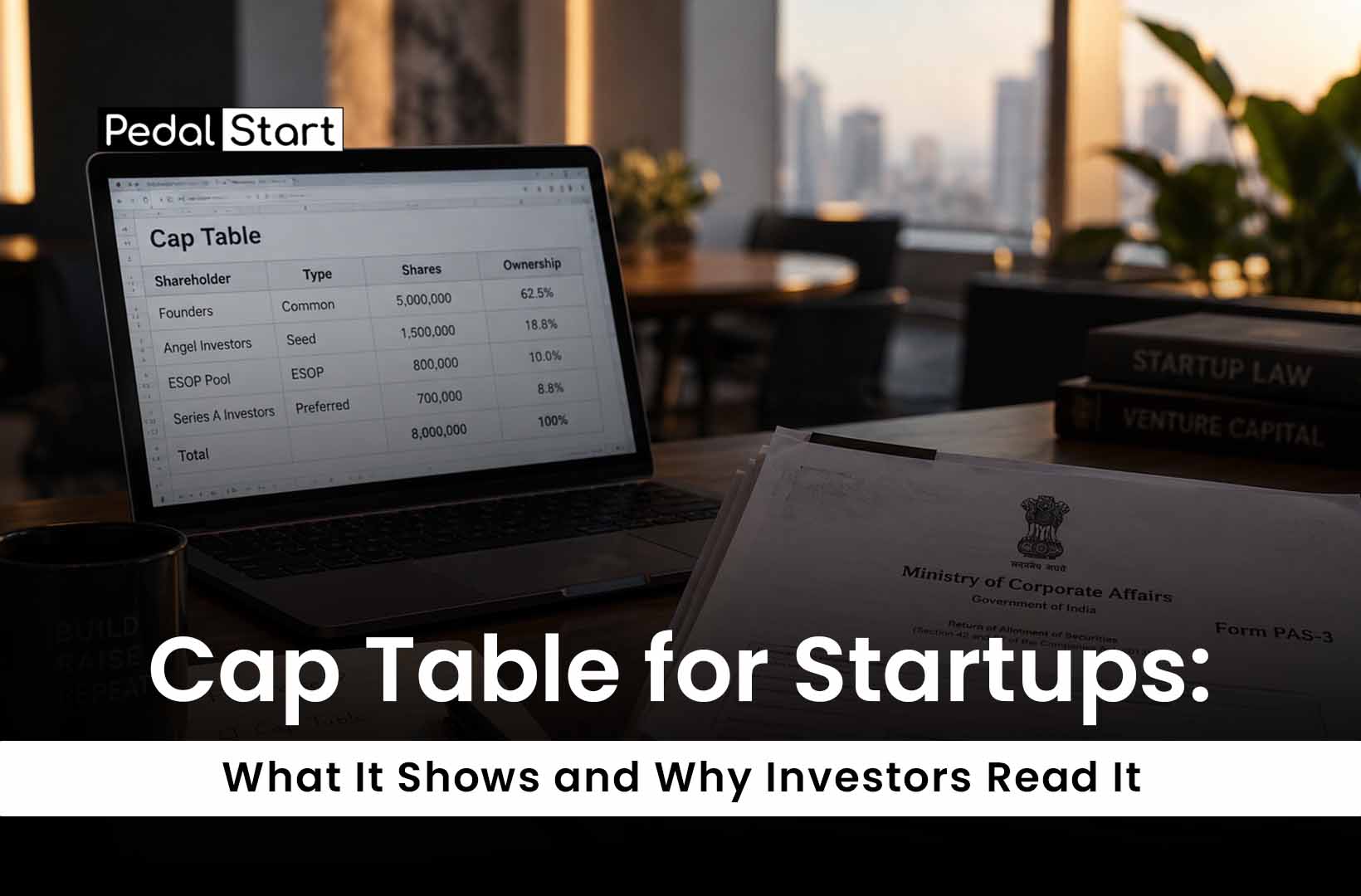
Your company has two records of who owns it.
One is the spreadsheet you maintain. The other is what sits at the Ministry of Corporate Affairs, built from the PAS-3 forms filed after each allotment.
Investors check both. When they disagree, the round stops while somebody works out which one is right, and that process takes months rather than days.
Most founders never think of the cap table as a claim that has to be proven. It is.
What is a cap table?
A capitalisation table records who owns what in your company, how much, and on what terms.
It covers shares already issued, options granted and reserved, and instruments that will convert into equity later. It also tracks how each of those changes with every round.
Early on it is a spreadsheet with one row per shareholder. That works until convertibles and option grants start accumulating, at which point the arithmetic stops being obvious.
What belongs in it?
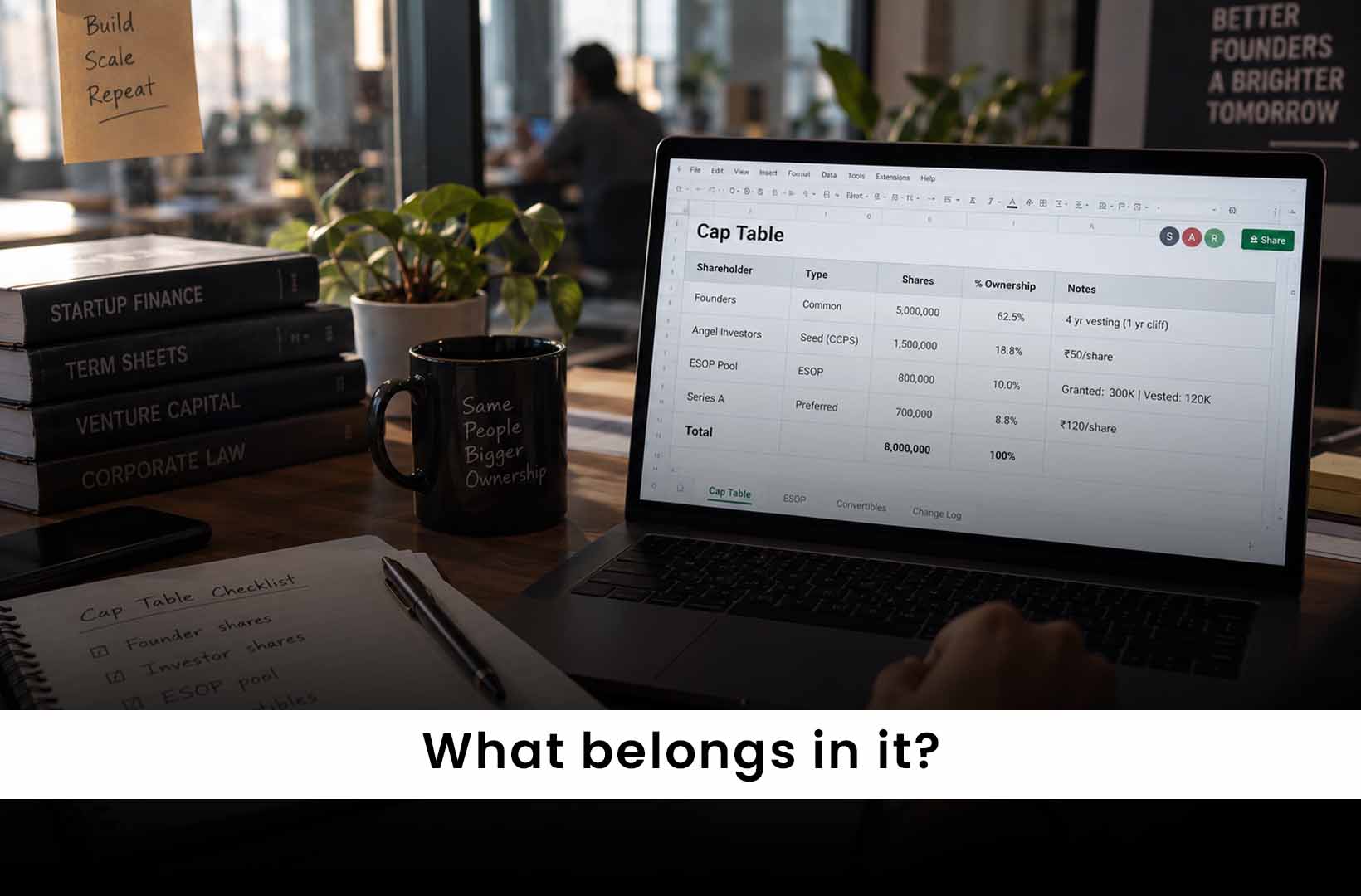
Component | What to track |
Founder shares | Number held, percentage, vesting schedule and cliff |
Investor shares | Share class (equity, CCPS, CCD), number, price per share, total consideration |
ESOP pool | Pool size, and separately: granted, vested, exercised and lapsed |
Convertibles | iSAFEs, CCDs and notes, with conversion cap, discount and trigger |
Change log | Every movement, dated, cross-referenced to the resolution that authorised it |
That last row is the one founders skip and diligence looks for. A cap table without a trail behind each change is an assertion rather than a record.
Why does it have to match your MCA filings?
Because Indian company law creates a parallel record, and it is the one that counts legally.
Every allotment of shares requires Form PAS-3 to be filed with the MCA within thirty days. That filing is public. Any investor can pull it, and all of them do.
So if your spreadsheet shows a shareholder who does not appear in your ROC filings, or the other way round, you have a discrepancy that has to be resolved before a round can close.
Practitioners describe this as fatal during diligence, and the fix is not quick. It means going back to the original instrument, confirming terms with the investor, passing the resolutions that should have been passed at the time, and filing the overdue forms, sometimes through a compounding application if the window has lapsed.
None of that can be papered over. Our guide on what investors check during diligence covers the rest of what gets verified.
What is a fully diluted cap table?

A fully diluted view counts every share that could exist, not just those issued today.
That includes the entire ESOP pool, granted or not, plus every convertible instrument at its conversion terms.
The distinction matters because investors calculate their ownership on a fully diluted basis and founders often do not. A founder negotiating from a non-diluted table is describing a different company from the one the investor is buying into, and the gap surfaces at exactly the wrong moment.
Modelling this before a term sheet is the single most useful hour a founder can spend on their cap table.
What breaks cap tables in India?
Equity promised without a resolution
The advisor who was offered 2% in a conversation. The early employee told they would get shares. Without a board resolution and a signed agreement behind it, there is a promise and no record, and both parties remember it differently later.
Informal ESOP grants
A letter, a verbal promise, a WhatsApp confirmation. None of these constitutes a valid grant under Indian law.
A grant needs an approved ESOP scheme complying with the Companies (Share Capital and Debentures) Rules 2014, a special resolution under Section 62(1)(b) of the Companies Act, an individual grant letter, a board resolution authorising it, and a fair market value determination from a registered valuer for the strike price. Our ESOP guide covers the scheme itself.
Unfiled conversions
When a loan converts to equity, or CCPS converts to equity shares, that conversion needs a board resolution, in some cases a special resolution, and Form PAS-3 within thirty days.
Where those filings were never made, the company is carrying an unauthorised allotment. That is a serious finding for any investor checking MCA records.
Convertibles left out of the fully diluted count
SAFEs, CCDs and CCPS do not appear as equity today, and they will. Omitting them from the fully diluted table understates how much of the company is already spoken for.
Many founders discover the real dilution from their own convertibles at the moment those instruments convert, which is too late to renegotiate anything. Our guide on equity dilution covers how to model it.
Missing FC-GPR filings
Any Indian company that has taken investment from a non-resident must file Form FC-GPR with its authorised dealer bank within thirty days of allotment, along with annual FLA returns.
Non-compliance does not invalidate the investment. It creates a regulatory overhang that an acquirer or new investor inherits, and they will price that in.
How should you set it up?
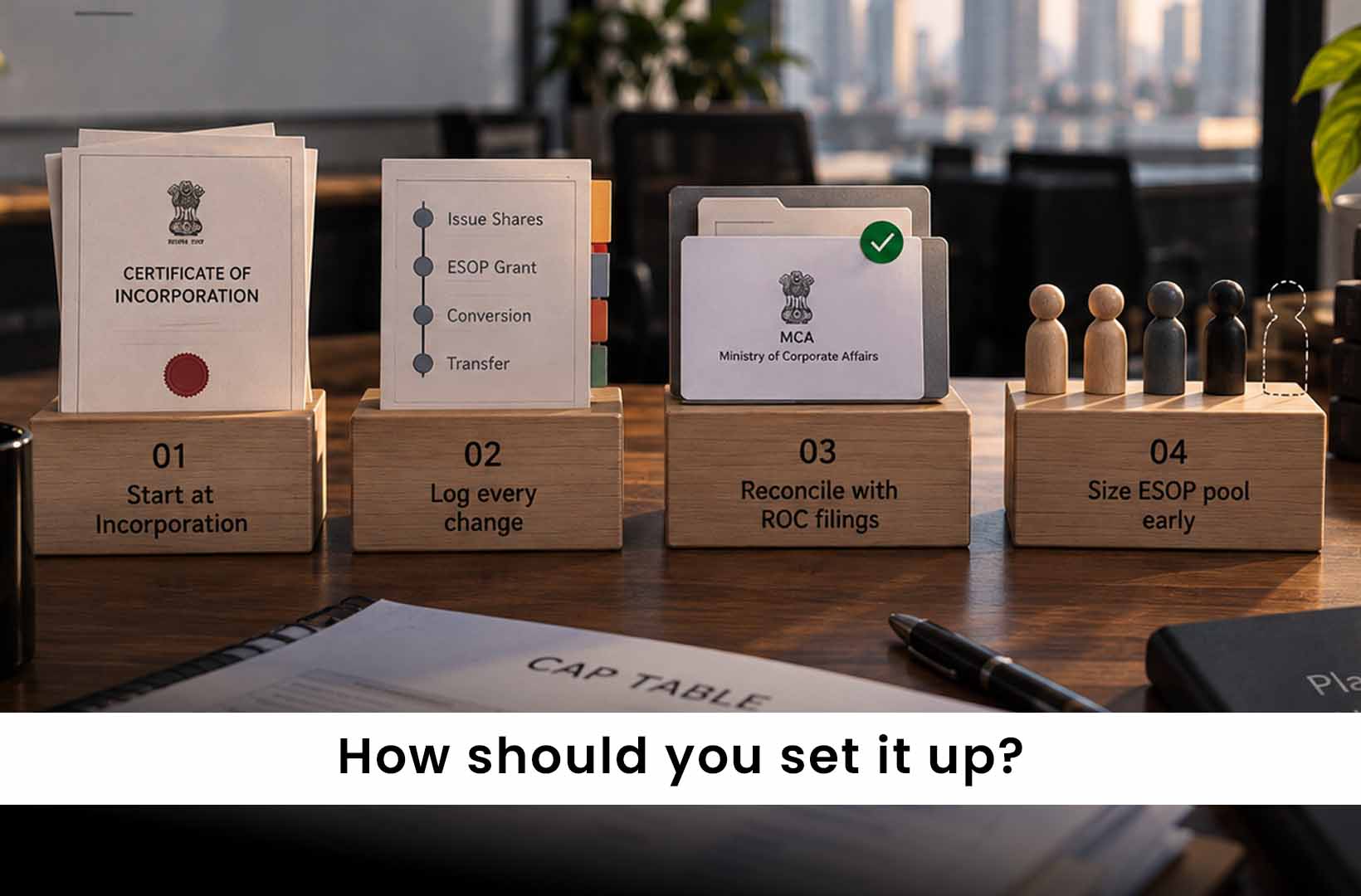
Four things, none of them expensive.
Start at incorporation. A cap table built as events happen takes minutes to maintain. One reconstructed from two years of memory takes weeks and produces surprises.
Log every change against its resolution. Date, event, resolution reference. That single discipline is what separates a record from a guess.
Reconcile against your ROC filings periodically. Quarterly is enough. It is far cheaper to catch a missing PAS-3 within the month than during diligence.
Size the ESOP pool before term sheet conversations, not during. If your pool is small and largely exhausted, an investor will ask for a top-up, and that dilution comes from founders rather than from them. Model your hiring plan for the next eighteen to twenty-four months and set the pool accordingly.
At PedalStart, the cap table is among the first things we look at, and how it has been kept tells us a good deal about how the company has been run.
The short version
A cap table is not a spreadsheet. It is a claim about ownership that has to survive somebody else checking it against public filings.
Keep it current, log every change against the resolution that authorised it, count the option pool and every convertible on a fully diluted basis, and reconcile with your MCA filings before an investor does it for you.
The work is small when done continuously and considerable when left until a round is in progress.
Key takeaways
A cap table records shares, options, and convertible instruments, and how ownership changes with each round.
It must reconcile with Form PAS-3 filings at the MCA. A discrepancy between the two stalls a funding round.
Investors calculate ownership on a fully diluted basis, counting the entire ESOP pool and every convertible.
Informal ESOP grants are not valid under Indian law. A grant needs an approved scheme, a special resolution, a grant letter, and a registered valuer's FMV.
Size the ESOP pool before term sheet negotiations. A top-up requested later dilutes founders, not the incoming investor.
Frequently asked questions
What is a cap table for a startup?
A capitalisation table recording who owns what in the company, including issued shares, options granted and reserved, and convertible instruments, along with how ownership changes at each round.
What should a cap table include?
Founder shares with vesting terms, investor shares by class and price, the ESOP pool split into granted, vested, exercised and lapsed, all convertible instruments with their conversion terms, and a dated log of every change cross-referenced to the authorising resolution.
Does a cap table need to match ROC filings?
Yes. Every allotment requires Form PAS-3 to be filed with the MCA within thirty days, and that record is public. Any discrepancy between your cap table and your filings will be found during diligence and must be resolved before a round can close.
What is a fully diluted cap table?
A view that counts every share that could exist, including the entire ESOP pool whether granted or not, and all convertible instruments at their conversion terms. Investors calculate their ownership this way.
Are informal ESOP grants valid in India?
No. A letter, verbal promise, or WhatsApp confirmation is not a valid grant. A grant requires an approved ESOP scheme, a special resolution under Section 62(1)(b), an individual grant letter, a board resolution, and a registered valuer's fair market value for the strike price.
How large should the ESOP pool be?
Commonly 10% to 15% before a Series A. Size it against your hiring plan for the next eighteen to twenty-four months and set it before term sheet negotiations, since a top-up requested later dilutes founders rather than the incoming investor.
Do I need cap table software?
Not early on. A well-maintained spreadsheet that reconciles with the register of members and your statutory filings is sufficient. Dedicated platforms become useful as instruments multiply and dilution modelling gets complex.