

A one-person company is legally a private limited company. It cannot issue ESOPs, cannot accept foreign investment, and cannot bring in a single investor without converting into something else first.
That is the tension worth understanding before you register one.
The structure exists for a real reason, and for a large number of solo founders it is the right answer. But it is built for someone running a business alone, not for someone building toward a round.
Here is what it is, who it suits, and where the limits sit.
What is a one person company?
A one person company, or OPC, is a private limited company with a single shareholder who owns all of it.
It was introduced under Section 3(1)(c) of the Companies Act, 2013, and became available from April 2014.
Before that, a solo founder had to choose between a sole proprietorship, which offers no liability protection, and finding a second person to satisfy the two-member requirement.
This structure removed that problem. One member, one director, full corporate status.
What you get is limited liability, a separate legal identity, and perpetual succession, which a proprietorship does not have.
What does an OPC look like in practice?
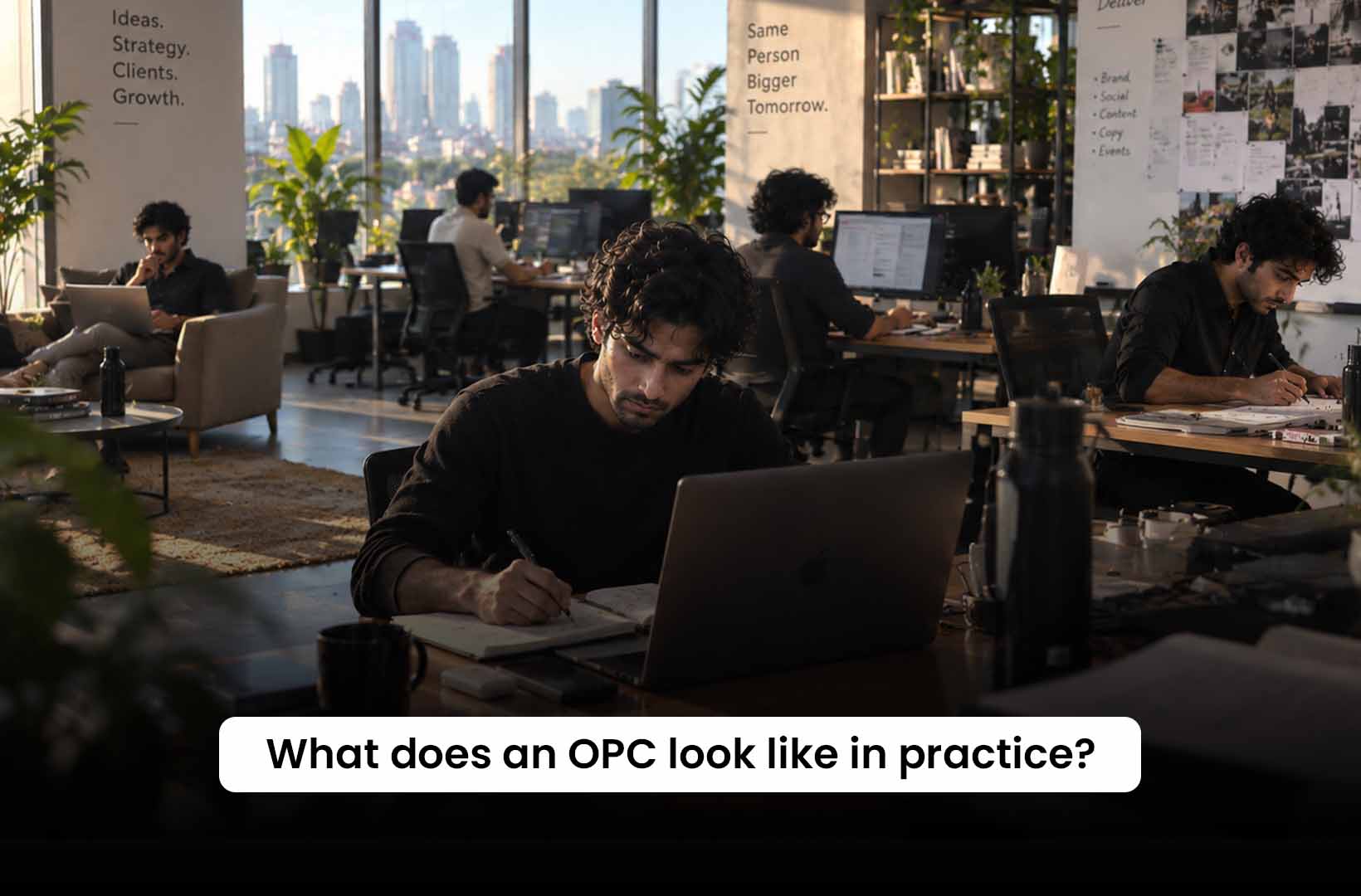
A consultant billing ₹40 lakh a year to corporate clients is the standard case.
As a sole proprietor, the business and the person are the same legal entity. A dispute reaches personal assets. Contracts are signed personally. Larger clients sometimes hesitate.
As a registered company, the same consultant has a CIN, an entity that signs its own contracts, and a liability wall between the business and personal savings.
The same logic applies to a freelance designer with recurring retainers, a doctor running a practice, an architect, or a digital business run by one person.
What these have in common is that the owner is the business, and no outside equity is expected.
Who can register one?
The eligibility rules are narrow, and there are four of them.
A natural person only. No company, LLP, HUF, trust, or foreign entity can be the member.
Resident Indian citizens, with NRIs permitted since the 2021 amendment.
One OPC per person. You cannot be the member of two, and you cannot be a member of one and a nominee in another.
A nominee is compulsory, named at incorporation.
That third condition catches people out. If you already hold an OPC, you cannot register a second one, and you cannot serve as somebody else's nominee either.
What is the nominee, and why does it matter?

This is the part unique to OPCs, and the part founders forget after incorporation.
Because the company has one member, the law requires you to name somebody who takes over if you die or become incapable of contracting.
Their written consent is filed in Form INC-3 at incorporation, under Rule 3 of the Companies (Incorporation) Rules, 2014.
It is not a formality. The nominee is the mechanism that gives an OPC perpetual succession, which is one of the main advantages over a proprietorship.
Two practical points. If your nominee withdraws consent, you have fifteen days from being notified to name a replacement. And the nominee needs DIR-3 KYC filed annually, alongside the director.
Choose somebody who will still be reachable in five years.
What does it cost to run?
Less than a private limited company, more than nothing.
It needs two board meetings a year rather than four, with a minimum ninety-day gap between them, and no annual general meeting at all. The annual return is the simplified MGT-7A rather than MGT-7.
The filings you cannot skip are AOC-4 for financial statements, MGT-7A for the annual return, ITR-6 for income tax, and DIR-3 KYC for both the director and the nominee.
Every one of these must be filed, including by dormant companies and those with no revenue. The penalty is ₹100 per day per form, with no upper limit, which becomes serious quickly.
On tax, the corporate rate applies: 22% under Section 115BAA or 25% under Section 115BA, depending on the regime chosen. It files ITR-6, the same return as any private limited company.
What can an OPC not do?
This is the section that decides it for anyone building a startup.
No ESOPs. Employee stock options sit under the Companies Act provisions available to companies with shareholders to allocate to. There is one member holding everything.
No foreign direct investment. FDI is not permitted into this structure.
No investors. Adding anyone means converting to a private limited company first.
No second shareholder. The structure is defined by having exactly one.
So if your plan involves raising from angels or funds, issuing options to attract early employees, or bringing in a co-founder with real equity, this is the wrong starting point.
Our guide on how to raise funds for a startup in India covers what those routes require.
OPC or private limited or LLP?
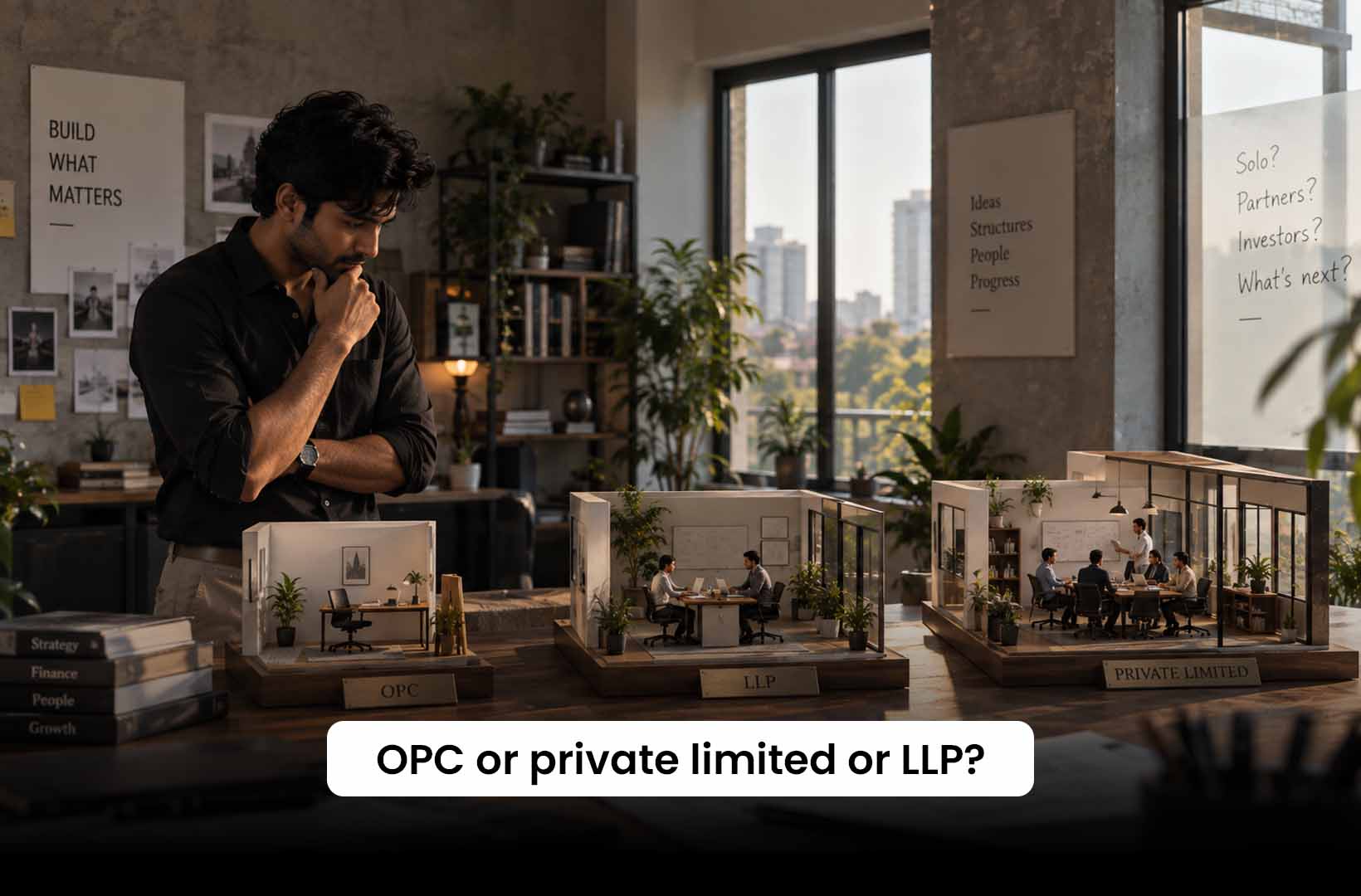
Three structures, three different purposes.
OPC | LLP | Private Limited | |
Minimum people | 1 | 2 partners | 2 directors, 2 shareholders |
Limited liability | Yes | Yes | Yes |
Can raise equity | No | No | Yes |
ESOPs | No | No | Yes |
Board meetings | 2 a year | None required | 4 a year |
AGM | Not required | Not required | Required |
Tax rate | 22% or 25% | 30% flat | 22% under 115BAA |
Annual return | MGT-7A | Form 11 and 8 | MGT-7 |
If you are alone and staying alone, an OPC. If there are two or more of you with no outside equity coming, an LLP may suit better. If equity has to change hands at any point, a private limited company.
Can you convert to a private limited company later?
Yes, and the rules have changed in a way that helps.
Before 2021, conversion was compulsory once paid-up capital crossed ₹50 lakh or turnover crossed ₹2 crore. The Companies (Incorporation) Second Amendment Rules, 2021 removed those mandatory thresholds, so the structure can now be kept as you grow.
Voluntary conversion remains available and is what you use when you need to bring somebody in.
The practical warning is the same one that applies to every structure decision. Conversion takes time, and founders tend to start it when an investor is already waiting.
At PedalStart, every company we back is a private limited company, because the instruments we invest through do not exist in any other form.
Choose for the business you expect in two or three years, not the one you have this month.
The short version
This structure gives a solo founder something that did not exist in India before 2014. Corporate status, limited liability, and perpetual succession, without needing to find a second person.
For a consultant, a professional practice, or a business that will stay owned by one person, it is a sensible structure and cheaper to maintain than a full private limited company.
For anyone who expects to raise money, issue options, or add a co-founder, it is a detour. You will convert eventually, and the conversion arrives at the least convenient moment.
The question to answer before registering is not if you are alone today. It is whether you intend to stay that way.
Key takeaways
An OPC is a private limited company with a single shareholder, available under Section 3(1)(c) of the Companies Act, 2013.
Only resident Indian citizens and NRIs can register one, and a person can hold or be a nominee in only one OPC.
A nominee must be named at incorporation via Form INC-3 and needs annual DIR-3 KYC.
An OPC cannot issue ESOPs, accept FDI, or add investors without converting to a private limited company.
Mandatory conversion thresholds were removed in 2021, so an OPC can now grow without being forced to convert.
Frequently asked questions
What is a one person company in simple terms? A private limited company owned by a single shareholder, giving a solo founder limited liability and corporate status without needing a second member.
Who can register an OPC in India? A natural person who is a resident Indian citizen, or an NRI since the 2021 amendment. One person can hold or be a nominee in only one OPC at a time.
Can an OPC raise funding from investors? Not without converting. It cannot issue ESOPs or accept foreign direct investment, and adding any shareholder requires conversion to a private limited company.
What compliance does an OPC need? AOC-4, MGT-7A, ITR-6 and DIR-3 KYC for the director and nominee, plus two board meetings a year. No AGM is required. Penalties run at ₹100 a day per form.
Is an OPC better than a sole proprietorship? For liability protection and continuity, yes. A proprietorship offers neither, and it dissolves on the owner's death, where an OPC passes to the nominee.