
Series A Funding: What It Takes to Raise One in India
Fewer than one in five seed-funded startups now make it to Series A.
That number used to be far friendlier. The bar moved, and it moved fast. What earned a Series A cheque five years ago would barely start a conversation today.
The reason is simple enough. Seed investors buy a story. Series A investors buy a spreadsheet.
Here is what the round actually is, what Indian investors want to see before they write the cheque, and what it costs you in ownership.
What is Series A funding?
Series A is the first large institutional round a startup raises, after seed and before Series B.
Seed money funds the search for a business model. Series A funds the scaling of one that already works. That distinction drives everything else about the round.
It is priced equity, meaning your company gets a formal valuation and investors buy shares at that price. The lead investor takes a board seat and becomes a long-term partner in how the company is run.
In India, these rounds commonly run between $8 million and $15 million, though smaller rounds are frequent, especially outside SaaS.
How is Series A different from seed?

The shift is from potential to proof.
At seed, an investor backs the team, the insight, and early signals. Diligence is light. The question is whether this could work.
At this stage, the question changes to if it already does. Investors run reference calls with your customers, inspect cohort data, and test if growth survives without discounts.
Seed | Series A | |
What is funded | Finding the model | Scaling a proven model |
Investor bets on | Team and vision | Revenue quality and retention |
Diligence | Light | Deep, including customer calls |
Board | Rarely a seat | Lead takes a seat |
Dilution | 10% to 20% | 15% to 25% |
What metrics do investors expect?
This depends heavily on what kind of business you are building, and most guides get this wrong by assuming everyone is SaaS.
For B2B SaaS, Indian startups commonly target $1 million to $2 million in ARR, roughly ₹9 crore to ₹17 crore, before raising. Investors want that growing two to three times year on year, with net revenue retention above 110%.
For consumer businesses, ARR is the wrong yardstick. Contribution margin per order and repeat purchase rate carry far more weight. A D2C brand with strong repeat behaviour and healthy margins is judged on those, not on a SaaS metric that does not fit.
Across both, one filter is now close to universal in India: CAC payback under 12 months. If a customer takes longer than a year to pay back what you spent acquiring them, expect hard questions.
Our guides on unit economics and calculating CAC and LTV cover what to have ready.
One honest caveat. These are medians, not gates. A company at ₹6 crore ARR growing four times with almost no churn beats one at ₹13 crore growing 60%.
How much equity do you give up?

More than founders expect, and the option pool is where the surprise tends to hide.
Expect to dilute roughly 18% to 25% to the new investor. Lead investors target around 20% ownership, and that figure moves less than most founders hope.
Then there is the option pool refresh, commonly another 5% to 10%, and it is carved out of the pre-money valuation. That means it dilutes existing shareholders before new money arrives.
Carta's 2026 data shows the median founding team holds about 56% after a seed round, falling to roughly 36% once Series A closes
Any SAFEs or convertible notes from earlier rounds also convert at this point, so model the cumulative effect before you negotiate. Our guide on equity dilution walks through the maths.
How is the valuation set?
Through comparables and negotiation, anchored loosely on a multiple of revenue.
B2B software at this stage tends to price somewhere between 15 and 30 times current ARR, with the multiple driven by growth rate, retention, and how hot the category is. AI runs hotter. Commodity software runs cooler.
A worked example: a company at $1.5 million ARR growing 2.5 times with 110% net revenue retention might price around $40 million post-money. A $10 million cheque then buys the investor roughly 20% to 25%.
The lever you actually control is competition. A round with two interested leads prices better than a round with one, every time.
How long does the process take?
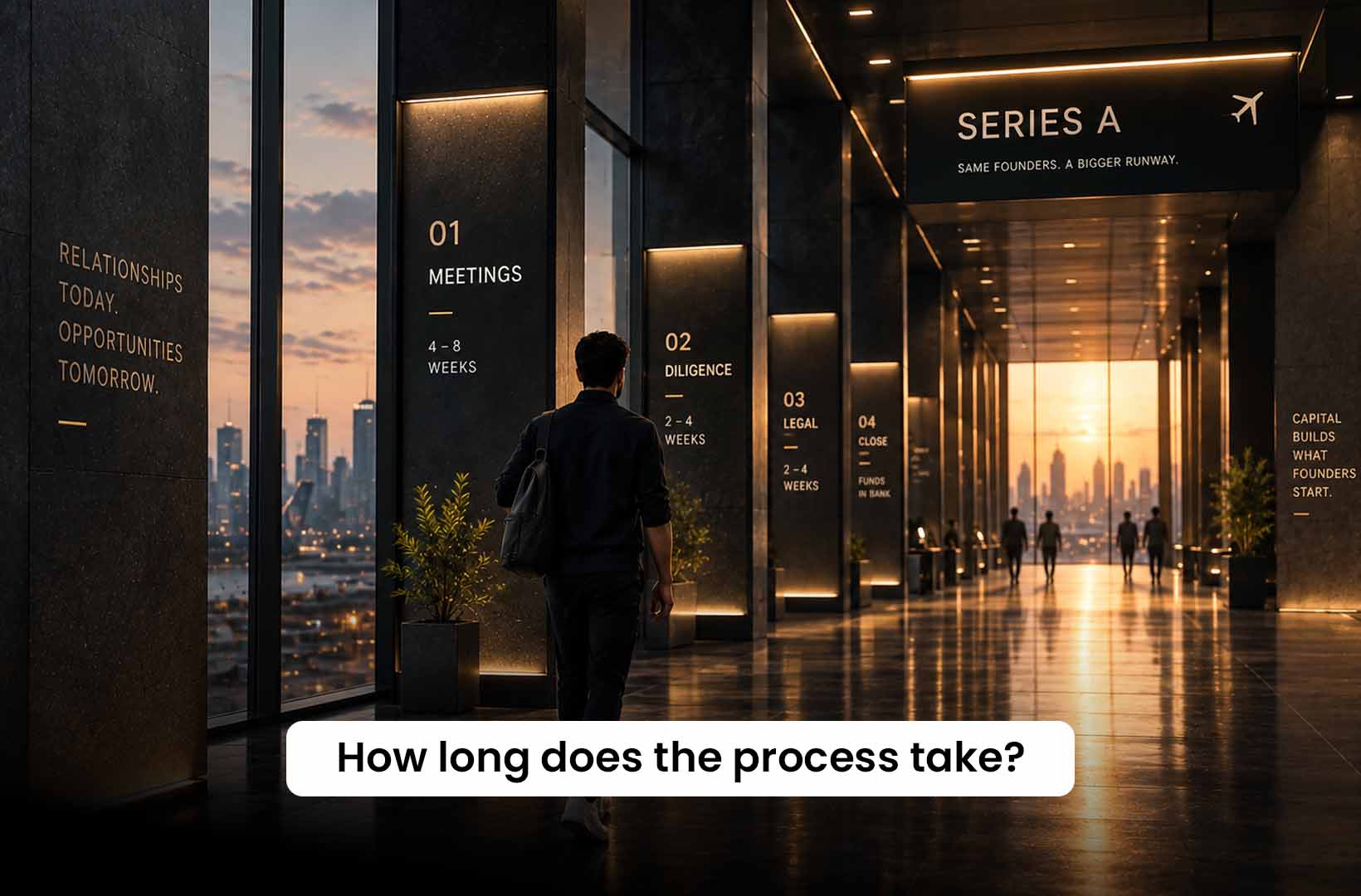
Plan for three to six months from first meeting to money in the bank.
Roughly four to eight weeks of investor meetings, two to four weeks of diligence once a lead commits, and another two to four weeks for legal work and closing.
Start building relationships far earlier than that. Twelve to eighteen months ahead of a formal raise is the right window for getting on the radar of the funds you want.
Founders who go into Sprint at PedalStart often spend that runway sharpening the numbers and the narrative before they ever open a process.
Why do most startups not make it?
Because the round tests things a good seed pitch never had to.
Growth without quality. Revenue driven by discounts or heavy ad spend does not survive scrutiny of cohort data.
Founder-dependent sales. If every deal still closes because a founder was in the room, investors see a business that cannot scale.
A market that looks too small. Investors here underwrite if this can return a fund, not if it can be a good business.
A vague use of funds. Money without a clear link to a specific milestone reads as drift.
Weak retention. Customers who do not stay make every other number meaningless.
The bottom line
This is the round where fundraising stops being about promise.
Seed buys you the chance to find something that works. Series A pays you to scale it, and only after investors have checked, in detail, that it does work.
So build the proof before you build the deck. Get retention right, know your CAC payback, and be honest about which metrics your kind of business should be judged on.
The founders who raise well at this stage are rarely the ones with the best story. They are the ones whose numbers made the story unnecessary.
Key takeaways
Series A is the first large institutional round, funding the scaling of a model that already works. In India, it commonly runs $8 million to $15 million.
Fewer than one in five seed-funded startups now reach Series A.
B2B SaaS startups in India commonly target ₹9 crore to ₹17 crore ARR, growing two to three times. Consumer businesses are judged on contribution margin and repeat rate instead.
CAC payback under 12 months has become a common filter in Indian Series A deals.
Expect 18% to 25% dilution to the new investor, plus a 5% to 10% option pool refresh carved out pre-money.
Frequently asked questions
What is Series A funding in simple terms? The first large institutional funding round after seed, where investors buy priced equity to help scale a business model that has already been proven to work.
How much ARR do you need for a Series A in India? For B2B SaaS, commonly ₹9 crore to ₹17 crore, growing two to three times a year. Consumer businesses are assessed on contribution margin and repeat purchase rate rather than ARR.
How much equity do founders give up in a Series A? Around 18% to 25% to the new investor, plus an option pool refresh of 5% to 10% taken from the pre-money valuation.
How long does a Series A take? Three to six months from the first investor meeting to closing, covering meetings, due diligence, and legal documentation.
What is the difference between Series A and Series B? Series A funds scaling a proven model. Series B funds market expansion at scale, with larger cheques and heavier reporting obligations.