Private Limited Company Registration for Startups: Getting It Investor-Ready (2026)


A two-director private limited company registered in Delhi with ₹1 lakh of authorised capital pays nothing in MCA filing fees and ₹360 in stamp duty. On the government side, it spends less on incorporation than on its two digital signatures.
The costly part surfaces later, when someone reads the records. In February 2026, the Registrar of Companies in Bengaluru fined one company ₹50,000, and each of its three directors ₹1 lakh, for filing INC-20A 433 days late.
We see incorporation from the investor's side of the table. At PedalStart, we run pre-seed rounds for startups through our PedalInvest angel network, and each of those rounds rests on filings the founders made when they incorporated. This guide covers every registration step along with what an investor will check about it later.
Key takeaways
Cost: ₹0 MCA filing fee for authorised capital up to ₹15 lakh. About ₹7,000 to ₹25,000 all-in with stamp duty, digital signatures, and a professional's fee.
Time: 7 to 10 working days with clean documents. Closer to three weeks after a resubmission.
Minimums: two directors and two shareholders (the same two people can hold both roles), one director resident in India, no minimum capital.
Investor lens: INC-20A, the cap table, authorised capital, and the articles are the incorporation records a funding round checks first.
What is private limited company registration?
Private limited company registration is the process of incorporating a business under the Companies Act, 2013, through the Ministry of Corporate Affairs' SPICe+ web form. Once approved, the company receives a Certificate of Incorporation with its Corporate Identity Number (CIN), plus its own PAN and TAN, from that same filing.
The company becomes a separate legal person that holds its own bank account, contracts, and intellectual property, and a shareholder's liability is limited to any amount unpaid on their shares. It is the structure Indian founders default to: in MCA incorporation data for 2025, about 93 of every 100 new companies registered as private limited.
Who can register a private limited company in India?
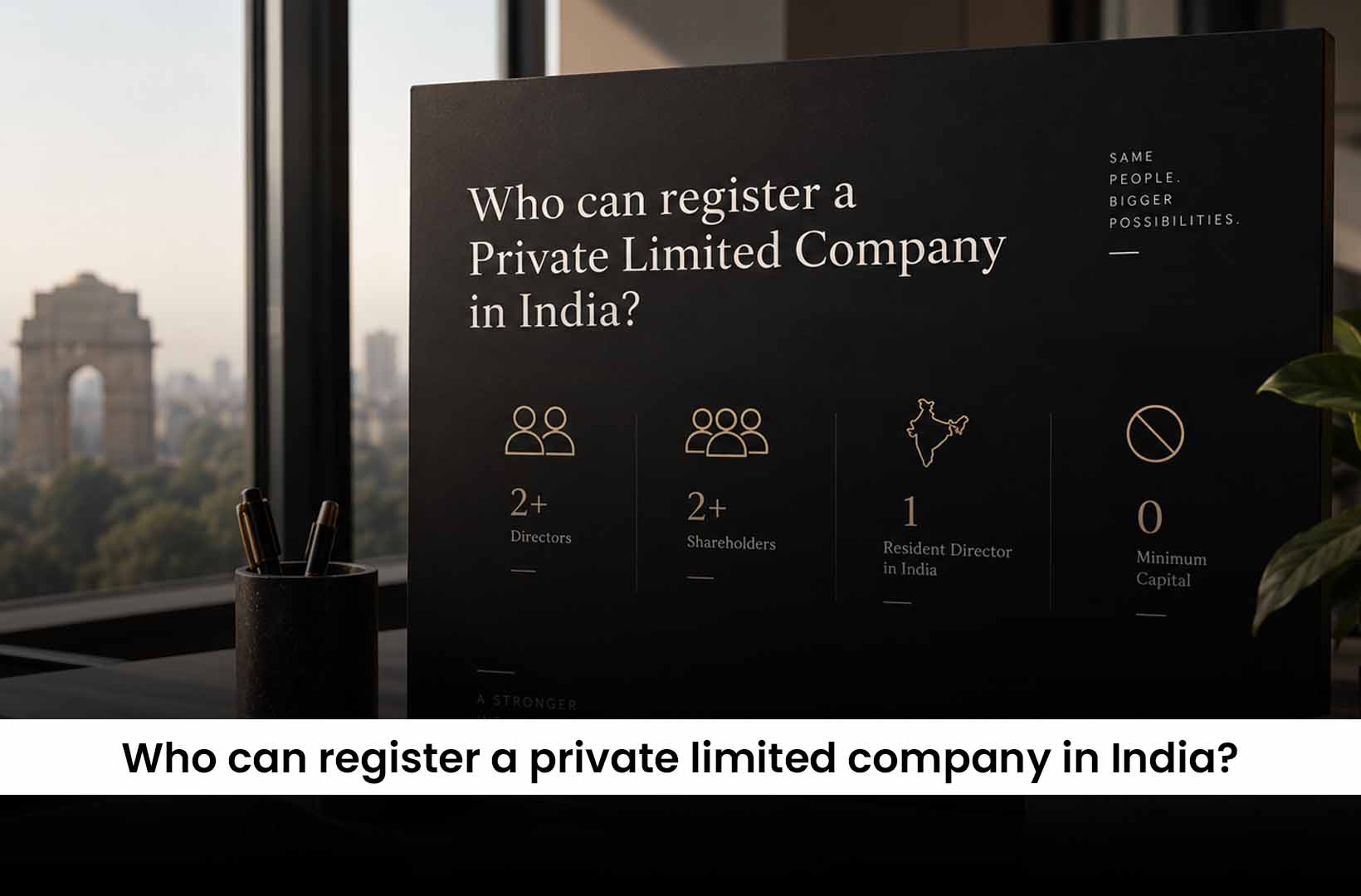
Any two people can register a private limited company in India, as long as at least one director stays in India for 182 days or more during the financial year. There is no minimum capital requirement.
Requirement | Rule under the Companies Act, 2013 |
Directors | Minimum 2, maximum 15 (more with a special resolution) |
Shareholders | Minimum 2, maximum 200 |
Director and shareholder overlap | Allowed. Two founders can fill both roles. |
Resident director | At least one director in India for 182 days or more in the financial year |
Minimum capital | None |
Company name | Must end with "Private Limited" |
Registered office | A real address in India with current proof |
A solo founder cannot incorporate a private limited company alone; the option is a One Person Company, which can convert once a second shareholder comes in.
Investor check: if a parent or friend joins only to meet the two-person minimum, expect questions about their shares and board seat at your first round. Decide now how that holding will be handled.
Why startups choose a private limited company over an LLP
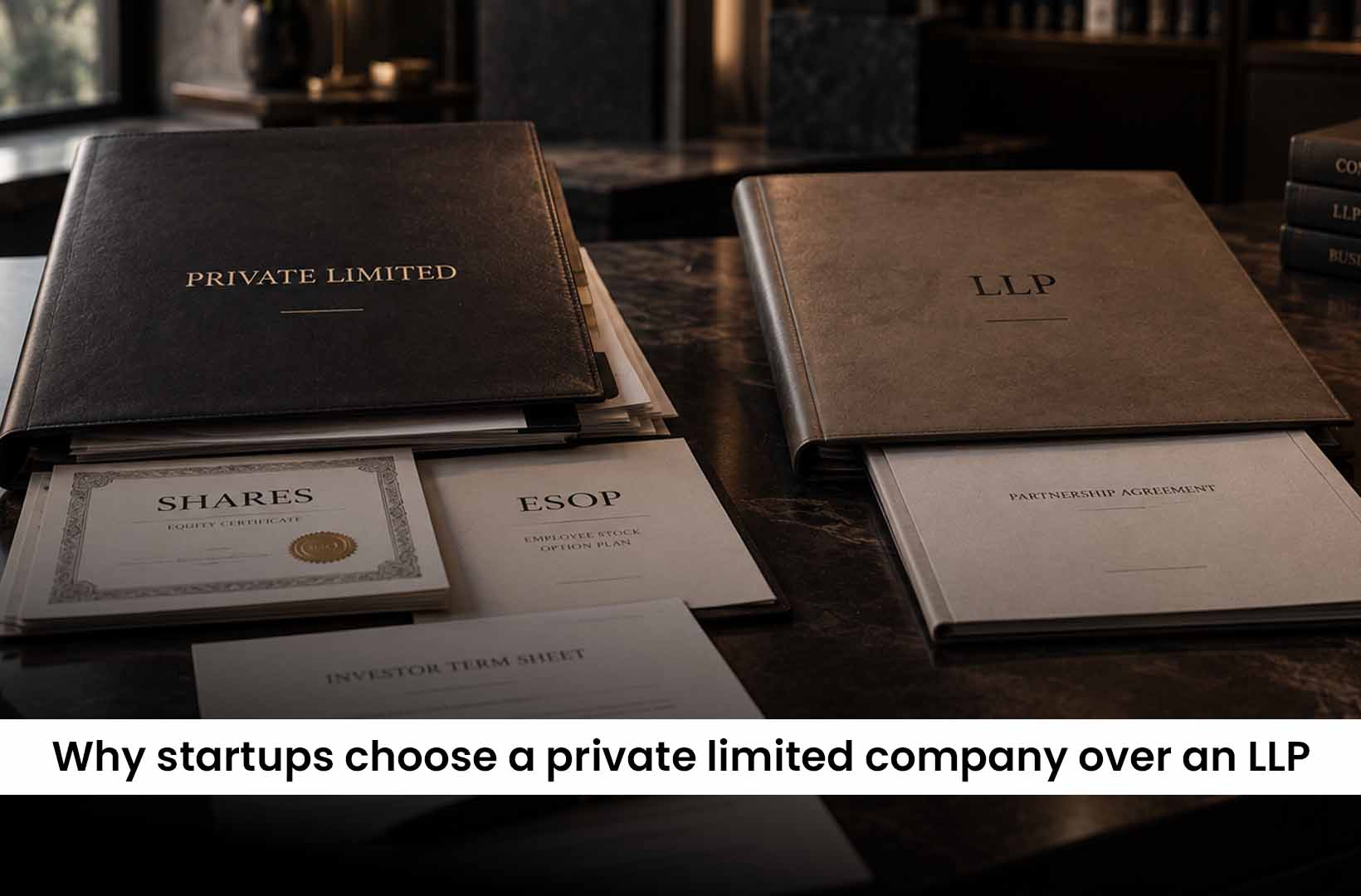
Pick a private limited company if you plan to raise outside capital or grant ESOPs, since an LLP cannot issue shares. An LLP fits a services business that will stay founder-funded and wants lighter compliance.
Factor | Private limited company | LLP |
Governing law | Companies Act, 2013 | LLP Act, 2008 |
Equity shares | Can issue | Cannot issue |
ESOPs | Allowed | Not available |
Income tax | 22% under Section 115BAA (25.17% with surcharge and cess) | 30% plus surcharge and cess |
Statutory audit | Every year | Only above ₹40 lakh turnover or ₹25 lakh contribution |
Compliance load | Higher | Lower |
The deciding factor is how rounds are structured. When we run a pre-seed round, investors come in through priced equity or through compulsorily convertible debentures (CCDs) with a valuation floor and cap. Both end in shares, and an LLP has no share capital to issue them from.
Converting an LLP into a company later is allowed, but it adds a second set of filings at the exact moment you want to be closing a round
How to register a private limited company: the 6-step process
Private limited company registration runs entirely online on the MCA V3 portal through SPICe+ (Form INC-32). The six steps are digital signatures, name reservation, the MoA and AoA, the SPICe+ Part B filing, fees and stamp duty, and approval by the Central Registration Centre (CRC).
Step 1: Get digital signature certificates (DSCs)
Every proposed director and subscriber needs a Class 3 DSC, about ₹1,000 to ₹2,500 each from a private certifying authority. Buy a two-year token so it outlasts your first annual filings.
Investor check: the round's own filings need a director's valid DSC. A lapsed token on closing week delays the resolution and allotment filings until it is reissued.
Step 2: Reserve the name through SPICe+ Part A
Part A reserves the name for ₹1,000 and holds it for 20 days. The CRC rejects names identical or too close to an existing company, LLP, or registered trademark, so search both the MCA register and IP India first.
Investor check: ensure that the company, not a founder personally, owns the brand as a trademark.
Step 3: Draft the eMoA and eAoA
The Memorandum of Association (INC-33) sets the company's objects and authorised capital; write the objects for the business you expect to run in two years. The Articles of Association (INC-34) set the internal rules on share transfers, board powers and meetings.
Investor check: the articles. The standard eAoA gets amended at your first priced round, for reasons covered in the diligence section below.
Step 4: File SPICe+ Part B with the linked forms
Part B carries director details, the registered office, capital and shareholding, allots DINs to up to three directors, and applies for PAN and TAN. AGILE-PRO-S (INC-35) goes with it for EPFO, ESIC, the company bank account and an optional GSTIN, and a practising CA, CS, cost accountant or advocate must certify the filing.
Investor check: the subscriber shareholding you declare here is line one of your cap table. Every later allotment is reconciled against it.
Step 5: Pay the fees and stamp duty
The portal calculates the MCA fee and your state's stamp duty from the authorised capital and registered office state, and collects both inside the form.
Investor check: that authorised capital has room for the round's shares and for CCDs when they convert.
Step 6: CRC approval and the Certificate of Incorporation
The CRC approves the application or returns it for resubmission with remarks. On approval, you receive the Certificate of Incorporation with the CIN, PAN, and TAN.
Investor check: the company's MCA master data, which anyone can pull and which now shows small company status. It reflects your filing discipline from this day on.
Step | Form | Realistic time | Government cost |
1. Digital signatures | Not an MCA form | 1 to 2 days | ₹1,000 to ₹2,500 per person (paid to vendor) |
2. Name reservation | SPICe+ Part A | 2 to 4 working days | ₹1,000 |
3. MoA and AoA | INC-33, INC-34 | Prepared alongside Part B | State stamp duty |
4. Incorporation filing | SPICe+ Part B, INC-35, INC-9 | Filed together | ₹0 up to ₹15 lakh capital |
5. Fees and stamp duty | Paid inside SPICe+ | Same day | PAN and TAN about ₹130 to ₹150 |
6. CRC review | Not applicable | 3 to 10 working days | None |
What documents are required for private limited company registration?
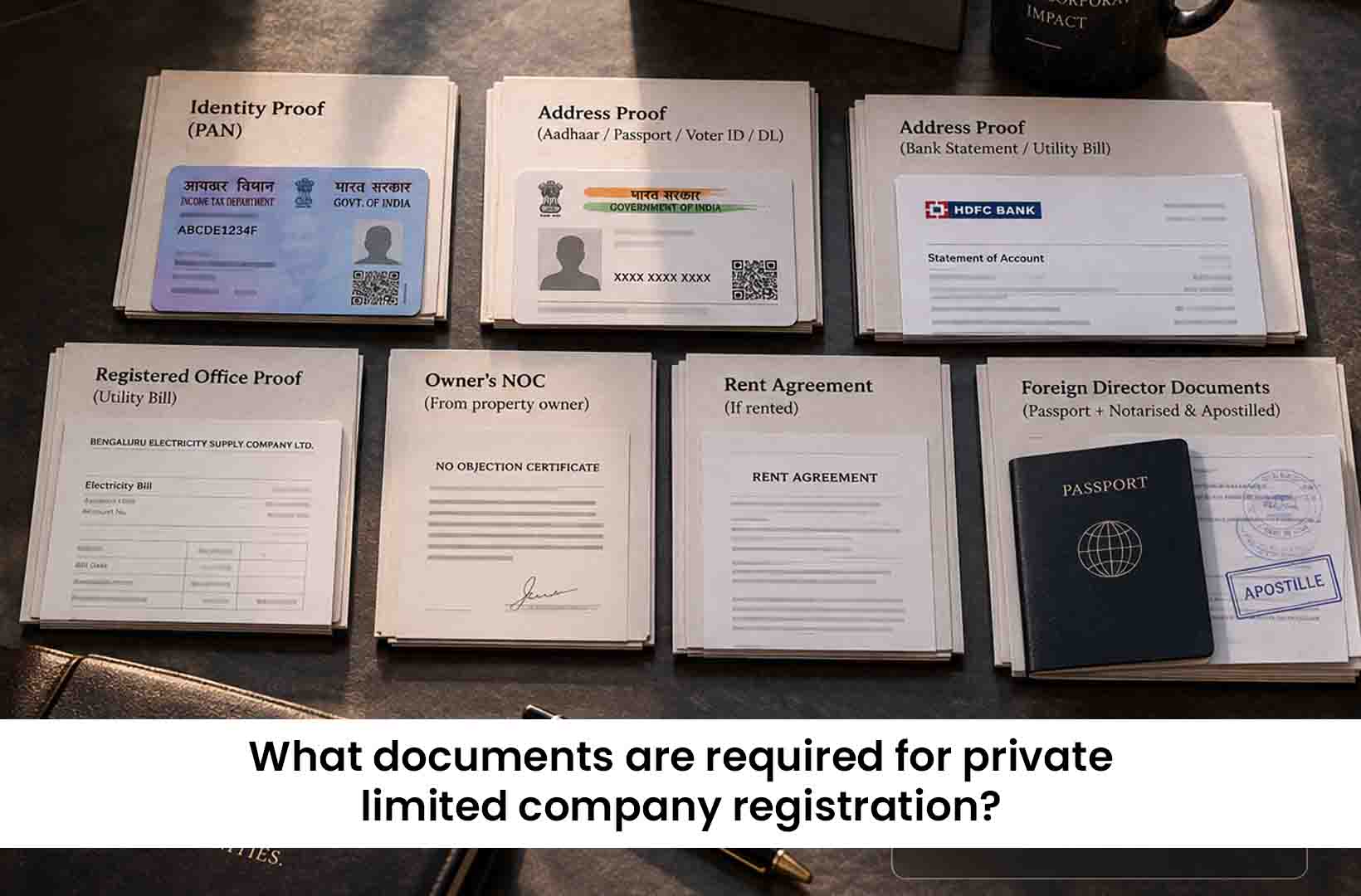
You need identity and address proof for every director and shareholder, proof of the registered office with the owner's no-objection certificate (NOC), and the company's proposed name, business activity, and capital details.
Document | Needed from | What to check |
PAN card | Every Indian director and shareholder | Name matches Aadhaar and the DSC letter for letter |
Aadhaar, passport, voter ID or driving licence | Every director and shareholder | Same ID used across all forms |
Bank statement or utility bill | Every director and shareholder | Not older than two months |
Electricity, water or gas bill | Registered office (a home address works) | Not older than two months |
NOC from the property owner | Registered office | Signed by the owner, even a family member |
Rent agreement | Registered office, if rented | Current |
Passport and address proof, notarised and apostilled | Foreign national directors | Done in their country of residence |
Check this before you upload
The date on the office utility bill. A bill older than two months is enough to get the application sent back.
Fees for private limited company registration in 2026
For a two-director company with ₹1 lakh of authorised capital, government charges come to roughly ₹1,300 to ₹2,500 in the states listed below. The all-in cost with DSCs and a professional's fee lands between about ₹7,000 and ₹25,000.
Cost item | Amount | Paid to |
SPICe+ filing fee | ₹0 if authorised capital is ₹15 lakh or less | MCA |
Name reservation (Part A) | ₹1,000 | MCA |
DIN | ₹0 for up to three directors | MCA |
PAN and TAN | About ₹130 to ₹150 combined | Income Tax Department, via SPICe+ |
Stamp duty on MoA, AoA and form | Depends on state and capital (table below) | State government |
Digital signature certificate | About ₹1,000 to ₹2,500 per person | Certifying authority |
Professional fee | About ₹2,000 to ₹15,000 | CA, CS or filing platform |
Key fact
The MCA has charged zero fee for incorporating companies with authorised capital up to ₹15 lakh since March 2019. Above that line, a slab fee applies.
Stamp duty by state for ₹1 lakh authorised capital
Stamp duty is the only registration cost that changes with geography, because each state sets its own rates on the memorandum and articles.
State | Form | MoA | AoA | Total |
Delhi | ₹10 | ₹200 | 0.15% of authorised capital | ₹360 |
Haryana | ₹15 | ₹60 | ₹60 | ₹135 |
Maharashtra | ₹100 | ₹200 | ₹1,000 per ₹5 lakh or part | ₹1,300 |
Uttar Pradesh | ₹10 | ₹500 | ₹500 | ₹1,010 |
West Bengal | ₹10 | ₹60 | ₹300 | ₹370 |
Source: MCA state-wise stamp duty schedule. Figures exclude Karnataka, which revised its rates in 2024.
Bengaluru founders should not trust older tables. Karnataka's Stamp (Amendment) Act, 2023, notified on 3 February 2024, raised the duty on memoranda and articles of association, and published estimates for a ₹1 lakh company now disagree with each other. The SPICe+ form computes the binding amount, so read it there.
How to size authorised capital for your first round
Authorised capital is the ceiling on the share capital a company can issue, and in several states the AoA duty rises with it. The same Delhi company at ₹10 lakh of authorised capital pays ₹1,710 in stamp duty instead of ₹360; in Maharashtra, ₹2,300 instead of ₹1,300.
It counts face value, not valuation. A ₹1 crore round that allots 1,000 shares of ₹10 face value at a premium uses only ₹10,000 of authorised capital, because the premium sits in a separate securities premium account.
Leave room for conversion as well. CCDs issued at pre-seed turn into shares later, and the company needs enough unissued authorised capital on the day they convert; running short means an SH-7 filing and stamp duty on the increase (0.15% of it in Delhi) in the middle of a round.
How long does private limited company registration take?
Plan for 7 to 10 working days from buying DSCs to holding the Certificate of Incorporation, if your name and documents are clean. A name rejection or a resubmission on address proof can stretch it to three weeks or more.
Stage | Realistic time |
DSC issuance | 1 to 2 days |
Name approval (Part A) | 2 to 4 working days |
Part B review by the CRC | 3 to 10 working days |
Each resubmission | 3 to 7 extra days |
Is GST registration mandatory for a private limited company?
No. A private limited company needs GST registration only when its turnover crosses the threshold, or from its first sale if it supplies goods across state lines or sells goods through e-commerce marketplaces.
Type of supply | Register once aggregate turnover crosses |
Goods, most states | ₹40 lakh |
Services | ₹20 lakh |
Goods, special category states | ₹20 lakh |
Services, special category states | ₹10 lakh |
Inter-state supply of goods, or goods sold via e-commerce operators | Mandatory from the first sale |
If you already know you will need a GSTIN, apply inside AGILE-PRO-S during incorporation and skip a separate GST registration. Registering voluntarily below the threshold lets the company claim input tax credit on its purchases
The first 180 days after incorporation
A new private limited company has five tasks with deadlines in its first six months, and each one leaves a record an investor will read later.
Task | Deadline | Provision |
Hold the first board meeting | Within 30 days of incorporation | Section 173(1) |
Appoint the first statutory auditor | Within 30 days by the board, or within 90 more days by shareholders | Section 139(6) |
Issue share certificates to subscribers | Within 2 months of incorporation | Section 56(4)(a) |
Get subscribers' money into the company bank account | Before filing INC-20A | Section 10A |
File INC-20A (commencement of business) | Within 180 days of incorporation | Section 10A |
INC-20A penalty
₹50,000 on the company, plus ₹1,000 a day on each officer in default, capped at ₹1 lakh each. Until it is filed, the company cannot start business or borrow.
Registrars are enforcing this. The February 2026 Bengaluru order involved a company incorporated in July 2023 that filed INC-20A in March 2025, and a second order the same day fined a company 127 days late, with ₹1 lakh on each of its two directors. Both were refused the lighter penalties for small companies because neither qualified.
That status is now easier to hold. Since 1 December 2025, a private company counts as small if its paid-up capital is ₹10 crore or less and turnover is ₹100 crore or less, which brings lower penalties, two board meetings a year, and an exemption from mandatory demat shares. Holding and subsidiary companies are excluded, so a startup that later sets up a foreign parent loses it.
What investors check about your incorporation before a round
Before money moves, an investor reads the company's own records: its MCA status and filings, the cap table against the register of members, the room left in authorised capital, the articles, and who owns the IP. A gap in any of these gets fixed before allotment, which means it gets fixed on your round's clock.
Our own sequence shows why. When we run a round, investors complete KYC, our partner CA firm prepares the compliance documents, and investors sign the CCD agreement. The company then files with the MCA and issues a call for money within 3 to 4 working days, and stamped CCD certificates follow within 2 to 3 weeks, well inside the six months the law allows for debenture certificates. Those timelines hold only when nothing in the company's records needs repair first.
What gets checked | Where it lives | What a gap costs |
Company status and first-year filings | MCA master data, INC-20A | No right to commence business or borrow; the Registrar can strike the company off |
Cap table | MoA subscriber page, register of members, share certificates, PAS-3 filings | Founder shares without certificates or traceable payment get cleaned up before new allotments |
Authorised capital | MoA, SH-7 filings | An SH-7 increase and stamp duty before allotment or CCD conversion |
Articles of association | AoA | A special resolution to amend them for investor rights |
IP and brand | Assignment deeds, trademark filings | Founders assign code, domains and marks to the company before closing |
Annual filings and auditor | AOC-4, MGT-7 or MGT-7A, auditor appointment | Late fees that grow each day, plus penalties |
Why the articles get rewritten at the first priced round
The eAoA you file at incorporation is a standard template. Since the Supreme Court's decision in V.B. Rangaraj v. V.B. Gopalakrishnan, share transfer restrictions that sit only in a shareholders' agreement, and not in the articles, have been held not to bind the company.
That is why investors ask for terms such as right of first refusal, board nomination, and consent rights to be written into the AoA. Amending the articles needs a special resolution, so it becomes part of the round's paperwork.
How round money has to move
New shares and CCDs are issued by private placement under Section 42. The company files its special resolution before sending the offer letter (PAS-4), takes the money into a separate bank account, allots within 60 days, and files the return of allotment (PAS-3) within 15 days; the money cannot be used until PAS-3 is filed.
This is where incorporation-era habits show up. A Registrar penalised a space-tech startup and its directors for taking private placement money into the company's regular operating account and spending it before filing PAS-3.
Frequently asked questions
Can one person register a private limited company?
No. A private limited company needs at least two shareholders and two directors. A single founder can register a One Person Company instead and convert it later.
Can a salaried employee be a director of a private limited company?
Company law does not stop it, and an employee can hold a DIN and sit on a board. Your employment contract may restrict outside directorships, so read it before you file.
Can NRIs or foreign nationals register a private limited company in India?
Yes. They can be directors and shareholders, provided at least one director meets the 182-day residency rule, and their documents are notarised and apostilled. Shares issued to them also need reporting under FEMA.
Can a private limited company apply for trademark registration?
Yes, in its own name. The e-filing fee is ₹9,000 per class, halved to ₹4,500 for DPIIT-recognised startups and small enterprises.
Do I need DPIIT recognition to register a private limited company?
No. DPIIT recognition is a separate application made after incorporation. It unlocks the lower trademark fee and eligibility for programmes such as the Startup India Seed Fund Scheme.
Can I register a private limited company without a CA?
You can prepare the forms yourself on the MCA portal, but a practising CA, CS, cost accountant, or advocate must certify the SPICe+ filing.
Is there a minimum capital for a private limited company?
No. The minimum paid-up capital requirement was removed in 2015. ₹1 lakh of authorised capital is a common starting point because it keeps stamp duty low