

Bootstrap Meaning in Business for Indian Founders
If you ask ten founders what bootstrap meaning in business is, you will hear slightly different versions.
At its core, it is simple. You are building your company using your own money or the revenue the business generates. No external capital, no investor pressure, no dilution early on.
For a bootstrapped founder India, this usually means tighter control over decisions, slower hiring, and a constant focus on revenue from day one.
This is where bootstrapping startup India starts to feel real. You are not optimizing for valuation. You are optimizing for survival and steady growth.
Equity Dilution Explained with a Simple Cap Table
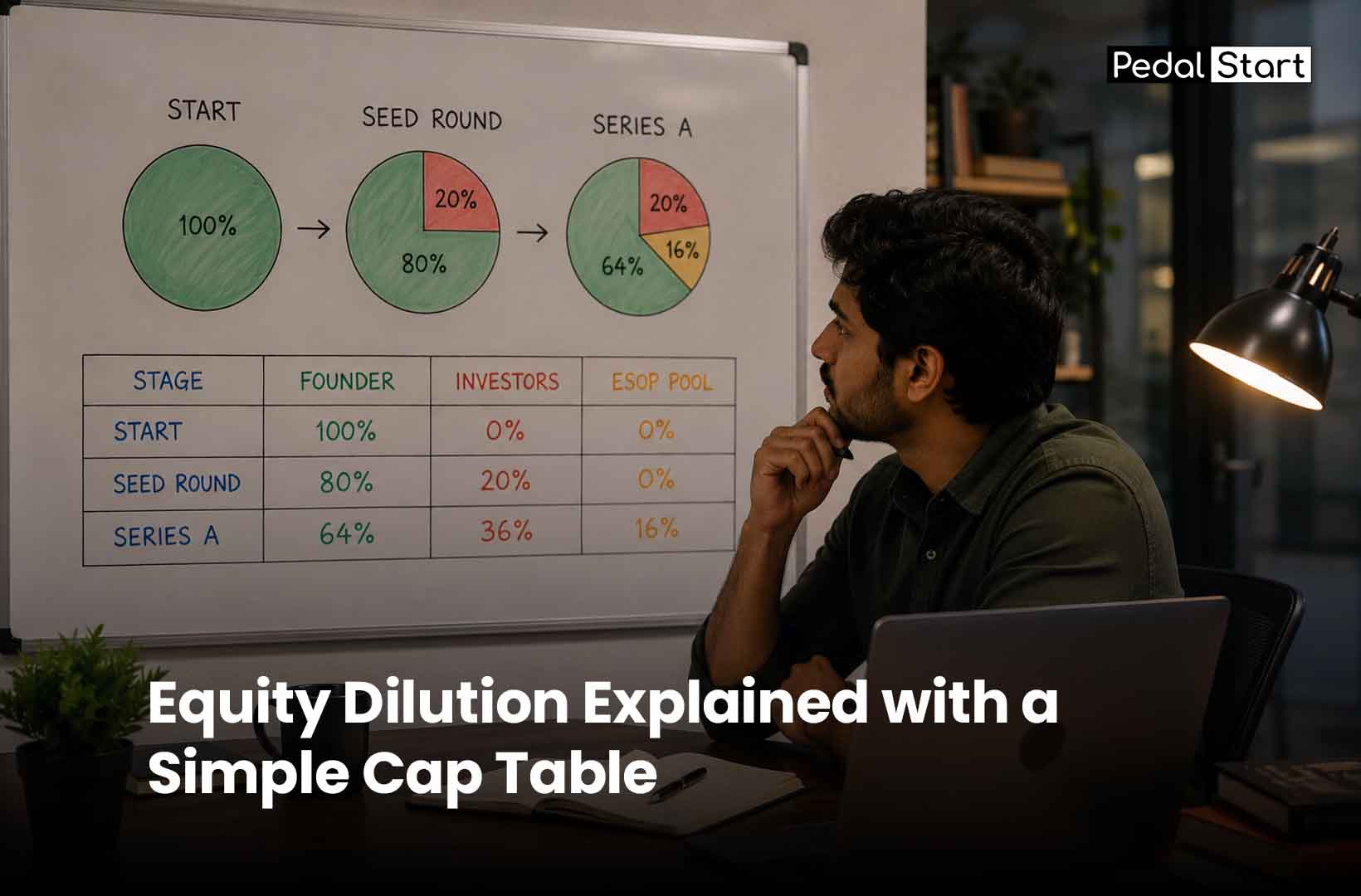
Once you decide to raise money, ownership starts changing.
Let’s say you start with 100 percent of your company.
You raise your first round and give away 20 percent. Now you own 80 percent.
In the next round, you dilute again. Maybe another 20 percent goes to new investors. Your ownership comes down further.
This is startup equity dilution. It is not inherently bad. It is the cost of bringing in capital to grow faster.
The real question is whether the value created with that capital justifies the ownership you give away.
For founders comparing self-funded startups vs VC backed, this is often the biggest mental shift.
Comparison: Control, Speed, Stress, Profitability, Exit
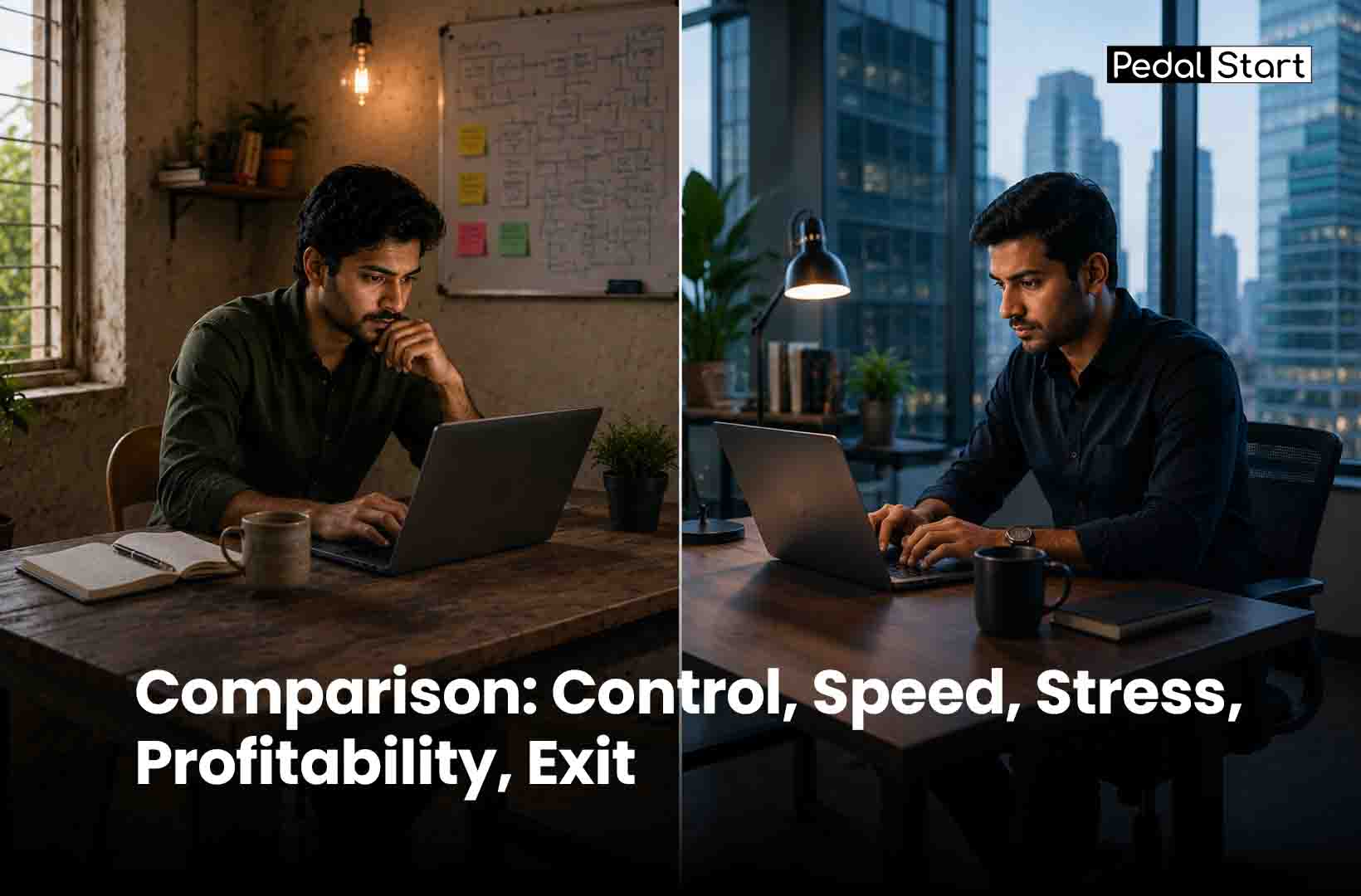
The conversation around bootstrapped vs funded startup India usually comes down to a few trade-offs.
Control stays high in a bootstrapped setup. Founders make decisions without external approval. In a funded company, investors are part of major decisions.
Speed looks very different. Funded startups can hire faster, spend more on distribution, and enter markets quickly. Bootstrapped companies move at the pace their revenue allows.
Stress exists on both sides, just in different forms. Bootstrapped founders worry about cash flow every month. Funded founders deal with growth expectations and timelines.
Profitability shows up earlier in bootstrapped companies. Funded startups often delay profits while focusing on growth.
Exit options also differ. Venture-backed companies are usually built for large outcomes. Bootstrapped businesses often aim for sustainable, long-term value.
This is the real difference between venture backed vs bootstrapped journeys.
When Bootstrapping Works Better
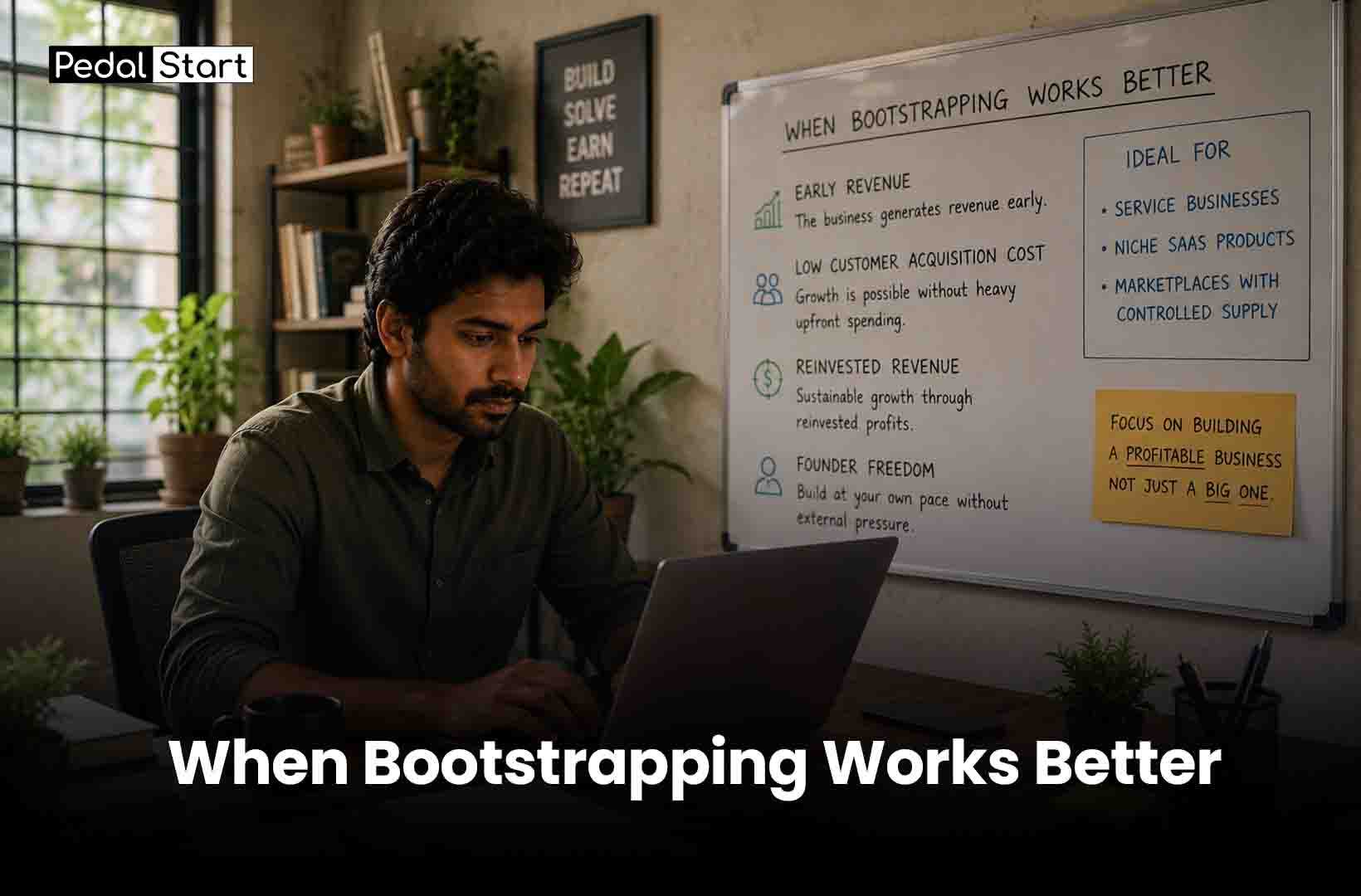
Bootstrapping works well when the business can generate revenue early.
Service businesses, niche SaaS products, and marketplaces with controlled supply often fall into this category.
If customer acquisition does not require heavy upfront spending, and growth can be sustained through reinvested revenue, staying bootstrapped gives founders more flexibility.
It also works for founders who want to build at their own pace without external pressure.
Many profitable startup vs growth startup discussions start here. Some founders simply prefer building a business that makes money early rather than chasing scale immediately.
When VC Funding Makes More Sense
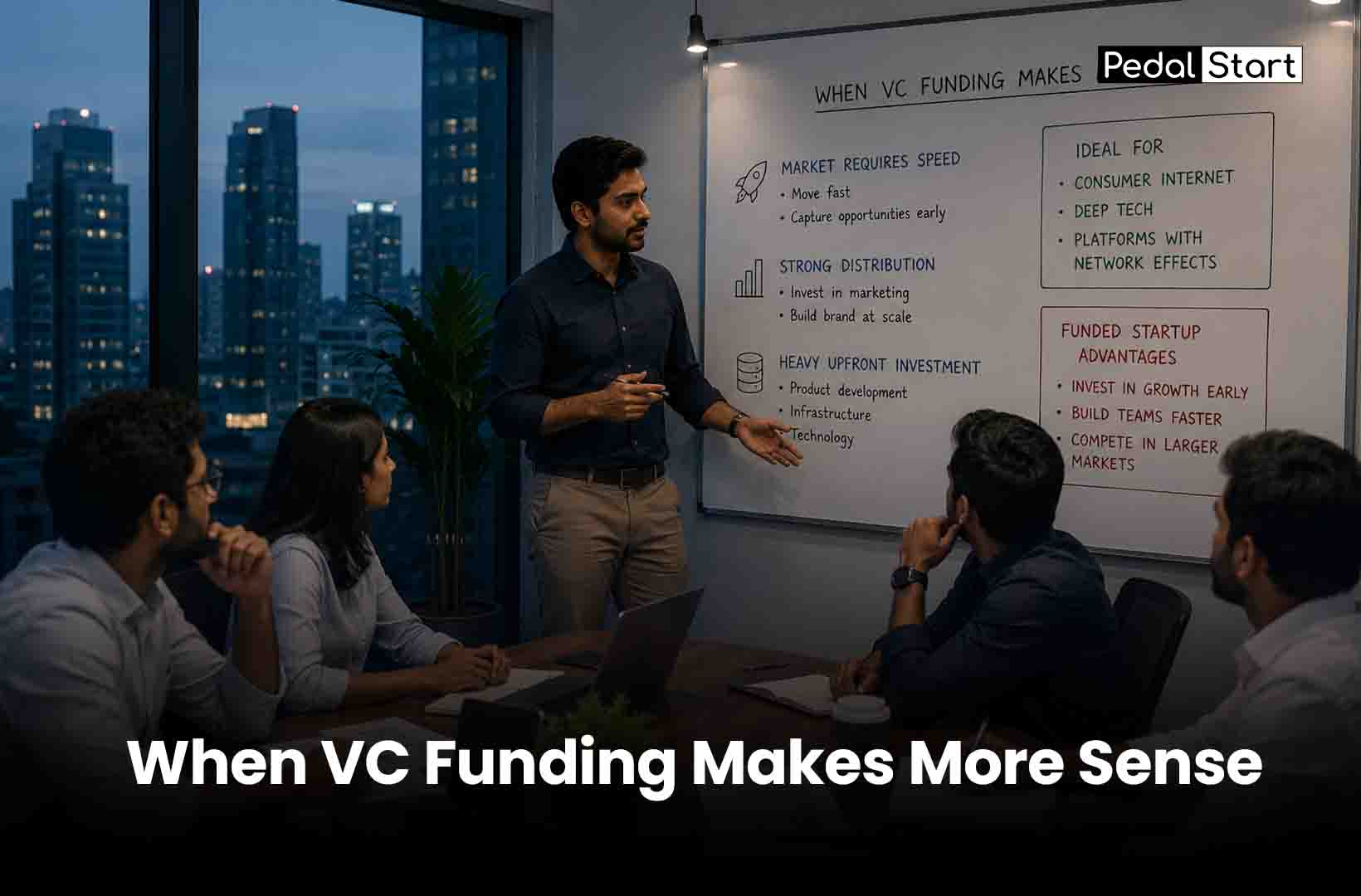
There are cases where staying bootstrapped limits what you can build.
If your market requires speed, strong distribution, or heavy upfront investment, external capital becomes important.
Consumer internet, deep tech, and platforms that rely on network effects often fall into this category.
This is where funded startup advantages become clear. You can invest in growth early, build teams faster, and compete in larger markets.
For founders navigating startup funding pros and cons, the decision usually comes down to how fast the market is moving and how capital-intensive the business is.
Indian Examples on Both Sides
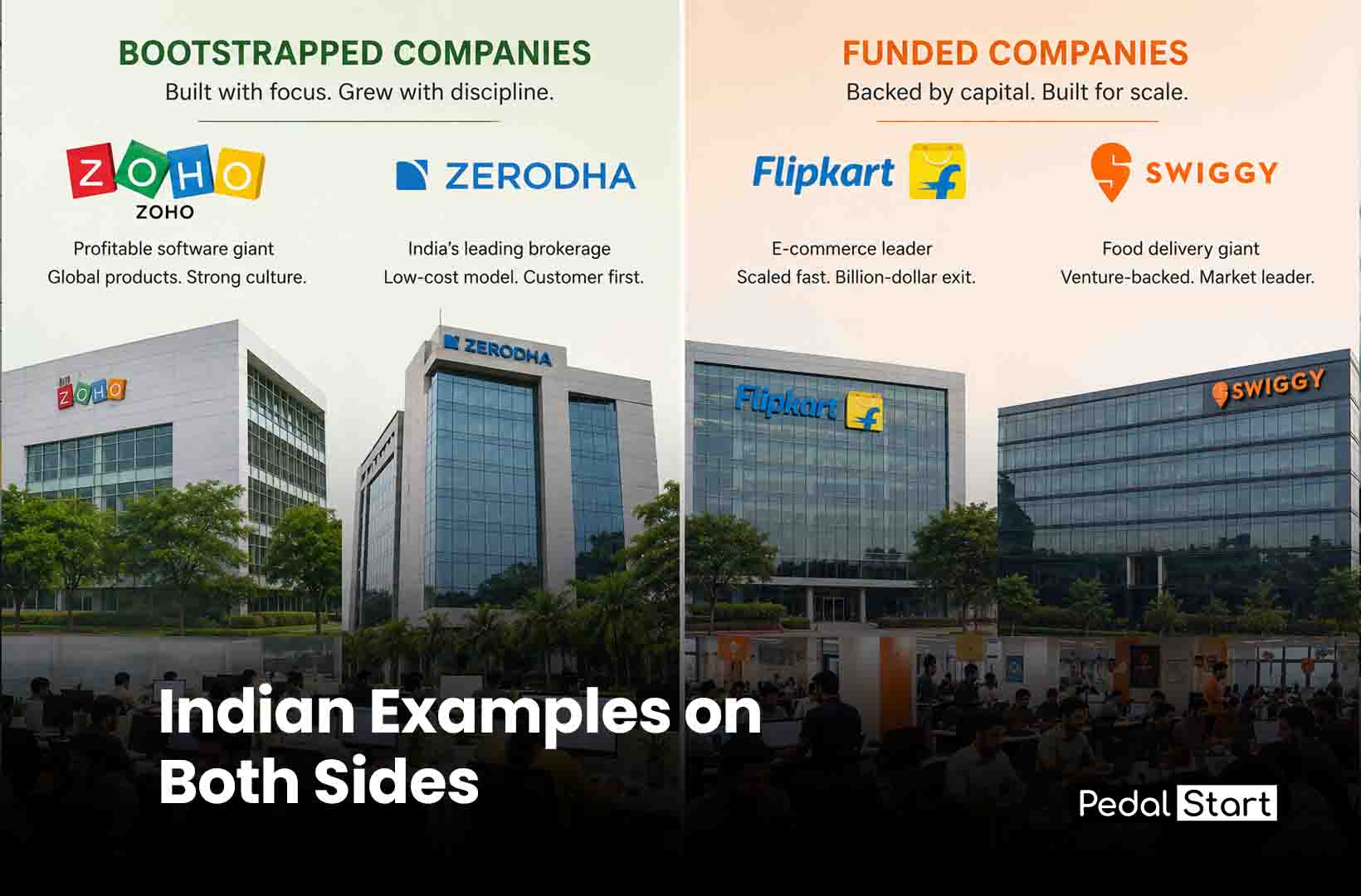
India has strong examples of both paths.
Bootstrapped companies like Zoho and Zerodha built large, profitable businesses without raising external capital. They focused on product, customer value, and steady expansion.
On the funded side, companies like Flipkart and Swiggy scaled rapidly with venture backing. They entered competitive markets and grew through capital-driven expansion.
These examples show that funded vs bootstrapped is not about right or wrong. It is about fit.
Cash Flow vs Growth Rate
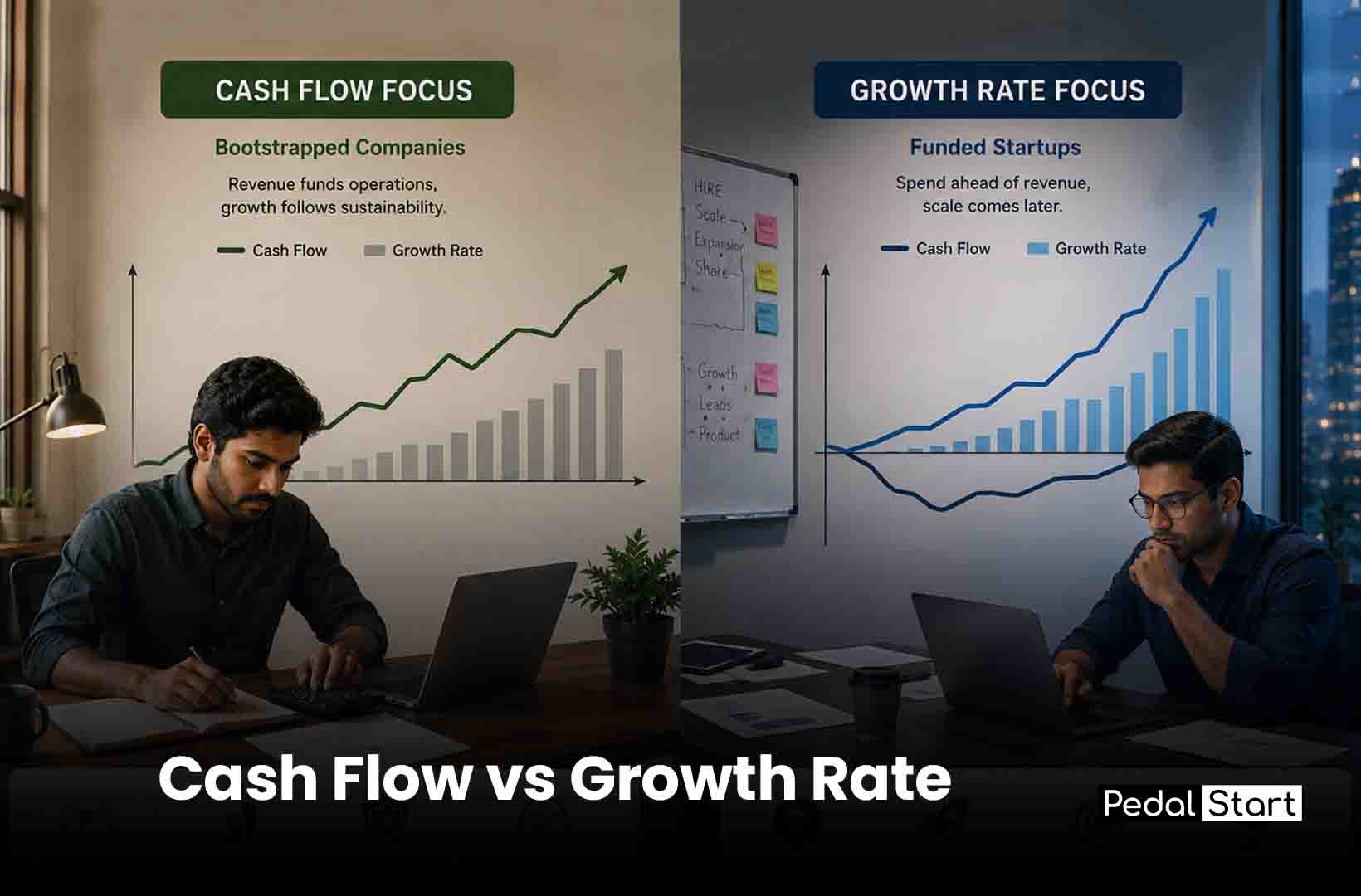
One of the simplest ways to understand this decision is to look at cash flow and growth.
Bootstrapped companies pay close attention to cash flow. Revenue funds operations, and growth follows what the business can sustain.
Funded startups prioritize growth rate. They spend ahead of revenue with the expectation that scale will come later.
This trade-off sits at the center of every startup funding decision.
Neither approach is universally better. It depends on what the business needs at that stage.
A Simple Decision Framework

If you are deciding between bootstrapped vs funded startup India, a few questions can help.
Can your business generate revenue early?
Does your market require fast scaling to win?
How comfortable are you with sharing ownership?
What kind of company are you trying to build?
How do you want to operate day to day?
The answers to these questions usually make the direction clearer.
Hybrid Approach: Build First, Raise Later

Many founders are now choosing a middle path.
They start by bootstrapping startup India until they reach product-market fit. This helps them understand the business without external pressure.
Once there is clarity on what is working, they raise capital to scale faster.
This approach reduces early dilution and still allows founders to benefit from funded startup advantages at the right time.
It also gives investors more confidence, since the business already shows signs of traction.
The conversation around bootstrapped vs funded startup India is not about picking a side.
It is about understanding what your business needs right now and what trade-offs you are willing to make.
The path you choose shapes how you build, how you grow, and how much control you keep along the way.