
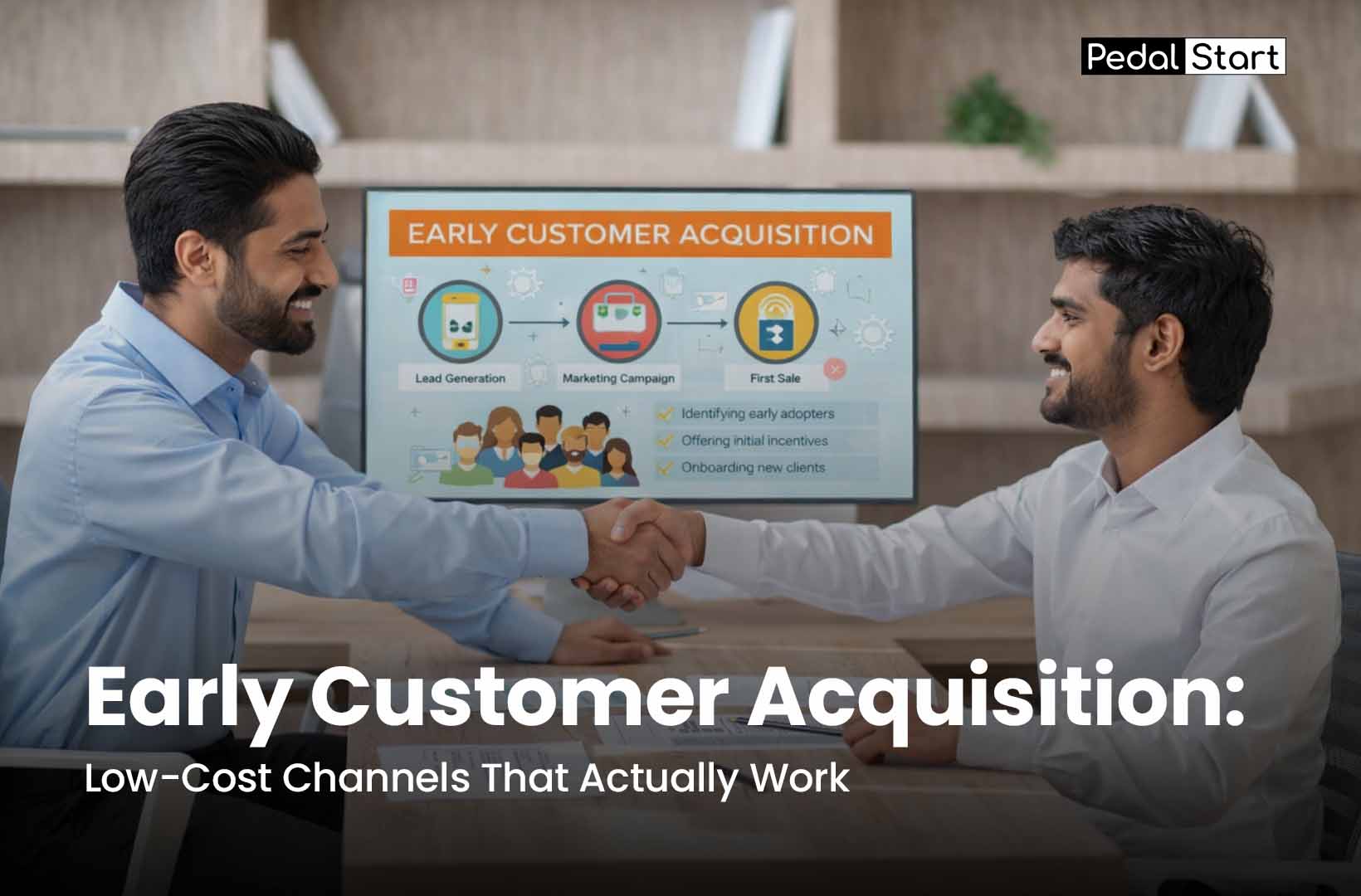
Strategies can be thought of, ideas can be worked on, teams can be built most easily and product or services are just a matter of making, but the first few customers? The ones who decide a startup’s whole trajectory, success or failure, acceptance in the market are not at all easy to find.
At the start, there is no brand, no distribution engine, no large marketing budget. What you do have is proximity to the problem and the ability to move fast.
That is enough, if used well.
Early customer acquisition is not about finding the perfect channel. It is about finding any channel that brings you closer to real users who care enough to engage, respond, or pay.
This phase shapes how your startup growth strategy evolves later. The patterns you discover here often become the foundation for larger, repeatable channels.
Founder-Led Sales in the Early Days

In the beginning, no one understands the product better than the founder.
That is why founder-led sales shouldn’t be optional. It is the fastest way to learn what actually resonates.
Reaching out directly to potential users, setting up calls without a polished pitch, walking them through the problem and your approach, listening carefully to objections, taking notes and really trying to solve or make your services or product better can give you 10x more clarity than internal discussions among the team only.
Take a look at which part of the pitch is interesting to them, where is the conversation slowing down, which part of it is where hesitation comes?
These signals help refine positioning much faster than mere delusional thoughts.
Founder-led selling also builds confidence in the product. When you have seen someone understand the value in real time, it changes how you communicate it going forward.
This stage may not feel scalable because it is not meant to be.
It is meant to be precise.
Leveraging Partnerships for Growth

Partnerships are one of the most underused startup growth channels in the early stage.
Not the large, formal partnerships that take months to close. Smaller, focused collaborations that give you access to the right audience can be enough.
This could mean working with a company that already serves your target users. Or aligning with a platform where your audience is active.
The key is relevance.
If your product fits naturally into their ecosystem, the introduction feels useful rather than promotional.
For example, a B2B startup might collaborate with a service provider already working with their target clients. A consumer product might partner with a niche community or platform where trust already exists.
The advantage here is simple. You are not starting from zero.
You are entering a space where attention and credibility already exist, and building on top of it.
Community-Led Customer Acquisition

Communities can completely change how trust is built.
People are more open to trying something new when it comes recommended within a group they already value.
This makes community-led efforts one of the most effective approaches for low cost marketing for startups.
But it requires a different mindset.
It is not about posting links or promoting your product directly. It is about participating.
Answering questions, sharing insights from your journey, offering help where relevant, over time, this builds familiarity.
When your product comes up in that context, it feels like a continuation of the conversation rather than an interruption.
This approach may take time. But the quality of users it brings in is often higher. They are more engaged, more responsive, and more likely to give meaningful feedback.
Content as a Trust Builder

Content works best in the early stage when it reflects real thinking, not marketing intent. Writing about what you are learning, breaking down problems you are solving, sharing observations from user interactions and more.
This kind of content does two things.
It attracts people who are already interested in the space. And it builds credibility before any direct interaction happens.
For founders exploring startup growth channels, content becomes a long-term asset.
It continues to bring in attention even when you are not actively pushing it.
The format can vary. Short posts, detailed articles, simple breakdowns. What matters is relevance and honesty.
When someone discovers your product after reading your content, the conversation starts at a different level. There is already some trust.
Testing and Optimizing Acquisition Channels

At some point, you will try multiple approaches.
Outbound outreach, partnerships, communities, content etc. Not all of them will work equally well.
Instead of spreading effort across too many channels, discipline helps to test them one by one with intent.
What kind of users does this channel bring, how do they behave after coming in, do they convert, engage, or drop off? These answers shape where you focus next.
A strong startup growth strategy is not built by doing everything. It is built by identifying what works and going deeper there.
Over time, one or two channels start standing out. That is where repeatability begins.
Some experiments work immediately. Others take longer. Some do not work at all. But each interaction adds to your understanding.
The first set of users, the first conversions, the first feedback loops. These are not just milestones. They are inputs into how the business evolves because It's not just about getting users. It is about learning how your product finds its place in the real world.
And once that starts becoming clear, growth becomes easier to build on.