

Understanding the Startup Accelerator Program in India
If you are exploring a startup accelerator in India, the first question to get clarity on is - What does an accelerator actually do for you at this stage?
A startup accelerator program is not just a short-term learning experience. At its best, it is a structured environment where your business is tested, refined, and pushed toward market readiness. It brings together mentorship, peer learning, and investor access, but the real value lies in how it forces clarity.
In India, this has evolved further. A strong Indian startup accelerator today does not operate only through cohort sessions. It works closely with founders on business fundamentals such as sales, pricing, positioning, and capital readiness.
This is why preparation matters. Accelerators amplify what already exists. If the base is unclear, the outcome remains limited.
How to Join a Startup Accelerator Successfully
Founders often approach applications as a formality, whereas selection is a filtering process that reflects how well you understand your own business.
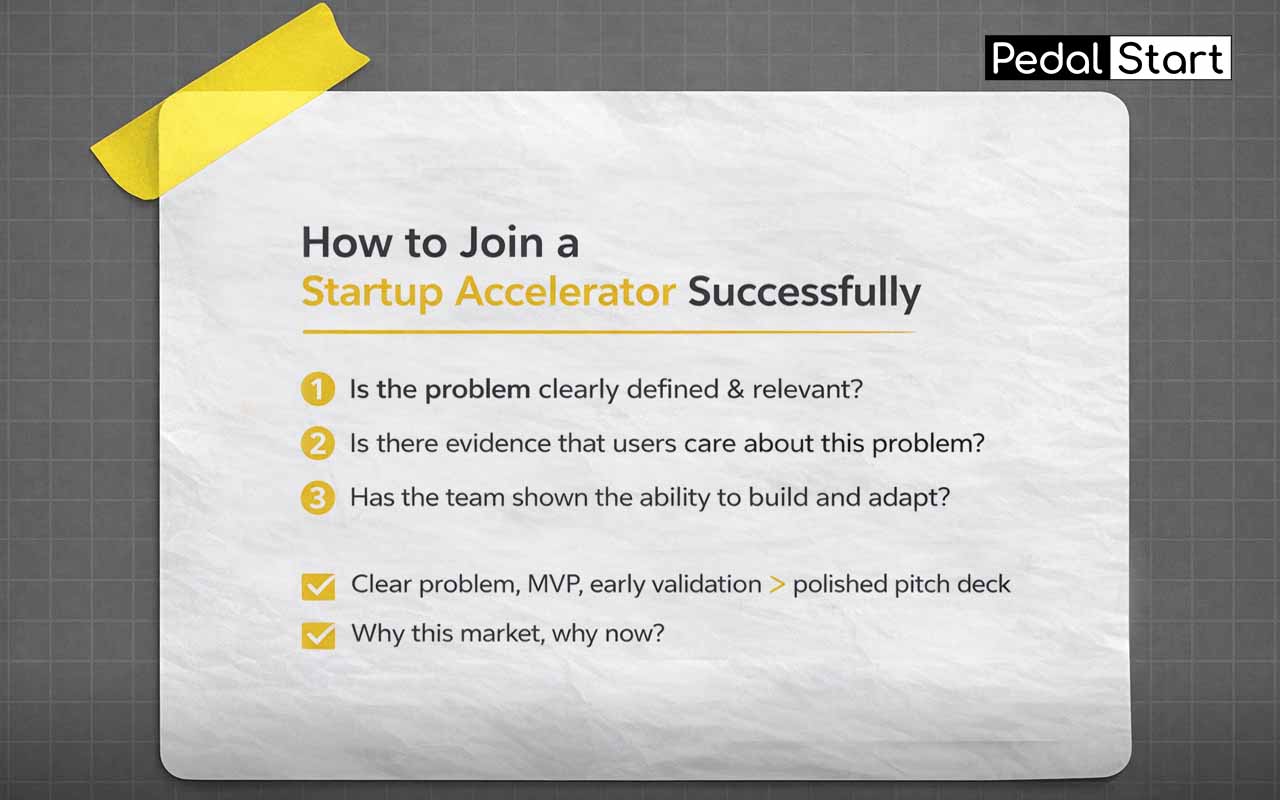
If you are figuring out how to join a startup accelerator, your application needs to answer a few underlying questions.
Is the problem clearly defined and relevant?
Is there evidence that users care about this problem?
Has the team shown the ability to build and adapt?
Selection committees do not expect perfection. They look for direction and seriousness. A clear problem statement, a working MVP, and some level of early validation go much further than a polished pitch deck.
It is also important to demonstrate thought processes. Why this market, why this approach, and why now. Founders who can articulate this clearly tend to stand out.
Preparation here is less about presentation and more about substance.
Key Requirements for India Startup Accelerators
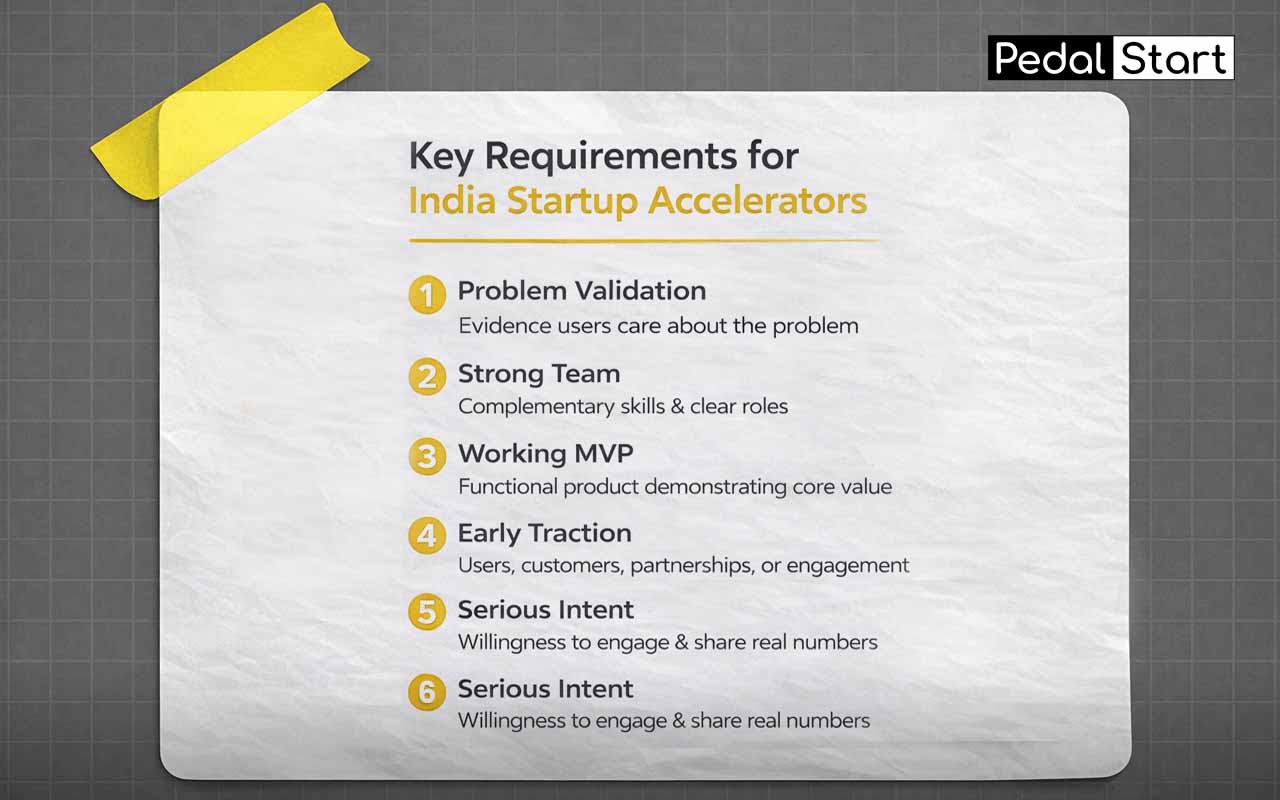
Most Indian accelerator programs evaluate startups across a few consistent dimensions. Understanding these early helps you prepare with intent.
First is problem validation. A startup built on assumption struggles to hold up under scrutiny. Conversations with users, early usage patterns, or even small revenue signals can indicate whether the problem is real.
Second is the team. At an early stage, investors and accelerators are backing people as much as ideas. Complementary skills, clarity in roles, and the ability to take feedback seriously matter more than experience alone.
Third is a working product. It does not have to be perfect, but there should be something users can interact with. A simple MVP is often enough if it captures the core value proposition.
Fourth is early traction. This could be users, pilot customers, partnerships, or even consistent engagement. It shows that the startup is moving beyond theory.
Finally, there is intent. Accelerators look for founders who are ready to engage deeply, share real numbers, and work through challenges in real time as passive participation does not lead to meaningful outcomes.
Preparing for a Startup Mentorship Program in India
Getting selected into a startup accelerator program is only the starting point. The real work begins after that.
Preparation before entering a startup mentorship program in India can significantly change what you take away from it.
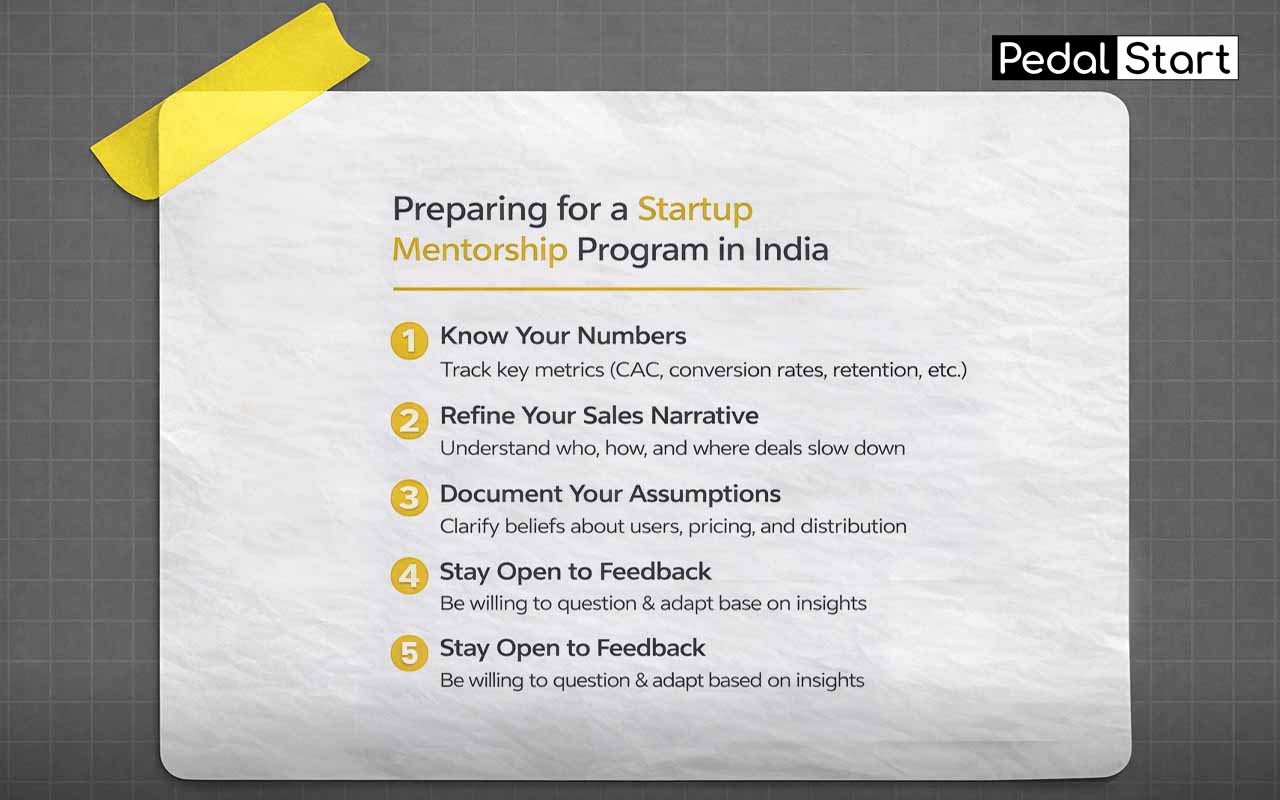
Start with your numbers. Even at an early stage, you should have clarity on basic metrics such as customer acquisition cost, conversion rates, and retention behaviour. You may not have perfect answers, but you should know what you are tracking.
Next is your sales narrative. Be clear about who you are selling to, how conversations are happening, and where deals are slowing down. This becomes a central area of discussion during accelerator programs.
It is also useful to document your assumptions. What do you believe about your users, pricing, or distribution? Accelerators work best when these assumptions are tested actively.
Another important aspect is openness. Founders who benefit the most are those who are willing to question their own thinking and adapt quickly based on feedback.
Preparation here is not about getting everything right. It is about being ready to work on what is not.
Choosing the Right Startup Accelerator in India
Not every startup accelerator in India will be the right fit for your stage or needs. Choosing carefully can make a significant difference.
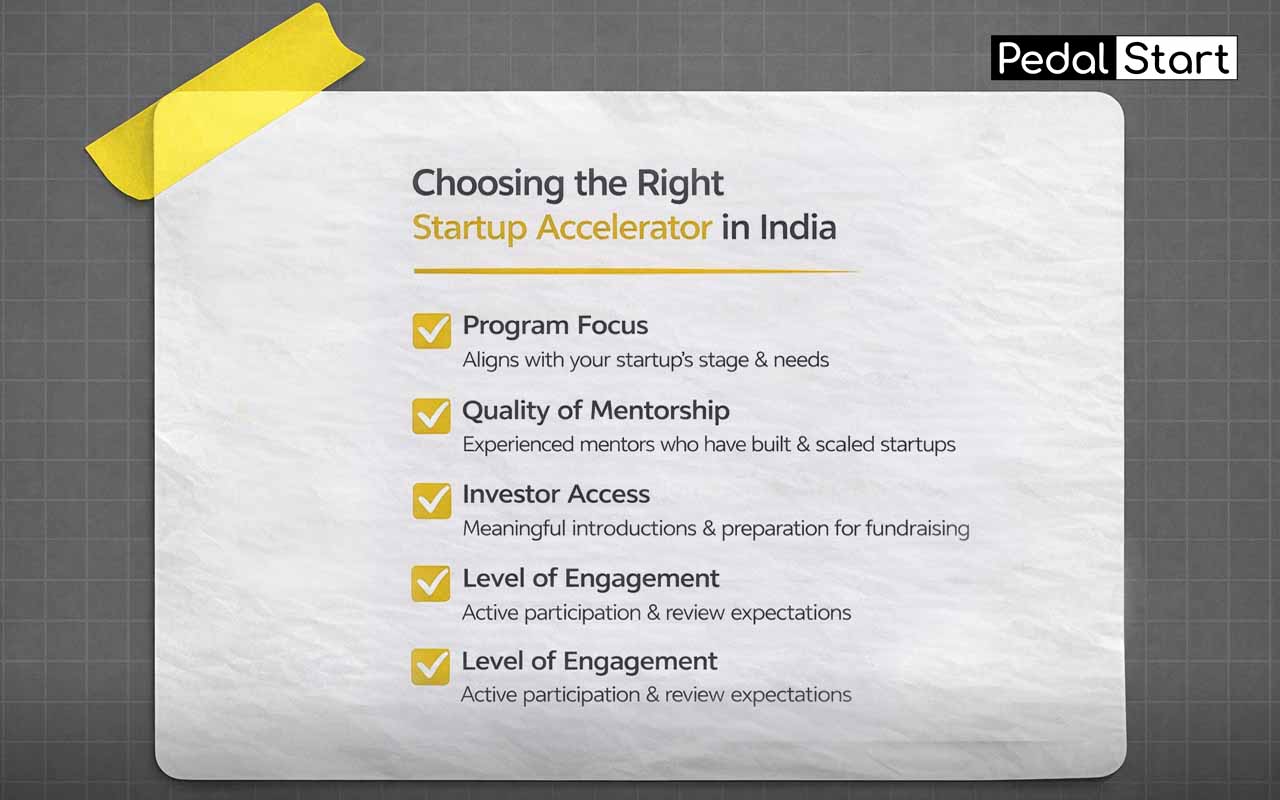
Start by understanding the focus of the program. Some accelerators are better suited for idea-stage startups, while others work more closely with startups that already have early traction.
Look at the type of mentorship offered. Programs that involve operators who have built and scaled businesses tend to provide more practical inputs compared to those focused only on high-level strategy.
Investor access is another factor, but it should be seen in context. The quality of preparation before introductions matters more than the number of investors in the network.
Also consider the level of engagement expected. Some programs require active participation and regular reviews, while others are lighter in structure. Your choice should depend on how much involvement you are prepared for.
Finally, speak to founders who have gone through the program. Their experience often gives a clearer picture than any external description.
Preparing for an accelerator is not about checking boxes. It is about building enough clarity so that when you enter the program, you can use it fully.
For early-stage founders, the right startup accelerator program can compress months of learning into a shorter, more focused cycle. But that only happens when preparation meets the opportunity.