

A founder reads American fundraising advice, decides a SAFE is the clean way to take a first cheque, and finds out from a lawyer that it does not work here. Indian rounds close on compulsorily convertible preference shares or compulsorily convertible debentures, and the difference between them changes what you owe, when you owe it, and what happens if the next round never arrives.
Key takeaways
A plain US SAFE is not a recognised capital instrument for foreign investment into an Indian company. Indian rounds use CCPS or CCD instead.
CCPS behave as equity with preference rights attached. CCDs behave as debt until the moment they convert.
CCPS are the default for most Indian venture rounds. CCDs appear more often in angel and accelerator cheques.
Both require a valuation at the time of issue. A SAFE defers that valuation to conversion, which is part of why it does not fit.
The clause that matters more than the instrument is the conversion trigger: what event converts it, and what happens if that event never comes.
Why can’t Indian startups just use a SAFE?

Foreign investment into an Indian company runs through the Foreign Exchange Management (Non-Debt Instruments) Rules, 2019. Those rules recognise a short list of capital instruments: equity shares, compulsorily convertible preference shares, compulsorily convertible debentures, and share warrants.
A SAFE is none of those. It is a contract giving the investor a right to shares at a future event. When the money lands, no instrument has been issued, which leaves no clean route for the FC-GPR filing that reports the investment. Money in the company and nothing recognised as issued against it is a position no founder wants to explain later.
This is why the Indian version, the iSAFE, is structured as CCPS. The commercial logic of a SAFE is preserved, and an actual capital instrument gets issued. If an overseas investor asks you for a SAFE, that is the usual answer.
For a purely resident investor, the analysis sits under the Companies Act, and the deposit rules rather than FEMA, and the conclusion is similar: the money has to arrive against something the law recognises.
What is a CCPS?
Compulsorily convertible preference shares are preference shares that must convert into equity. Not may, must. That compulsion is what lets them count as equity under FEMA rather than as borrowing.
Until conversion, they sit on the cap table as preference shares carrying rights ordinary shares do not have. A liquidation preference is the common one: in a sale or winding up, the holder is paid before ordinary shareholders. Anti-dilution protection is frequently attached as well.
They are the default instrument for institutional venture rounds in India. If a fund is leading your round, this is most often what the term sheet says.
What is a CCD?
Compulsorily convertible debentures are debt instruments that must convert into equity. Before conversion, they are a debenture, which means they can carry interest, and that interest is a real obligation rather than a formality.
After conversion, they become ordinary equity. The same FEMA treatment applies as for CCPS: because conversion is compulsory, the instrument counts as equity rather than as external borrowing. An instrument that is optionally or partly convertible loses that treatment and raises a different set of questions entirely.
CCD suits an investor who wants a fixed return in the period before conversion, and it suits a company that would rather not create a class of preference shares this early.
What is a convertible note in India, and who can use one?

The Indian convertible note is a specific regulated instrument, not a general description.
For a non-resident investor, the thresholds are concrete. The minimum is ₹25 lakh in a single tranche, and the note must convert or be repaid within ten years. The issuing company has to meet the recognised startup definition, which means DPIIT recognition is a gate rather than a nice-to-have.
Those conditions rule it out for most small first cheques. A ₹10 lakh angel investment cannot be a convertible note from a non-resident. That single fact pushes a large share of early Indian rounds toward CCPS or CCD by default.
CCPS vs CCD: what actually differs
CCPS | CCD | |
What it is before conversion | Preference shares | Debentures |
Treated as | Equity in substance | Debt until conversion |
Return before conversion | Dividend, where provided | Interest, where provided |
Liquidation preference | Commonly attached | Not inherent to the instrument |
Anti-dilution | Frequently attached | Negotiated separately |
Sits on the cap table | Yes, as a share class | As debt, until it converts |
Conversion | Compulsory | Compulsory |
Valuation at issue | Required | Required |
Most common in | Institutional venture rounds | Angel and accelerator cheques |
Both convert compulsorily. Both need a valuation when issued. The live differences are what the holder is owed in the gap, and what seniority they carry if things go wrong.
Which one will an investor ask for?
A venture fund leading a priced round will almost always ask for CCPS, because the preference and anti-dilution rights it wants attach naturally to a preference share class.
Angel investors and accelerators more often use CCD, where the cheque is smaller, the round is unpriced or lightly priced, and the conversion is set against a cap and a floor rather than a fixed valuation. PedalStart invests through CCDs for this reason.
A founder rarely gets to pick. What you do get to negotiate is the terms attached, and those matter more than the label on the document.
What does each one cost you?
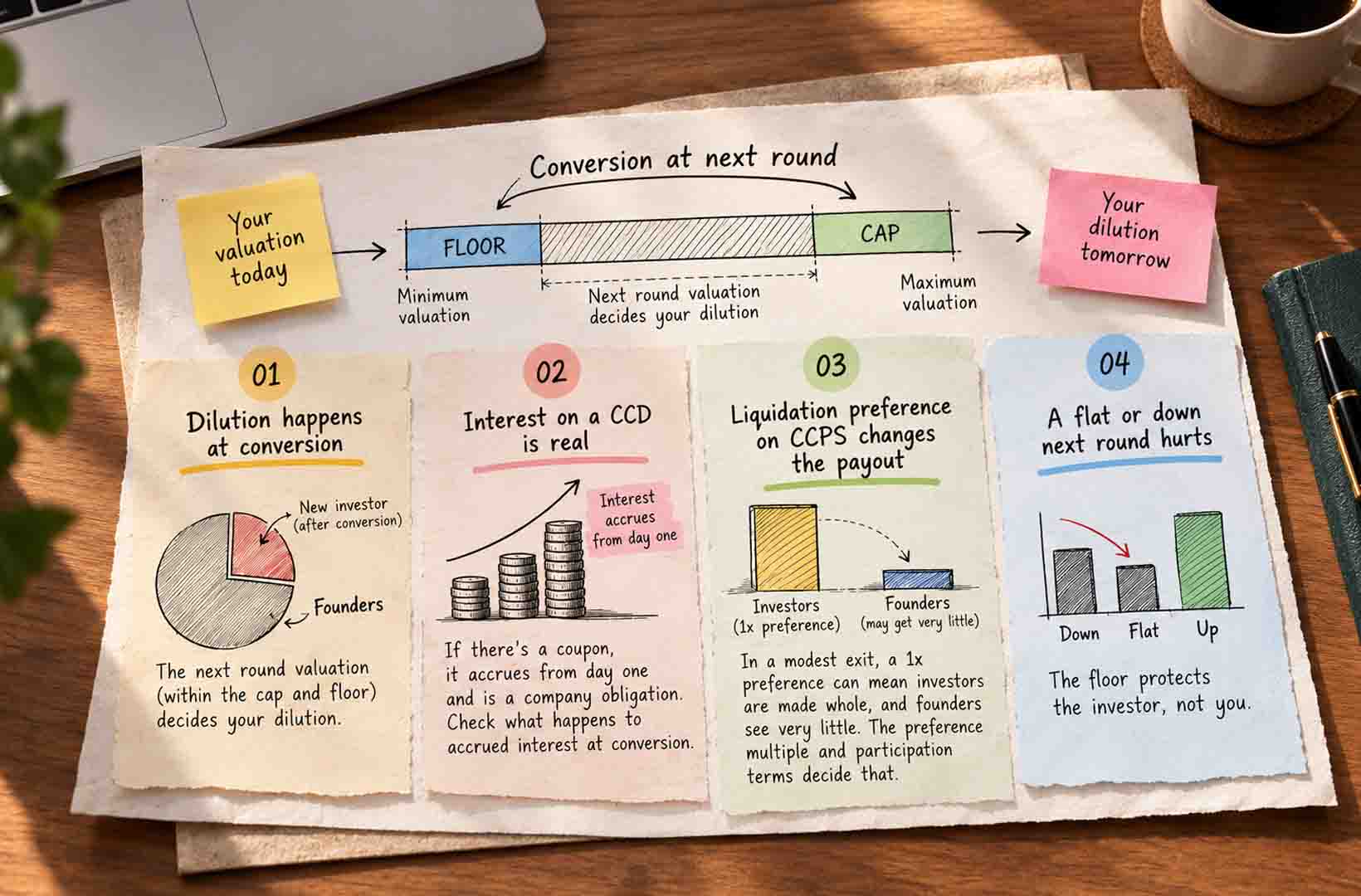
Dilution lands at conversion, not at signing. With a cap and floor structure, the valuation that decides your dilution is set by your next round, inside the band you agreed. A low cap with a strong next round is the expensive outcome, and it is the number to argue hardest about.
Interest on a CCD is real. If the instrument carries a coupon, that accrues from day one and it is an obligation of the company, not a courtesy. Check what happens to accrued interest at conversion.
A liquidation preference on CCPS changes who gets paid. In a modest exit, a 1x preference can mean investors are made whole, and founders see very little. The preference multiple and participation terms decide that, not the headline valuation.
A flat or down next round hurts under both. The floor protects the investor, not you.
What should you check before you sign?

The conversion trigger. Which event converts the instrument, and what is the long-stop date if that event never happens?
The cap and the floor. Both numbers, and which applies in which scenario. Confirm they are the right way round, because inverted cap and floor language is a real drafting error.
What happens on non-conversion. Repayment, extension, or conversion at a default valuation. Each has a very different consequence for your balance sheet.
Interest and its treatment at conversion. Accrued, waived, or converted into additional shares.
How it interacts with anti-dilution. Two protective mechanisms stacking can dilute founders much faster than either alone.
Your filing obligations. Allotment to a non-resident carries a 30-day FC-GPR reporting deadline, and a missed filing is a compliance problem that follows the company into diligence.
This is a description of how the instruments work rather than advice on which to sign. The rules change, and the terms on your document are the ones that bind you, so have your lawyer read the actual draft against the current position.
Frequently asked questions
Can an Indian startup issue a SAFE to an Indian investor?
The FEMA capital instrument restriction applies to foreign investment. For a resident investor, the question moves to the Companies Act and the deposit rules, and the practical answer most advisers reach is the same: issue something the law recognises. The iSAFE, structured as CCPS, exists to solve exactly this.
Is a CCD a loan?
It is a debt instrument before conversion, so it can carry interest, and it sits differently on your balance sheet to equity. Because conversion is compulsory, it is not treated as borrowing under FEMA. Those two things are both true, and founders often conflate them.
What happens if the next round never happens?
That is the single most important clause in the document. Depending on the drafting, the instrument converts at a default valuation, extends, or becomes repayable. Read it before you read the valuation.
Do I need DPIIT recognition to raise?
Not to issue CCPS or CCD. You do need it for the convertible note route, alongside the ₹25 lakh minimum tranche from a non-resident.
Can one round use both instruments?
It happens, with different investors on different paper. It also makes your cap table harder to read at the next round, and a confusing cap table costs you time in diligence.
Where this leaves you
The instrument is decided by who is writing the cheque far more often than by what you would prefer. What you control is the conversion trigger, the band your dilution falls inside, and what the document says about the scenario where nothing goes to plan.
Founders spend their negotiating energy on the valuation and sign the conversion mechanics unread. The mechanics are where the money actually moves



