

A startup can grow fast and still be dying.
Ten thousand new customers a month looks like success. But if each one costs more to win than they ever bring back, that growth is quietly burning the company down.
Unit economics is the test that tells the two apart. It answers one question: does a single customer make you money, or lose it?
Get this right, and growth builds a business. Get it wrong, and growth just loses money faster.
After the funding reset, Indian investors have stopped rewarding growth for its own sake. They want to see that each customer makes money first. So this matters more than ever if you are building and raising in India today.
This guide explains what unit economics is, how to calculate it, and how to read the numbers the way an early-stage investor does.
What is unit economics?
Unit economics is the profit and cost of a single unit of your business.
A "unit" is most often one customer, sometimes one sale. Instead of looking at the whole company's revenue, you zoom in on one: what it costs to win them, and what they give back.
If a single unit makes money, the business can scale into a real one. If it loses money, scaling only multiplies the loss.
That is why investors care about unit economics more than topline growth. Revenue tells you how big you are. Unit economics tells you if you should exist.
What are the two ways to measure it?

There are two ways to define a unit, and people mix them up.
Per sale (contribution margin). If your unit is one sale, unit economics is the contribution margin: the price of one order minus the variable costs of delivering it. This fits most consumer businesses, a D2C brand, a quick-commerce order, a single treatment at a clinic.
Per customer (LTV and CAC). If your unit is one customer, it is the relationship between what a customer is worth over time (LTV) and what it costs to acquire them (CAC). This fits repeat-purchase and subscription businesses, from a consumer app to SaaS.
Most founders end up caring about the per-customer view, because the real question is rarely one order. It is whether a customer comes back and earns back the cost of winning them. The rest of this guide focuses there.
How do you calculate CAC?
Customer acquisition cost, or CAC, is what you spend to win one customer.
The formula is simple: CAC equals total sales and marketing spend, divided by the number of new customers acquired.
Spend ₹5 lakh on marketing in a month and win 250 customers, and your CAC is ₹2,000.
But that simple formula hides the traps that make founders' numbers look better than they are:
Hidden costs. Real CAC includes salaries, tools, agency fees, and commissions, not just ad spend.
Blended vs paid. Mixing paid and organic makes CAC look artificially low. Show both: blended (all-in) and paid (ad-driven).
Rising cost. Early customers are cheap. As you scale, CAC climbs, so do not assume today's number holds.
How do you calculate LTV?
Lifetime value, or LTV, is how much profit a customer gives you over their whole relationship with you.
A common formula: LTV equals average revenue per customer, times gross margin, divided by the churn rate.
And here is the mistake almost everyone makes. They use revenue instead of gross margin.
A brand with 40% margins earns half the LTV of one with 80% margins, even at the same revenue. Use revenue, and you overstate LTV and overspend to acquire customers you cannot afford.
The other trap is churn. Churn sits in the denominator, so a small error swings the number wildly. Cutting annual churn from 20% to 10% doubles LTV for the same customer. Base it on real retention data, not hope.
What is a good LTV:CAC ratio?
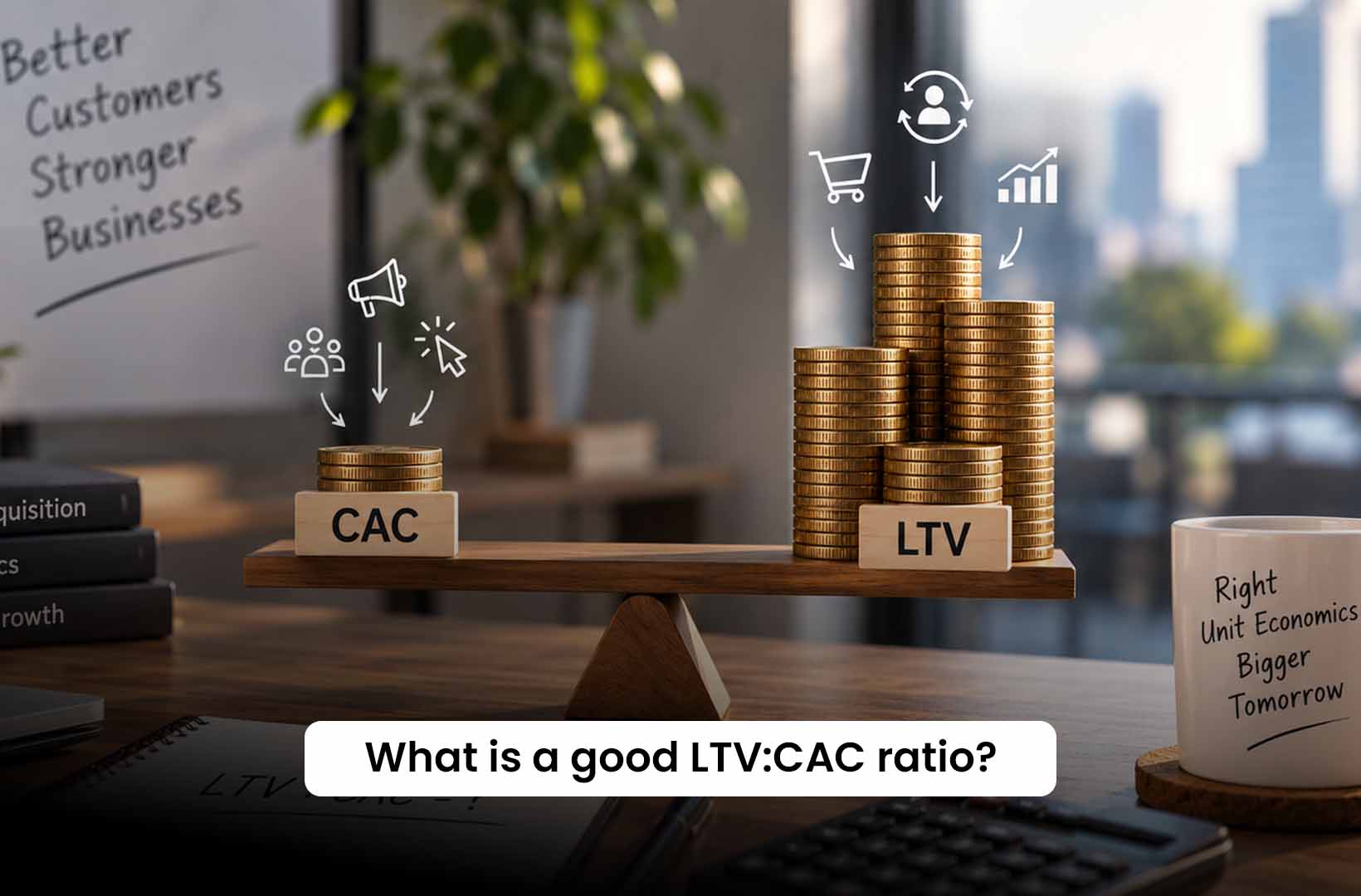
The LTV:CAC ratio is the number investors check first. It compares what a customer is worth to what they cost.
The widely-used benchmark, popularised by investor David Skok, is about 3 to 1. A customer should be worth roughly three times what you paid to acquire them.
Here is how to read it:
Ratio | What it means |
Below 1:1 | You lose money on every customer. Growth makes it worse. |
Around 3:1 | Healthy. Sustainable growth. |
Above 5:1 | Strong, but you may be underspending on growth and leaving room on the table. |
At PedalStart, this is one of the first things we look at in an early-stage company. A founder who knows their real LTV:CAC, and can defend it understands their business.
It is also central to what we pressure-test with founders in our Sprint programme, before the raise, not after an investor finds the gap.
How long should CAC payback take?

CAC payback is how long a customer takes to earn back what you spent to acquire them.
Spend ₹4,000 to win a customer who gives ₹400 of gross profit a month, and your payback is ten months.
Why it matters: until a customer pays you back, you are out of pocket. A long payback ties up cash and shortens your runway. A short one frees cash to grow.
The rough benchmark is under 12 months for most early-stage businesses. Beyond 18 to 24 months, you are financing growth rather than generating it, which only works while capital is cheap.
Why do unit economics matter more than growth?
Because growth cannot fix a broken unit. It only scales the damage.
If you lose money on every customer, ten times the customers means ten times the loss. More funding just lets you lose it faster.
This is the difference between founders who raise the next round and founders who run out of cash. India's funding market has learned it the hard way.
The rounds that close in 2026 go to businesses that make money on each customer, not the ones with the fastest-growing user chart.
It is the same thing investors look for before they write a cheque.
So before you spend to grow, make sure the unit works. Real growth is adding more of something that already pays for itself. Everything else is expensive noise.
Common unit economics mistakes

A few mistakes come up again and again.
Using revenue instead of gross margin in LTV, which overstates it badly.
Underestimating CAC by leaving out salaries, tools, and rising costs at scale.
Ignoring churn, the one input that quietly breaks every LTV number.
Confusing growth with health. More users while losing money on each is not progress.
Measuring blended CAC only. Without paid CAC, you cannot see if your acquisition actually works.
The simple version
Strip it back, and unit economics answers one question: does a single customer make you money?
If yes, growth is your friend. Spend to win more of them. If no, growth is your enemy. Fix the unit before you scale.
The founders who last, and the ones Indian investors back now, are not those with the most users. They are the ones who made each customer pay for themselves first, then grew.
Know your numbers, use gross margin not revenue, count every cost, and be honest about churn. That is the whole discipline.
Key takeaways
Unit economics is the profit and cost of a single customer or sale. It tells you if your business works at the smallest level.
Measure it two ways: contribution margin (per sale) or LTV against CAC (per customer).
The LTV:CAC ratio is the number investors check first. Around 3 to 1 is healthy.
Use gross margin, not revenue, in LTV, and include every cost in CAC. Both mistakes flatter your numbers.
Growth cannot fix broken unit economics. It only multiplies the loss.
Frequently asked questions
What is unit economics in simple terms? The profit and cost of a single unit of your business, most often one customer. It tells you if each customer makes or loses you money.
How do you calculate unit economics? Two ways. Per sale, use contribution margin: the price minus the variable cost. Per customer, compare lifetime value (LTV) to acquisition cost (CAC).
What is a good LTV to CAC ratio? Around 3: 1 is the widely used benchmark: a customer worth roughly three times what they cost to acquire. Below 1: 1 means you lose money on each one.
Why do investors care about unit economics? Because growth cannot fix a business that loses money per customer. Strong unit economics show the business can scale profitably, which is what investors fund.
What is the most common unit economics mistake? Using revenue instead of gross margin to calculate LTV. It overstates a customer's value and leads founders to overspend on acquisition.