
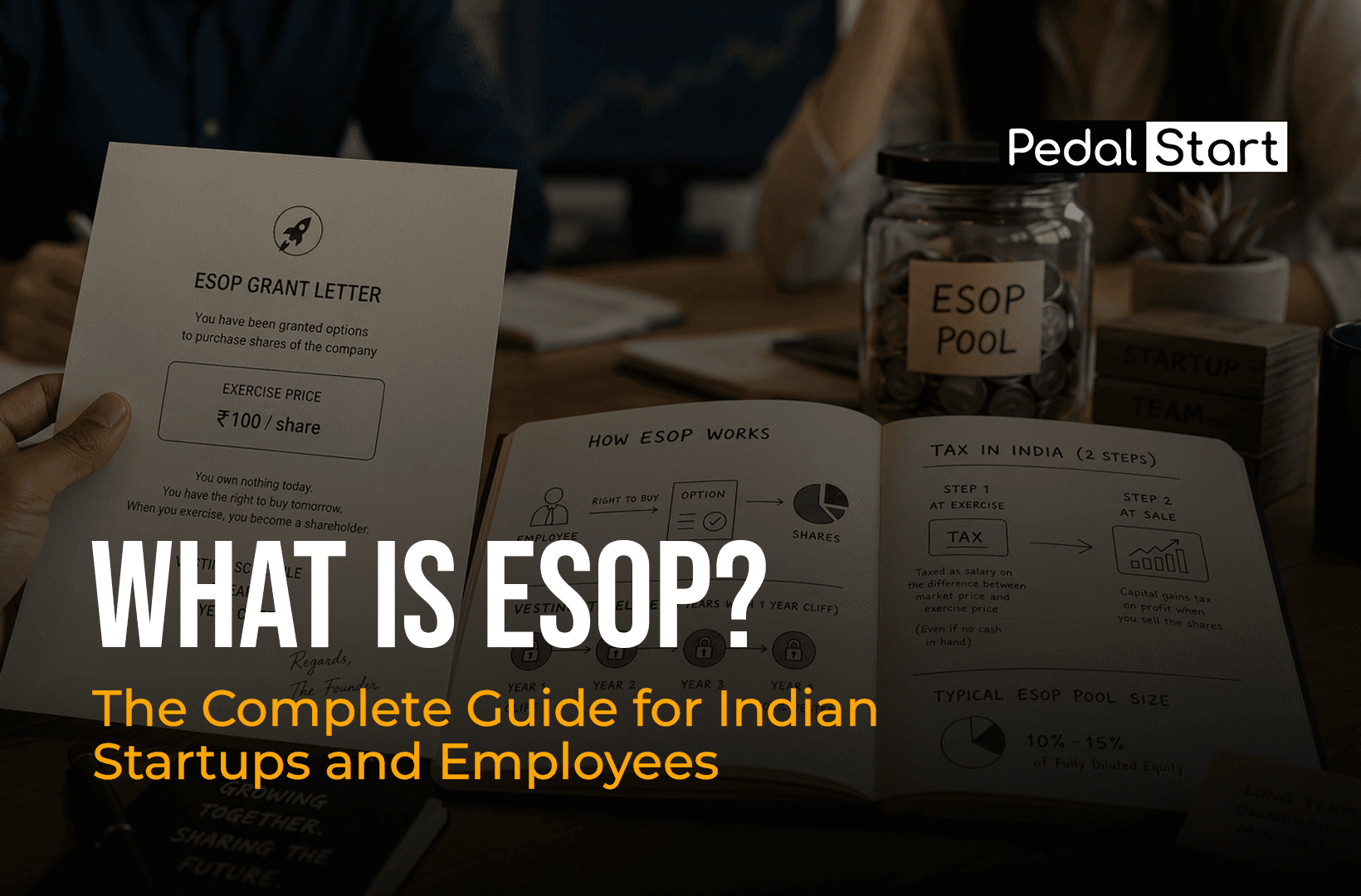
An ESOP, or Employee Stock Option Plan, is the right to buy shares in your company at a fixed price at a future date. It is an option to buy stock later, not stock itself, and that distinction is where most confusion begins.
If you have just been handed an ESOP letter, you are holding a promise with conditions attached. If you are a founder setting up a pool, you are deciding how much of your company to give away and when. This guide covers both sides.
Key takeaways
An ESOP gives you the right to buy shares at a fixed price. You own nothing until you exercise that right.
The Indian standard is four-year vesting with a one-year cliff.
ESOPs are taxed twice in India: as salary when you exercise, and as capital gains when you sell.
Tax at exercise is due even though no money has come in, which is where most employees get caught.
Most Indian startups reserve 10% to 15% of fully diluted equity for their ESOP pool.
What is an ESOP and how does it work?
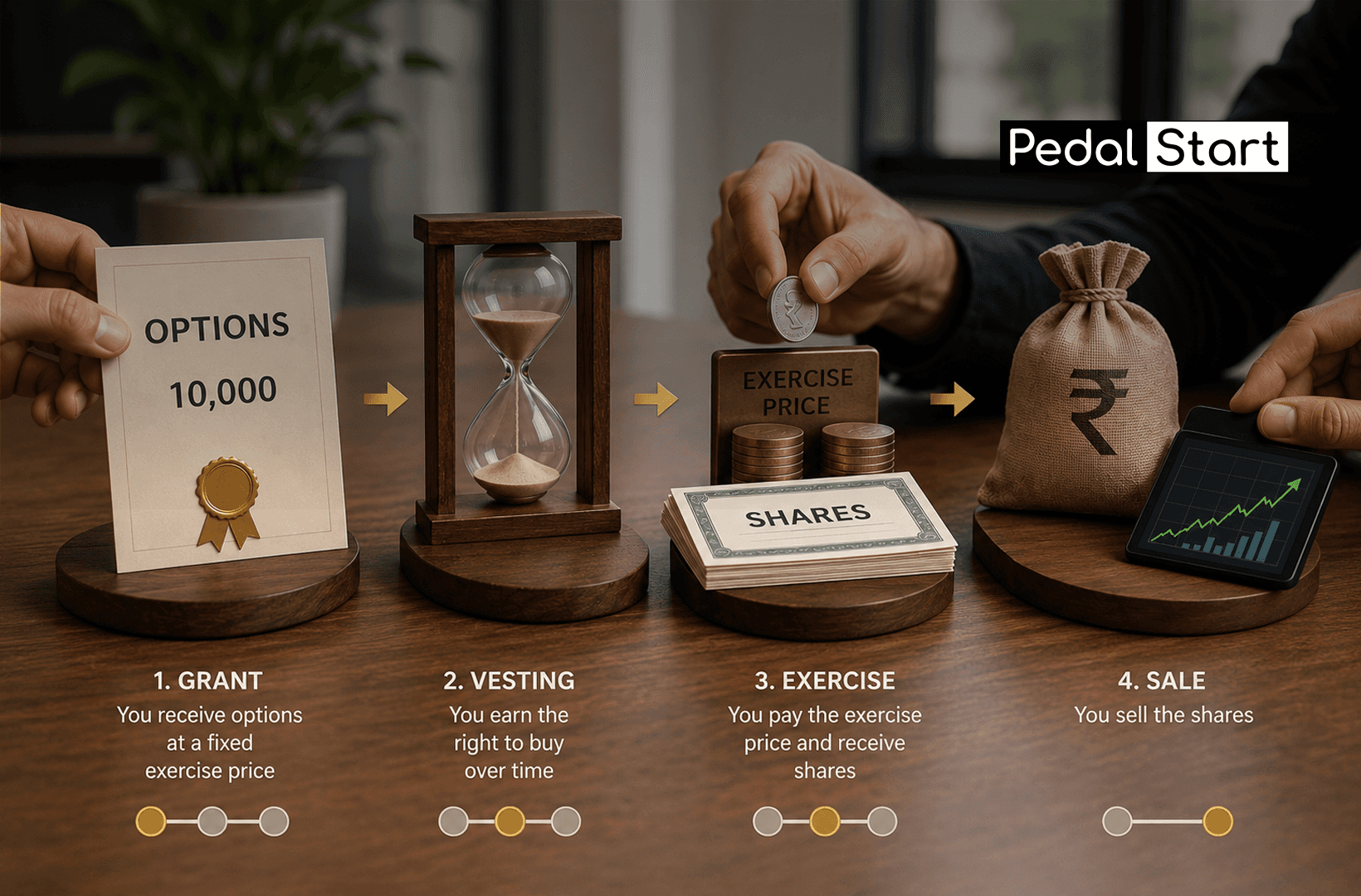
An ESOP works in four stages: grant, vesting, exercise, and sale. You receive options, you earn the right to buy over time, you pay to convert them into shares, and eventually you sell.
Each stage has different rules and different consequences.
Stage | What happens | Do you own shares? | Tax event |
Grant | Company allots you options at a fixed exercise price | No | No |
Vesting | You earn the right to buy over time | No | No |
Exercise | You pay the exercise price and receive shares | Yes | Yes, taxed as salary |
Sale | You sell the shares | No longer | Yes, capital gains |
The gap between grant and exercise is where most of the confusion sits. Being granted 10,000 options does not mean you own 10,000 shares. It means you have the right to buy them, once vested, at a price fixed years ago.
What are ESOP shares?
Strictly, there is no such thing as an ESOP share. You hold options, and options convert into shares only when you exercise them and pay.
The phrase gets used loosely in job offers, which creates a real problem. An employee who thinks they already own equity acts differently than one who knows it is conditional.
It can lapse if they leave before vesting.
One line worth remembering: an option is a right to buy, not a grant of ownership.
What is the vesting period in an ESOP?
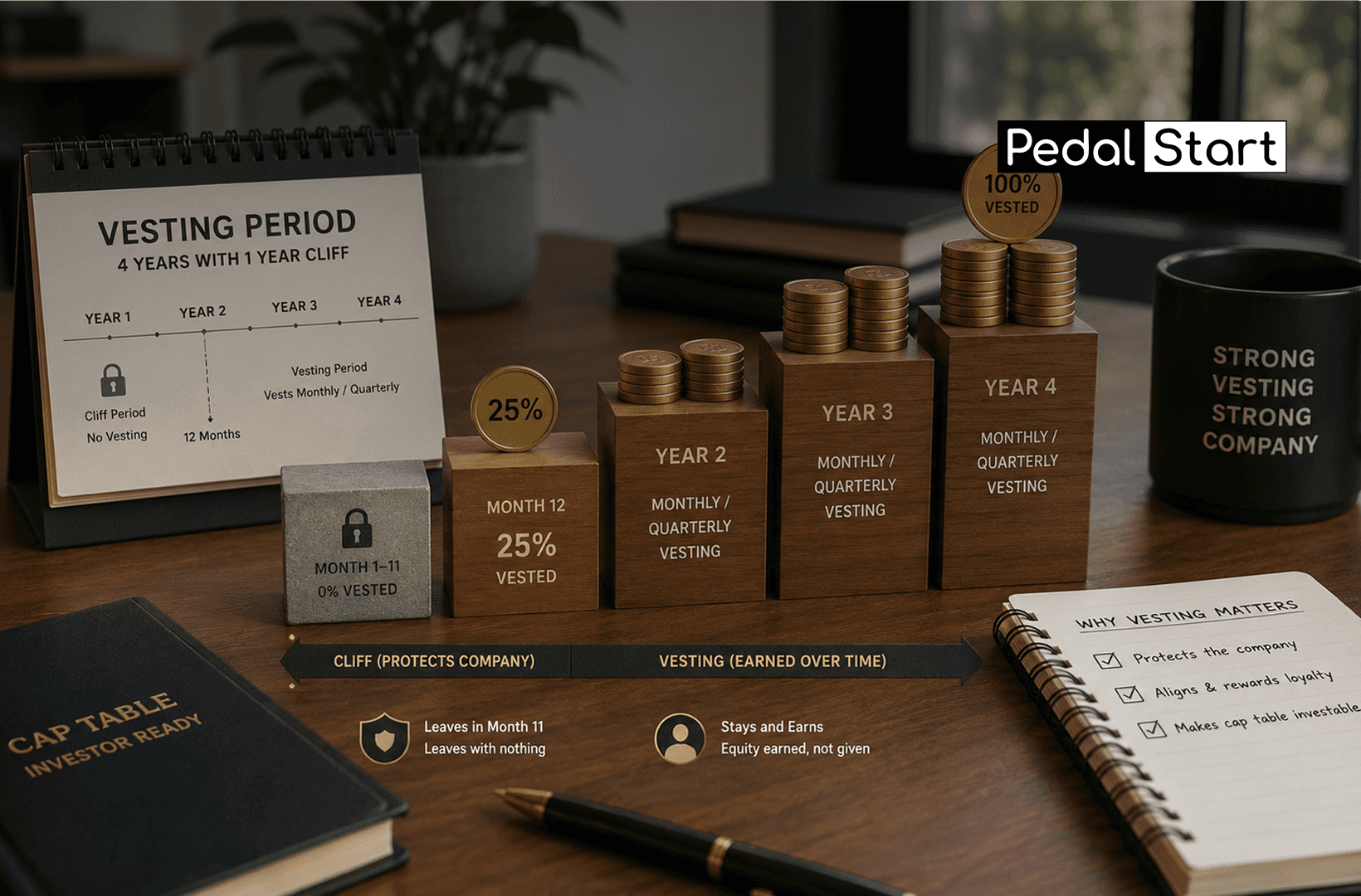
The vesting period is the time you must stay with the company before you can exercise your options. In India, the market standard is four years with a one-year cliff.
In practice: nothing vests for the first twelve months. At the twelve-month mark, 25% vests in one go. The remainder vests monthly or quarterly across the next three years.
The cliff protects the company. If someone leaves in month eleven, they leave with nothing.
For employees, equity is earned over time, not received on day one. For founders, vesting is what makes a cap table investable, and its absence is a red flag investors look for during diligence.
What is the exercise price in an ESOP?
The exercise price, also called the strike price, is the fixed amount you pay per share when you convert options into shares. It is set at or below the fair market value of the share on the date of grant.
This is the reason ESOPs can be valuable. If your strike price is fixed at ₹50 and fair market value later reaches ₹500, you still buy at ₹50.
For unlisted Indian companies, fair market value must be determined by a SEBI-registered Category I Merchant Banker. A valuation set arbitrarily or pulled from an outdated report inflates the tax employees face at exercise and invites scrutiny from the tax department.
How is ESOP taxed in India?
ESOPs are taxed at two separate points in India: once as a perquisite when you exercise, and again as capital gains when you sell the shares.
Event | What is taxed | How it is taxed |
Exercise | Fair market value on exercise date minus exercise price | Added to salary income, taxed at your slab rate, TDS deducted by employer |
Sale | Sale price minus fair market value at exercise | Capital gains |
Capital gains treatment depends on the holding period from the date of allotment. Listed shares held beyond 12 months and unlisted shares held beyond 24 months qualify for long-term treatment, taxed at 12.5% without indexation following the Finance Act 2024. Shorter holding periods are taxed as short-term gains.
The trap: tax at exercise is due on a paper gain. You pay real money on shares you cannot sell yet.
An employee at an unlisted startup can exercise options, trigger a tax bill of several lakhs, and hold shares with no buyer in sight.
The startup deferral, and who actually qualifies
The Finance Act 2020 introduced relief for employees of eligible startups. The perquisite tax due at exercise can be deferred until the earliest of three events.
These are 48 months after the end of the relevant assessment year.
Or the employee leaves the company.
Or the shares are sold.
The eligibility bar is higher than most people assume. The company needs DPIIT recognition under the Startup India scheme and an exemption certificate under Section 80-IAC. DPIIT recognition alone does not qualify. Analysis by Omnivoo estimates that about 1,500 Indian startups held 80-IAC certification in 2026. This is a small share of the recognized startup base.
Two further points matter. The deferral postpones the tax; it does not remove it. And the rate is locked at your slab in the year of exercise, not the year you eventually pay.
There have been Budget 2026 discussions around extending the deferral to all DPIIT-recognised startups rather than only 80-IAC certified ones. That remains a proposal at the time of writing and should not be assumed.
How much ESOP should a startup give?
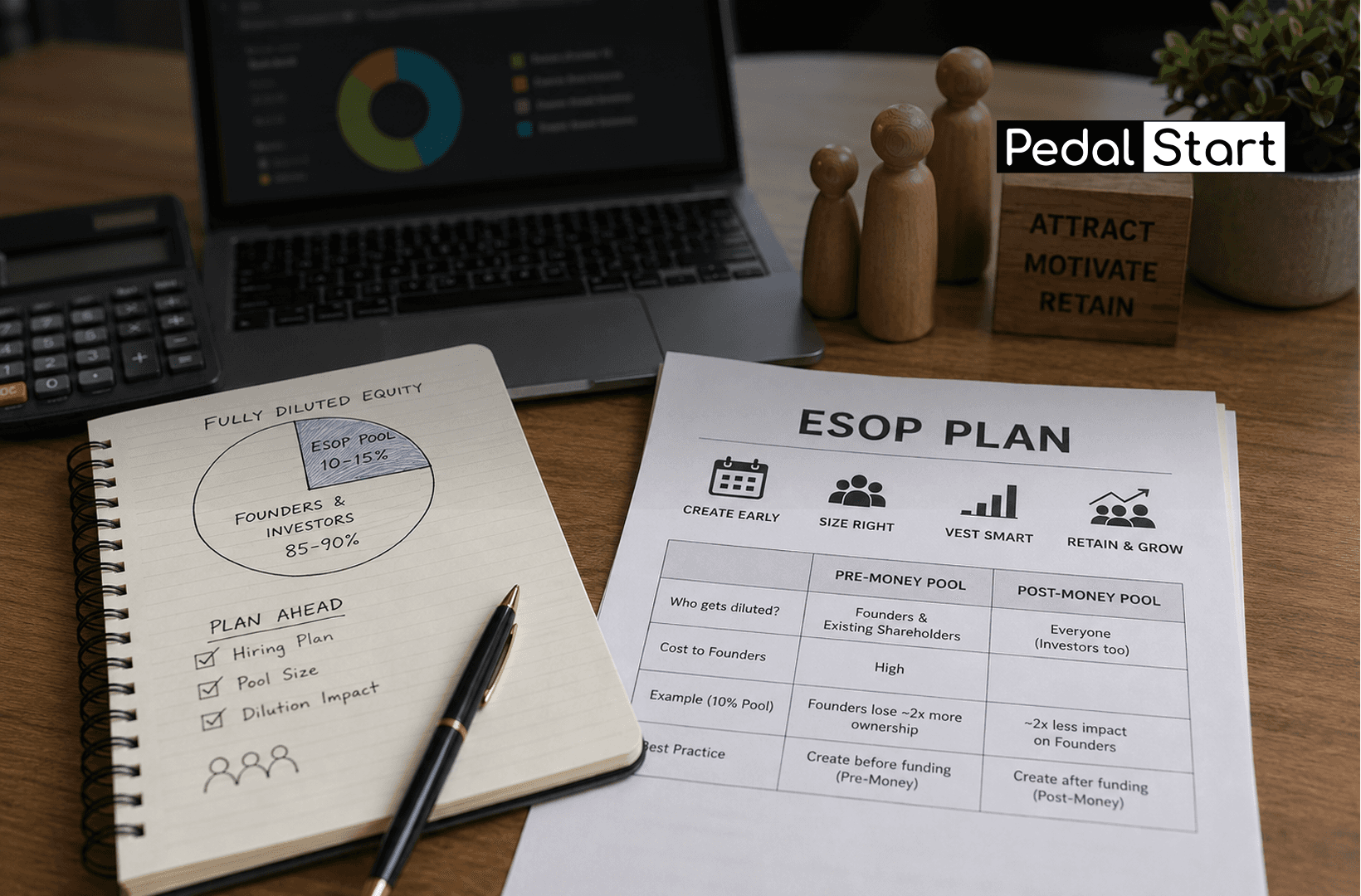
Most Indian startups reserve 10% to 15% of fully diluted equity for their ESOP pool. The right number inside that range depends on how much of your hiring plan depends on equity rather than cash.
The bigger decision is not the size of the pool. It is when you create it.
Institutional investors ask founders to create or top up the pool before their money comes in. This is called a pre-money pool, and the sequencing matters enormously. If the pool is created pre-money, founders and existing shareholders absorb the entire dilution. If it is created post-money, the incoming investor is diluted alongside everyone else.
A 10% pool created pre-money costs founders roughly twice what the same pool costs if created post-money.
This is one of the more common ways founders lose ownership without noticing. The valuation headline stays intact while the founder's post-round percentage quietly drops.
Two more things founders get wrong. Venture investors calculate ownership on a fully diluted basis, so the entire pool counts, granted or not. Modelling without the ungranted portion understates your real dilution. And a pool sized without a headcount plan leads either to a top-up round later, which dilutes again, or to unused equity sitting on the cap table.
Founders in structured early-stage programs like PedalStart get clearer answers by sizing the pool early.
They do it alongside a live hiring plan, not the week before a term sheet arrives.
This works because the question comes up while there is still time to adjust.
ESOP in the share market: how listed company ESOPs differ
ESOPs at listed companies work on the same mechanics, with one decisive difference: liquidity. Shares in a listed company can be sold on the exchange the day after you exercise.
That single difference changes everything downstream.
Listed company ESOP | Startup ESOP | |
Selling shares | Sell on the exchange | Needs a buyback, secondary sale, or exit |
Valuation | Market price | Merchant banker valuation |
Long-term holding period | 12 months | 24 months |
Risk of ending worthless | Lower | Real |
For a startup employee, the honest position is this: your options are worth something only if the company reaches a liquidity event, an acquisition, an IPO, a buyback, or a secondary sale. Many companies never reach one.
Common ESOP mistakes
Granting equity with no vesting schedule. A co-founder or early employee given equity outright can leave the next month and keep it. Investors treat this as a serious problem during diligence.
Forgetting the ungranted pool. Founders negotiating on a cap table that excludes unallocated options are working from a number investors do not recognise.
Assuming the tax deferral applies. It requires 80-IAC certification, not just DPIIT recognition. Confirm before telling employees the benefit is available to them.
Exercising with no plan for the tax. Employees who exercise without setting aside cash for the perquisite tax end up borrowing to pay tax on shares they cannot sell.
Using a generic scheme document. Templates written for other jurisdictions miss India-specific provisions like good leaver and bad leaver clauses, accelerated vesting on acquisition, and clawback terms. These gaps surface during exits, which is the worst possible moment.
Frequently asked questions
What is an ESOP in simple terms? An ESOP is the right to buy shares in your company at a fixed price at a future date. You earn that right over time through vesting, and you own shares only after you exercise the option and pay.
What is the vesting period in an ESOP? The vesting period is the time you must remain with the company before you can exercise your options. In India, four years with a one-year cliff is the standard. Nothing vests in the first twelve months, then 25% vests at once, with the remainder vesting monthly or quarterly.
What is the exercise price in an ESOP? The exercise price is the fixed per-share amount you pay to convert options into shares. It is set at or below fair market value on the grant date, which for unlisted Indian companies must be determined by a SEBI-registered Category I Merchant Banker.
How is ESOP taxed in India? Twice. At exercise, the difference between fair market value and your exercise price is added to your salary and taxed at your slab rate. At sale, the gain over that fair market value is taxed as capital gains, at 12.5% for long-term holdings following the Finance Act 2024.
What is ESOP financing? ESOP financing refers to loans that let employees cover the exercise price and the tax due at exercise, using the shares as security. It solves the cash-flow problem at exercise, and it also means taking on debt against an asset that may stay illiquid for years.
What happens to my ESOPs if I leave the company? Vested options are commonly exercisable within a limited window after you leave, often 90 days, though this varies by scheme. Unvested options lapse. If your employer used the startup tax deferral, leaving is one of the events that makes the deferred tax payable.
This guide is general information, not tax or legal advice. ESOP taxation depends on your individual circumstances and on rules that change with each Finance Act. Confirm your position with a qualified chartered accountant before exercising options or finalising a scheme.