

AI startups in India are reaching unicorn status faster than ever because of a rare combination: record AI funding, the economics of AI-native businesses, and India’s talent and market advantages. In 2026, two of them, Neysa and Sarvam AI, crossed a billion-dollar valuation in under three years, while the sector’s other new unicorns took eight to twelve.
That gap is the story. AI startups in India are scaling to unicorns faster than founders in almost any other sector, and the pace is accelerating.
This piece breaks down what is driving that speed, how these companies make money, how they are getting funded, and what it means if you are building something early. The numbers here are cross-checked, and the trend is real.
Key takeaways
Two Indian AI startups, Neysa and Sarvam AI, reached unicorn status in under three years in 2026, while the sector's other new unicorns took eight to twelve years.
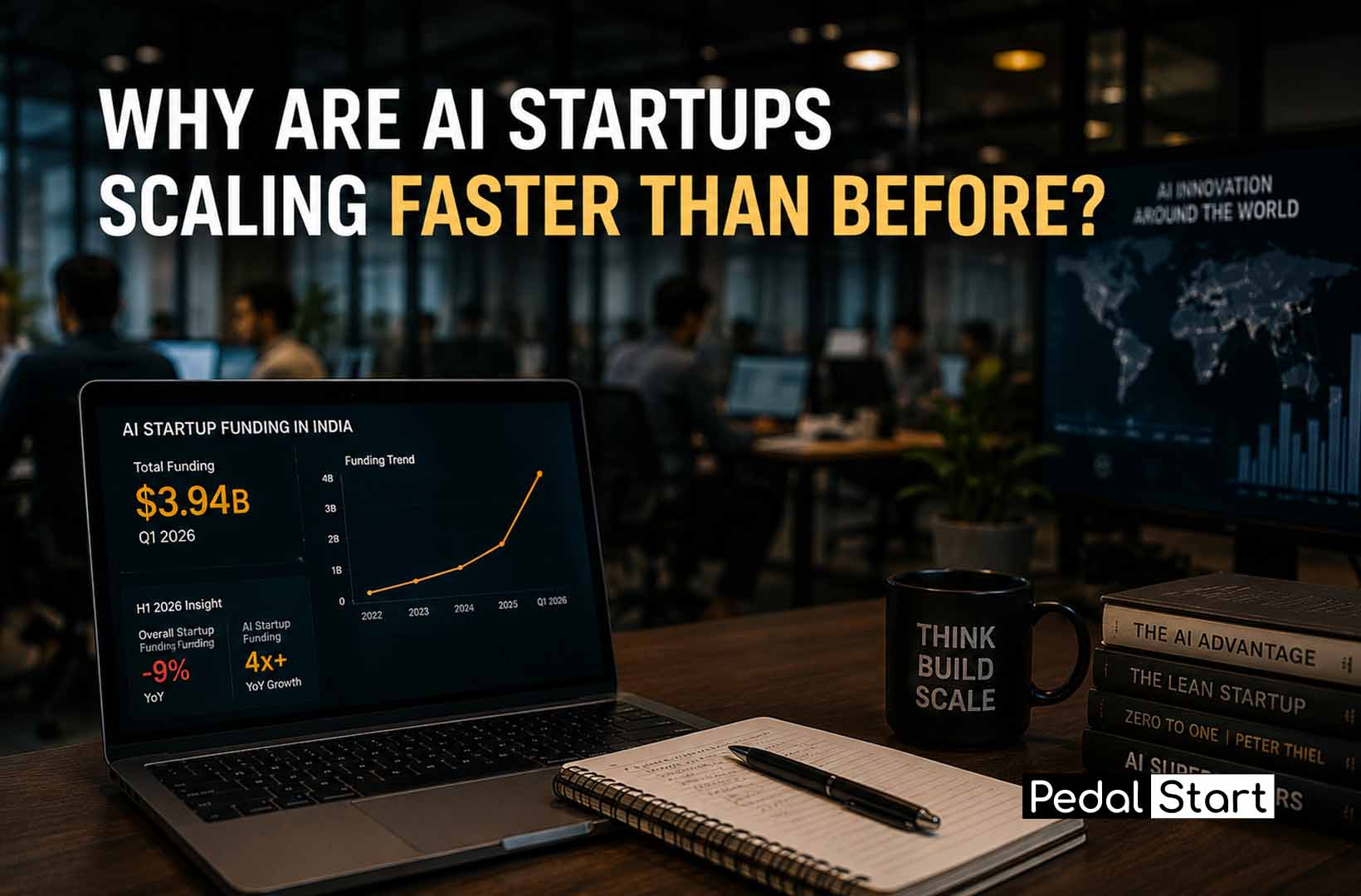
Indian AI startups raised roughly $3.94 billion in Q1 2026, close to six times the total for all of 2025.
AI funding grew more than 4x year on year in H1 2026, even as overall Indian startup funding fell about 9%.
Speed is the outcome of defensible technology, early revenue, and solving a problem large enough for enterprises and governments to pay for.
What is an AI startup?
An AI startup is a company that builds artificial intelligence into the core of its product, not as an add-on feature. The AI is the reason the product works. That could be a language model, a fraud-detection engine, or an infrastructure layer that runs other AI systems.
There is a useful distinction here. An "AI-native" company is built around AI from day one. An "AI-added" company bolts a feature onto an existing product. Investors in 2026 are paying close attention to which is which, because the AI-native ones tend to scale differently.
The startups making headlines in India, like Sarvam AI and Neysa, sit firmly in the AI-native camp. Their entire business is AI.
How fast are AI startups in India reaching unicorn status?

Very fast. In the first half of 2026, India's two AI unicorns reached the billion-dollar mark in under three years, while the sector's other new unicorns took between eight and twelve years, according to Tracxn data reported by Business Standard.
Here is how the two AI unicorns compare:
Startup | Unicorn date | Valuation | Round | Founded |
Neysa | February 2026 | ~$1.4B | ~$600M equity, Blackstone-led | 2023 |
Sarvam AI | June 2026 | ~$1.5B | $234M Series B, HCLTech-led | 2023 |
Neysa builds AI cloud and GPU infrastructure and was founded by serial entrepreneur Sharad Sanghi. Sarvam AI builds full-stack AI models for 22 Indian languages, serving banking, government, and telecom, and was founded by Vivek Raghavan and Pratyush Kumar.
Both went from founding to unicorn in a window that would have been hard to imagine for a consumer internet or fintech company a decade ago.
Key fact: Sarvam AI went from founding in August 2023 to a $1.5 billion valuation in under three years.
Why are AI startups scaling faster than before?
Three things are compressing the timeline: a surge of capital, the economics of AI-native businesses, and India's specific advantages.
Capital arrived first, and in volume. Indian AI startups raised roughly $3.94 billion in Q1 2026 alone, close to six times the total for all of 2025, based on figures reported by explainx.ai and IBTimes. Funding totals vary by tracker, but every source points in the same direction: money is flooding into AI while slowing elsewhere.
Key fact: Indian startup funding overall fell about 9% year on year in H1 2026, yet AI funding grew more than 4x.
The second driver is how AI-native companies are built. Modern AI tooling lets small teams build and ship faster, reach enterprise customers sooner, and show revenue earlier than previous startup generations. That is why investors are assigning premium valuations even to companies with early revenue.
The third driver is India itself. A deep engineering talent pool, government backing through the IndiaAI Mission, and demand for India-specific models (regional languages, local enterprise needs) give homegrown AI startups a market that global players do not serve as well.
How do AI startups make money?
AI startups make money mostly through recurring, usage-based revenue rather than one-time sales. The model scales because each new customer adds revenue without a matching jump in cost.
The common revenue models in 2026 look like this:
Enterprise contracts: selling AI systems to banks, governments, and large companies, often on annual deals.
API and usage-based pricing: charging per call, per token, or per unit of compute.
Vertical SaaS: software built for one industry, with AI as the core engine.
Infrastructure: renting out the compute and platforms that other AI companies run on, as Neysa does.
The infrastructure and enterprise models are drawing the biggest cheques right now, because investors see durable, defensible revenue rather than thin application-layer products.
Key fact: India had more than 1,700 AI-focused companies operating in 2026.
How are investors funding AI startups in India?
Investors are backing AI startups earlier and with more conviction, even as they pull back from the broader market. The funding environment in 2026 is running at two speeds.
On one side, late-stage mega-rounds have shrunk, and deal counts have fallen, as investors concentrate capital behind proven teams. On the other, early-stage and AI-focused cheques are growing. The result is a market that rewards clear evidence: defensible technology, real distribution, and disciplined unit economics.
For a first-time AI founder, that shift changes the game. Getting in front of the right investors early and being ready with proof rather than hype matters more than it did during the funding boom of 2021. This is where early-stage support structures earn their place. Founder-led accelerators such as PedalStart work with idea and pre-seed stage founders on exactly this part of the journey, from sharpening the pitch to opening access to an active investor network, which shortens the distance between a promising idea and a first cheque.
The takeaway for founders: the capital is there for AI, but it flows to those who can show why their approach holds up.
How do you start an AI startup in India?
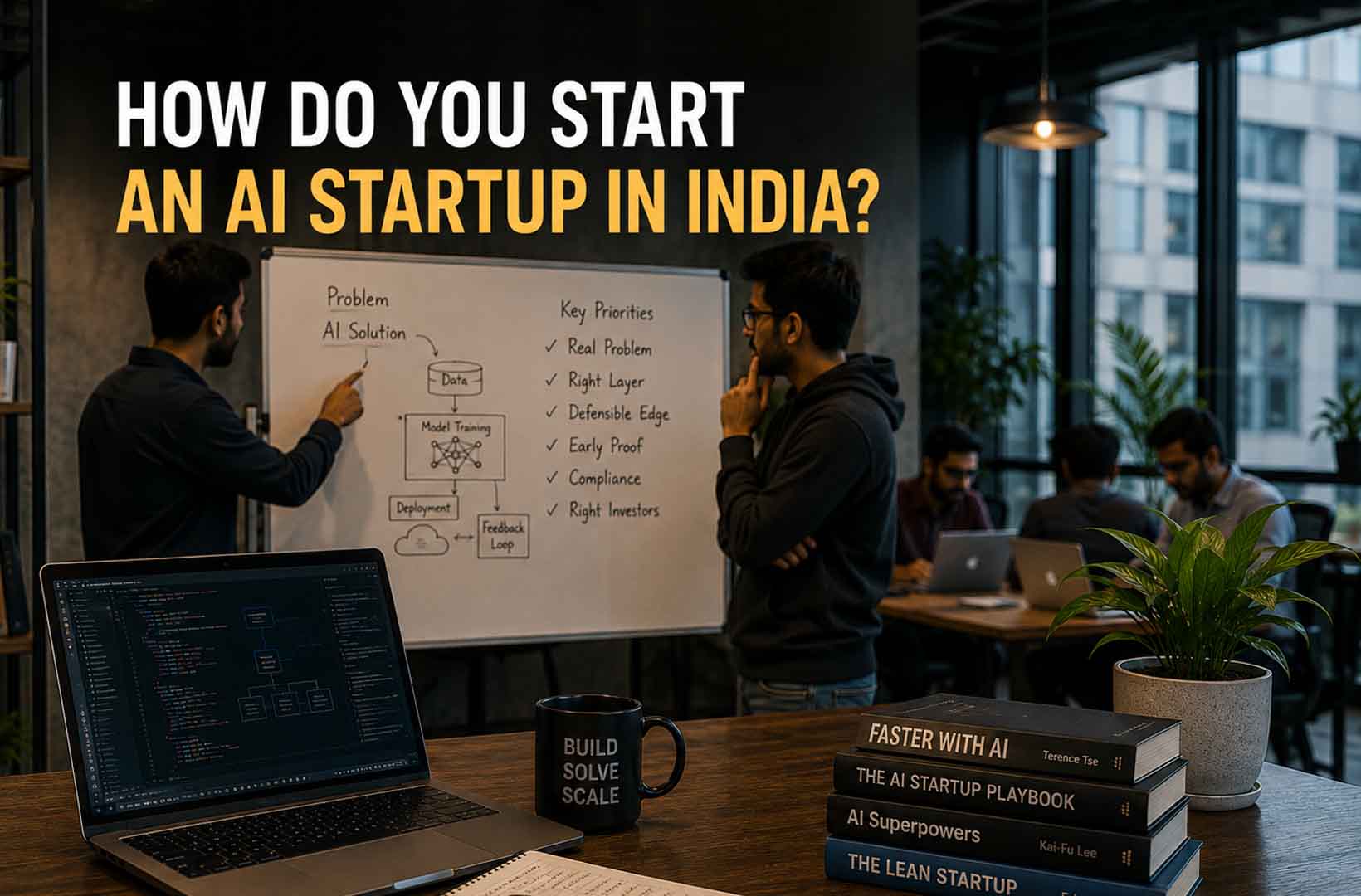
Starting an AI startup in India follows the same fundamentals as any startup, with a few AI-specific priorities layered on. Here is a practical sequence.
Find a real problem where AI is the best solution, not just a feature you can attach.
Decide your layer: are you building models, infrastructure, or an application on top of existing models? Investors treat these very differently.
Build a defensible edge. Proprietary data, a specific vertical, or India-specific capability (like regional languages) is harder to copy than a wrapper on a foreign model.
Get early proof. A paid pilot, real usage, or an enterprise letter of intent says more than a polished deck.
Sort out the basics: company registration, IP assignment, data privacy compliance, and clean records. These often decide if a deal survives due diligence.
Raise deliberately. Line up the right early-stage investors and enter conversations with evidence in hand.
The founders moving fastest are not skipping these steps. They are doing them in a tighter loop.
What this means for early-stage founders
The unicorn speed of 2026 is real, but it is worth reading it honestly. Two companies reaching billion-dollar valuations in under three years is remarkable, and also rare. Most AI startups will not follow that curve, and building for it can lead founders astray.
What the fast movers share is instructive. They built something defensible, they showed revenue or serious usage early, and they solved a problem that mattered enough for enterprises and governments to pay. Speed was the outcome, not the goal.
For a founder starting today, the lesson is not to chase a unicorn timeline. It is to build the kind of company that could earn one: clear problem, real edge, disciplined economics, and the right investors in the room at the right time.
India's AI moment is genuine. The founders who make the most of it will be the ones who treat the hype as a tailwind, not a strategy.
Frequently asked questions
What is an AI startup? An AI startup is a company that builds artificial intelligence into the core of its product, where the AI is the main reason the product works, rather than an added feature.
Which AI startups became unicorns in India in 2026? Neysa and Sarvam AI both became unicorns in the first half of 2026. Neysa reached a valuation of around $1.4 billion in February, and Sarvam AI reached around $1.5 billion in June.
How much did Indian AI startups raise in 2026? Indian AI startups raised roughly $3.94 billion in Q1 2026 alone, close to six times the full-year total for 2025. AI funding grew more than 4x year on year in H1 2026, even as overall startup funding declined.
How do AI startups make money? Most AI startups earn recurring revenue through enterprise contracts, API and usage-based pricing, vertical SaaS, or by providing the infrastructure other AI companies run on.
How can I invest in AI startups in India? Investors access early-stage AI startups through angel networks, syndicates, accelerators, and venture funds. Early-stage investing carries significant risk, so most investors diversify and back teams with defensible technology and clear revenue models.