
In the early days of building a startup, hiring feels like progress. A growing team signals momentum, credibility, and ambition. Founders often believe that expanding headcount accelerates execution.
But a thoughtful startup hiring strategy is less about growth and more about timing. Early hiring decisions Instead shape runway, culture, execution speed, and ultimately survival.
Building a company at the pre seed or seed stage is not about assembling a large organisation. It is about constructing a focused, adaptable lean startup team capable of learning faster than competitors.
The Hiring Too Early Trap

One of the most common patterns across early ventures is hiring in anticipation. Founders recruit marketing teams before confirming distribution channels, sales teams before defining positioning, or operations managers before operational complexity exists.
Research across venture backed startups shows that teams expanding aggressively within the first twelve months often experience higher burn without proportional traction improvement. The assumption that more people automatically translate into faster progress rarely holds true in uncertain environments.
Early-stage companies operate under evolving assumptions. Roles change frequently, strategies pivot, processes remain fluid, hiring too early locks startups into fixed cost structures when flexibility is still essential.
Effective early-stage team building begins with identifying constraints rather than ambitions. The question changes from “Who should we hire?” to “What problem cannot move forward without additional ownership?”
Until that answer becomes clear, founders themselves remain the most efficient operators.
First 5 Critical Roles in an Early-Stage Startup
The earliest hires define execution capability more than organisational hierarchy. These individuals often influence company trajectory far beyond their formal responsibilities.
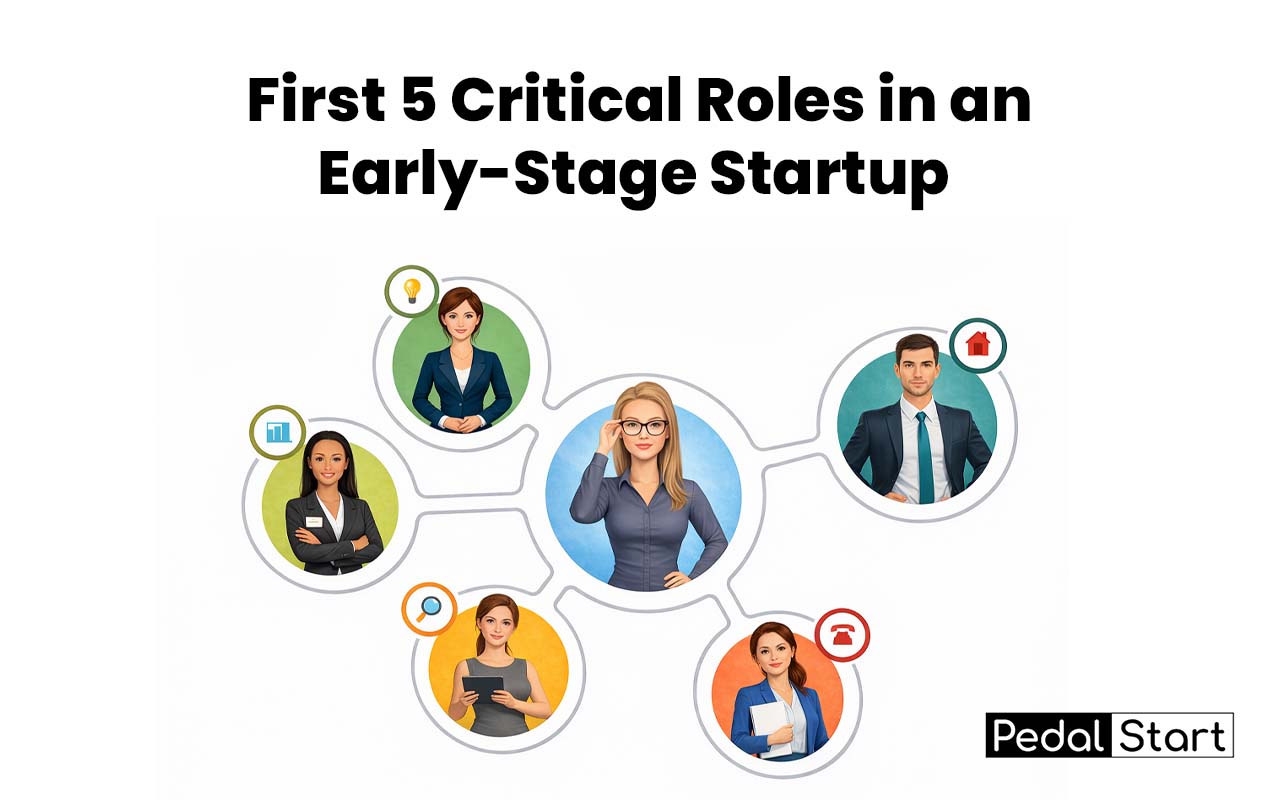
The first hires in startup environments typically fall into capability clusters rather than departments.
The first role usually strengthens product execution. Whether technical or operational, this hire helps translate founder vision into something customers can consistently use.
The second critical addition supports customer acquisition or revenue generation. At early stages, learning from real users matters more than scaling outreach volume. Someone capable of speaking directly with customers accelerates feedback cycles.
The third role often addresses delivery reliability. As early customers onboard, maintaining product experience becomes essential to retention.
Finance or operations ownership usually emerges later than founders expect but earlier than they plan. Even simple financial discipline improves decision quality.
Finally, startups benefit from hiring individuals who reduce founder bandwidth pressure rather than replicate founder skills. The objective is leverage, not duplication.
Generalists vs Specialists: What Works Better?

Large companies optimise through specialisation whereas startups survive through adaptability.
At early stages, generalists consistently outperform narrow specialists because problems are undefined. One week may require customer onboarding, another pricing experimentation, and another partnership outreach.
A generalist operator comfortable navigating ambiguity often delivers disproportionate impact within a lean startup team. They connect functions rather than optimise isolated tasks.
Specialists become valuable once repeatability emerges. When acquisition channels stabilise or product architecture matures, depth begins outperforming flexibility.
Balanced hiring evolves over time. Early adaptability eventually transitions into domain expertise.
Managing Burn Rate While Building a Team
Hiring decisions directly influence survival timelines. Payroll typically becomes the largest recurring expense for early-stage startups, making disciplined startup burn rate management essential.
Runway is not merely financial duration. It represents learning time. Every hiring decision either extends or reduces the opportunity to discover product market fit.
Many founders now adopt hybrid hiring models during early growth phases. Contract specialists, fractional leaders, and project-based contributors allow startups to access expertise without long term financial commitments.
This approach maintains operational agility while preserving capital for experimentation.
Global venture data from 2025 indicates that capital efficient startups increasingly delay full time executive hiring until revenue predictability improves. Instead, founders prioritise flexible engagement structures aligned with milestones.
Hiring for Culture and Execution Speed

Culture in early startups is rarely defined by mission statements. It is shaped by behaviour under pressure.
The earliest team members determine how decisions are made, how conflicts are resolved, and how accountability functions when uncertainty rises. Skills matter, but execution temperament matters more. Early hires must operate comfortably without structured processes. They should demonstrate ownership, speed of learning, and willingness to work across undefined boundaries.
Execution speed often becomes a competitive advantage at the startup stage. Smaller teams capable of rapid decision making consistently outperform larger but slower organisations.
Strong early-stage team building therefore prioritises individuals who combine competence with curiosity.
As venture capitalist Ben Horowitz observed in The Hard Thing About Hard Things, companies rarely fail because of lack of intelligence. They struggle when teams cannot execute under uncertainty.
Hiring decisions ultimately determine whether execution accelerates or slows the momentum.
A well-designed startup hiring strategy recognises that early success depends less on scale and more on alignment between people, stage, and learning objectives. Founders who delay unnecessary hiring, prioritise adaptable operators, and maintain disciplined startup burn rate management create longer experimentation windows.