

Equity is not the only way to fund a startup. In a tighter funding market, more founders are reaching for the alternative: venture debt.
The shift is real and measurable. India's venture debt market reached about $1.23 billion in 2024 and grew to roughly $1.38 billion in 2025, even as equity funding tightened, as founders look for capital that does not cost them ownership.
But it is not free money, and it is not right for every startup. This guide covers what it is, how it works in India, what it costs, and the part most guides skip: when it actually makes sense, and when it quietly becomes a problem.
What is venture debt?
Venture debt is a loan made to a startup that has already raised institutional venture capital. Instead of selling more equity, the founder borrows money and repays it with interest, keeping ownership largely intact.
It sits between a bank loan and an equity round. A bank will rarely lend to a young, unprofitable startup with no hard assets. A venture debt lender will, because they underwrite the loan against the startup's growth and the strength of its existing investors, not against collateral.
The trade is simple. You keep your equity, but you take on a repayment obligation and, in most cases, hand the lender a small equity sweetener called a warrant.
How does venture debt work in India?

Venture debt in India is structured as a term loan, repaid over 18 to 36 months, at an interest rate commonly in the 13 to 15% range. It comes from specialised lenders, not regular banks.
Feature | What to expect in India |
Structure | A term loan, not a line of equity |
Tenure | 18 to 36 months |
Interest rate | Commonly around 13 to 15% per year |
Equity impact | Small, through warrants |
Provided by | NBFCs and Category II AIFs, not traditional banks |
Prerequisite | A prior institutional equity round |
A few features define how it behaves:
Interest and moratorium. You pay interest across the term, often after a short interest-only period before principal repayment starts.
Warrants. The lender gets the right to buy a small slice of equity later, which compensates them for lending without collateral. This is the one place venture debt touches your cap table.
Timing. It is best raised soon after an equity round, when investor confidence and the company's cash position are strongest.
Who provides it. In India, it comes mainly from RBI-registered NBFCs and SEBI-registered Category II AIFs, not from high-street banks.
Venture debt vs equity
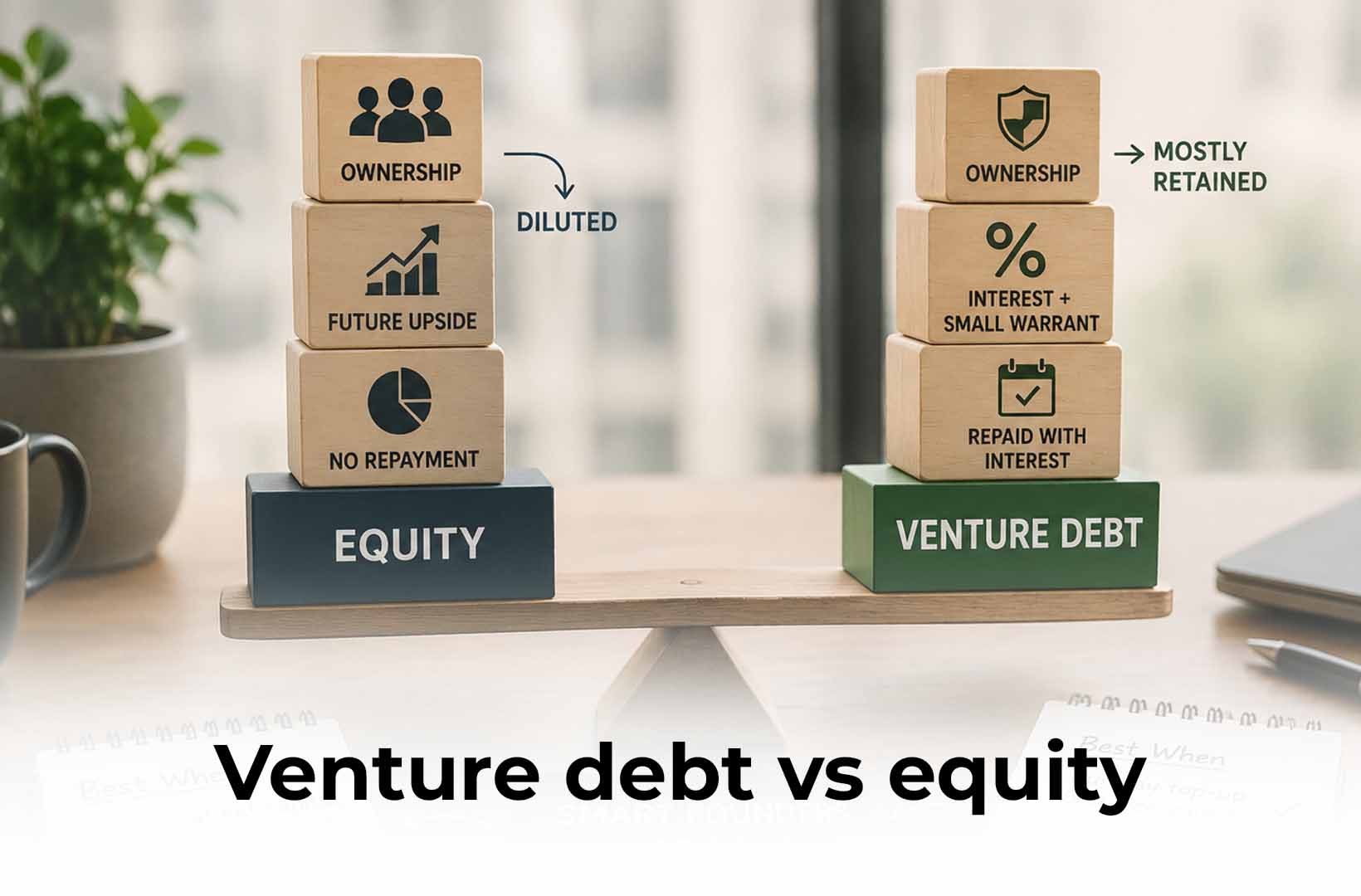
The core difference is simple. Equity is money you never repay but pay for with ownership. Venture debt is money you repay but keep ownership.
Equity | Venture debt | |
Repayment | None | Repaid with interest |
Ownership | Mostly retained | |
Cost | A share of all future upside | Interest, plus a small warrant |
Best when | You need large, patient capital | You need a runway top-up between rounds |
Requires | A compelling growth story | A prior equity round and a path to the next |
Most founders do not choose one or the other. They use equity as the foundation and venture debt as a top-up, to stretch runway without selling more of the company.
Because it needs a prior institutional round, this financing is not first-cheque money. Founders raise their initial equity through angel networks and accelerators first, the kind of early support PedalInvest, PedalStart's angel network, provides, and only layer on debt once that foundation and a clear next round are in place.
When does venture debt make sense, and when is it a trap?
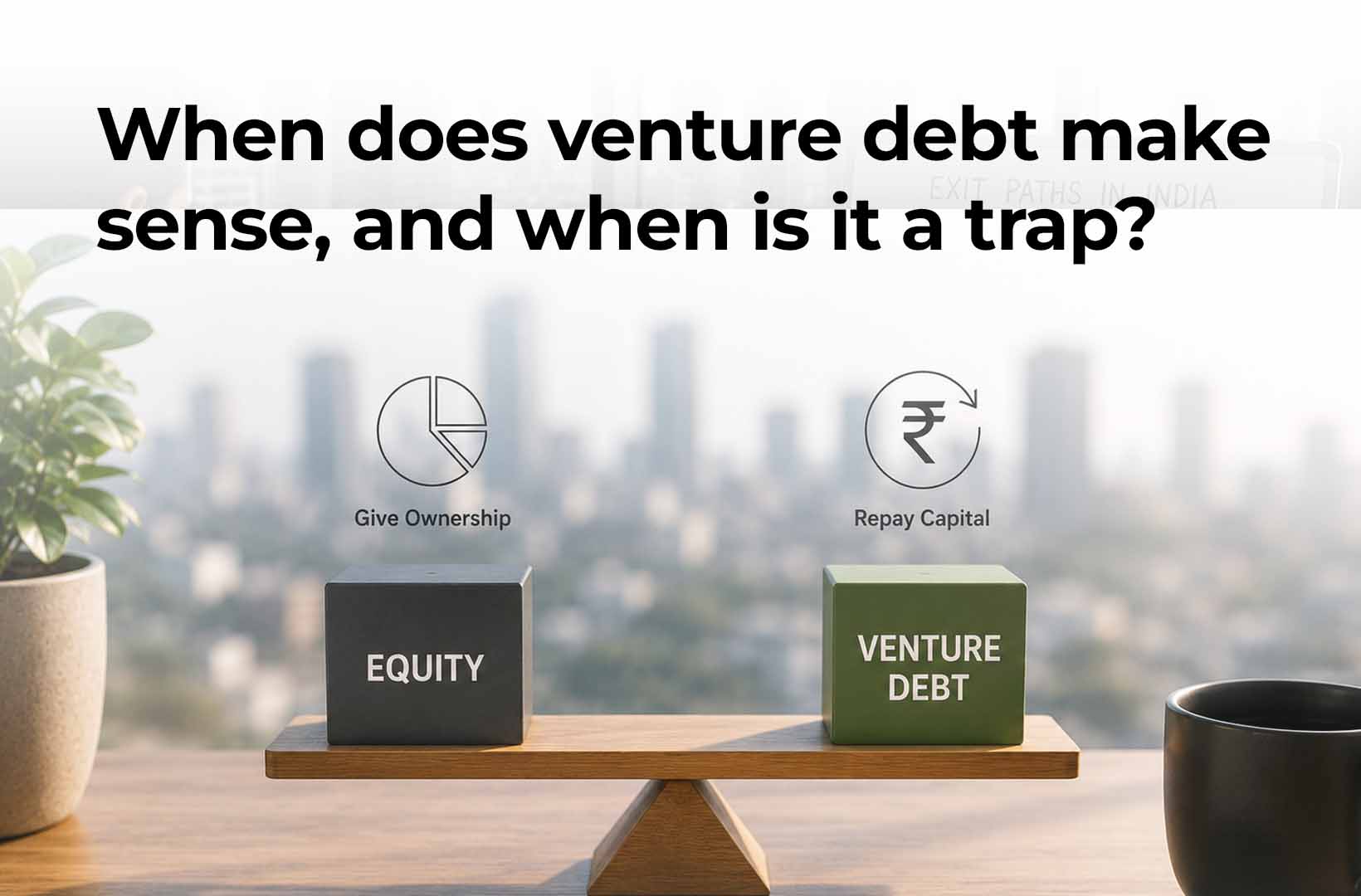
Venture debt makes sense when you have a clear, near-term reason to need cash and a credible way to repay it. It becomes a trap when you use it to survive rather than to grow.
It makes sense when you want to:
Extend your runway to hit a milestone before your next equity round, so you can raise at a higher valuation.
Bridge to a round you are confident is coming.
Fund working capital, inventory, or capex without diluting.
Reduce or avoid a down round in a difficult market.
This matches how founders in India actually use it. Industry data shows the most common uses are working capital and runway extension, with a rising share using it as a pre-IPO bridge.
It becomes a trap when:
You are borrowing to delay a shutdown, not to reach a milestone. Debt does not fix a broken business. It adds a repayment you cannot make.
You have no clear next round. It is repaid out of future funding or revenue. With no line of sight to either, the repayments will choke your cash flow.
You ignore the covenants and warrants. Miss a covenant and the lender can call the loan. Stack too many warrants across rounds and the dilution you tried to avoid comes back anyway.
The honest test is this. If venture debt buys you time to become more valuable, it is a tool. If it only buys you time, it is a liability.
Who provides venture debt in India?
Venture debt in India comes from specialised lenders, not high-street banks. They fall into two regulated buckets: RBI-registered NBFCs and SEBI-registered Category II AIFs that focus on startup lending.
Rather than hunting for a single "best" lender, match the lender to your situation. What to evaluate:
Stage and sector fit. Lenders specialise. One that understands SaaS subscription revenue is very different from one that understands consumer inventory cycles. A lender who knows your model underwrites faster and sets more reasonable covenants.
Terms beyond the headline rate. Look at the warrant coverage, the moratorium, the covenants, and what happens if your next round slips.
Track record with companies like yours. A lender who has backed startups at your stage will not panic at normal business volatility.
The right lender is the one whose focus matches your stage, your sector, and the specific capital gap you are filling.
Can you invest in venture debt?
Yes, but mostly at an institutional or high-net-worth level. Venture debt funds are structured as SEBI-registered Category II AIFs, which carry a ₹1 crore minimum commitment and are aimed at accredited and institutional investors, not retail.
For most individuals, this route is out of reach. The more accessible route to startup exposure remains equity, through the channels covered in our guide on how to invest in startups in India.
Closing note
Venture debt has earned its place in the Indian founder's toolkit, and used well, it does something equity cannot. It buys you time and growth without costing you a bigger slice of your company. But it rewards discipline, not desperation. Raise it when you have a milestone to hit and a clear way to repay, treat the warrants and covenants as seriously as the interest rate, and it becomes one of the cleaner ways to fund your next stage. Borrow it to outrun a problem, and it only follows you home.
Key takeaways
Venture debt is a loan for VC-backed startups that lets them raise capital without giving up much equity.
In India it runs 18 to 36 months at about 13 to 15%, plus a small warrant, from NBFCs and Category II AIFs.
It makes sense to extend runway or bridge to a round you can see coming. It is a trap when used to delay a shutdown.
It requires a prior institutional equity round, so it is not first-cheque money.
Match the lender to your stage and sector, and read the covenants and warrants, not just the interest rate.
Frequently asked questions
What is venture debt in simple terms? It is a loan for startups that have already raised venture capital, letting them get cash without giving up much ownership.
How much does venture debt cost in India? Interest is commonly around 13 to 15% per year, plus a small equity warrant for the lender.
Who can raise venture debt? Startups that have already raised an institutional equity round and can show a path to the next round or to real revenue.
Is venture debt better than equity? Neither is better. They solve different problems. Equity funds large, patient growth, while venture debt tops up runway without dilution.
Can retail investors invest in venture debt? Rarely. Venture debt funds are Category II AIFs with a ₹1 crore minimum, aimed at institutional and accredited investors.