

Every investor who puts money into a startup asks the same question sooner or later: how do I get it back? That is what an exit strategy answers. For founders, it is the endgame that quietly shapes how the company is built. For investors, it is the only point where a paper gain becomes real money.
Exits in India are having a moment. Startup exit value reached $26.7 billion in 2024, the highest since 2021, and venture investors booked almost $2 billion from IPO exits alone in 2025 through listings like Groww, Lenskart, and Urban Company. Knowing your options and which one fits your situation matters more now than it has in years.
This guide explains how to exit a startup investment. It covers each option and how to choose the right one. It also explains what exits look like in India today.
What is a startup exit strategy?
A startup exit strategy is a plan for how founders and early investors will eventually sell their ownership and turn it into cash. It defines the route to a liquidity event, the moment equity on paper becomes money in the bank.
Every startup ends in one of a few ways. It gets acquired, it goes public, its shares change hands privately, or it winds down. An exit strategy is deciding, in advance, which of those you are building toward, then preparing the company so that path stays open.
What are the ways to exit a startup investment?
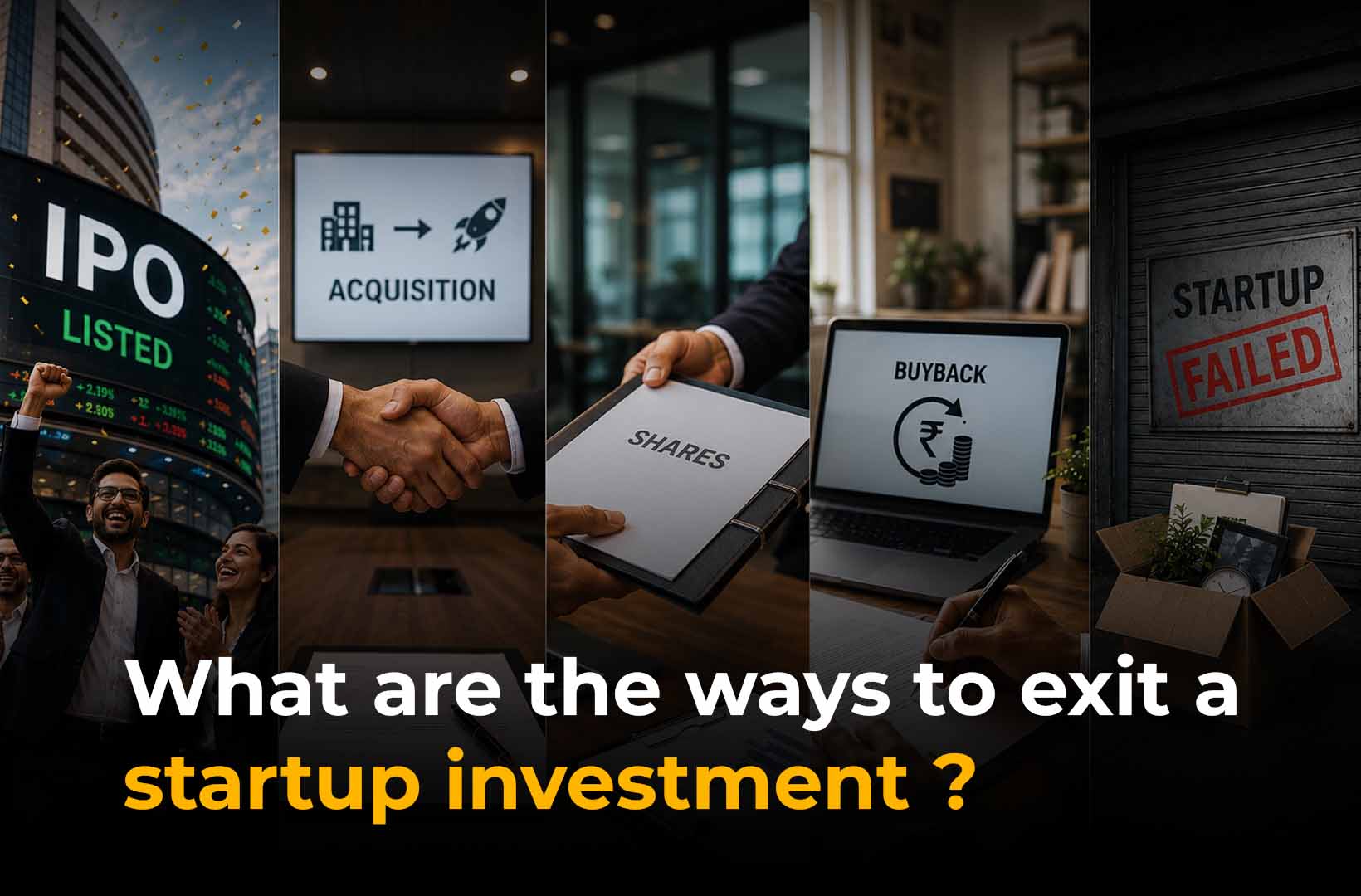
There are five main ways to exit a startup investment: an IPO, an acquisition or merger, a secondary sale, a buyback, and, in the worst case, a write-off. Most exits happen through acquisitions and secondary sales, not the headline-grabbing IPO.
Exit method | How it works | Best suited for |
IPO (public listing) | The company lists shares on a public exchange like the NSE or BSE, and investors sell into the market | Large, high-growth startups ready for public scrutiny |
Acquisition or merger (M&A) | A bigger company buys or merges with the startup; investors receive cash or acquirer stock | The most common exit; startups with strategic value to a buyer |
Secondary sale | An investor sells private shares to another investor or fund before any formal exit | Early investors and employees who want partial liquidity sooner |
Buyback | The company or founders repurchase shares, including ESOP buybacks | Profitable startups giving early holders liquidity without a full exit |
Write-off or liquidation | The startup fails; assets are sold, and investors recover salvage value, often little or nothing | The failure case, and statistically the most common outcome |
Two points deserve emphasis. First, IPOs get the headlines, but most venture-backed exits worldwide are acquisitions, not public listings. Second, the write-off is the most common outcome by count, since the majority of startups do not survive. A realistic exit strategy plans for both the upside and the downside.
Which startup exit strategy is right for you?
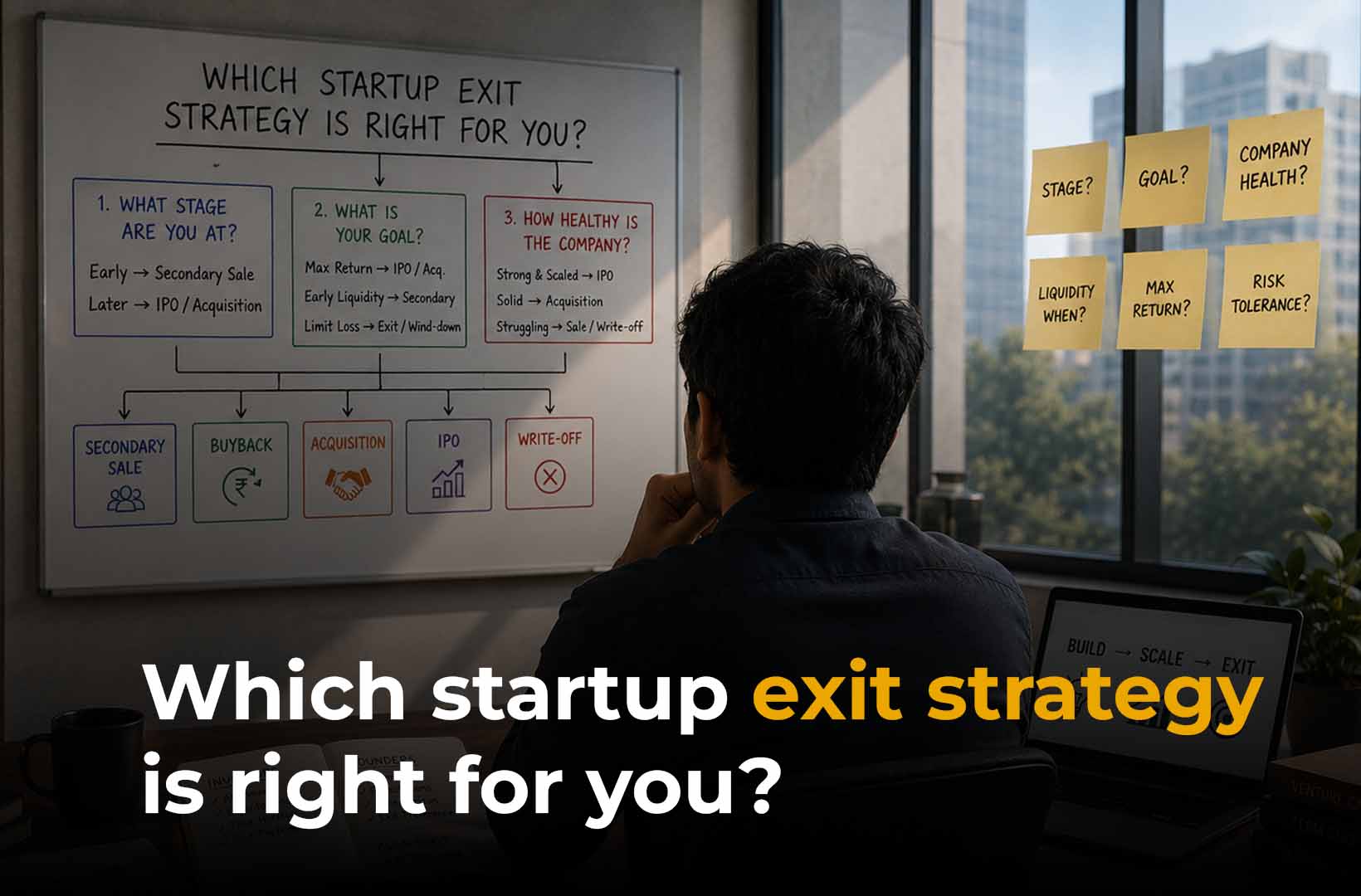
The right exit strategy depends on your stage, your goals, and how the company is performing. Early investors often favor secondary sales for earlier liquidity, while founders and later investors lean toward an IPO or acquisition once the company has real scale.
Three questions decide it:
What stage are you at? Early backers may not want to wait 8 to 10 years for an IPO, so a secondary sale to a later-stage fund gives them liquidity sooner. Founders and late-stage investors are closer to a full exit and can hold out for an IPO or acquisition.
What is your goal? Maximum return points toward an IPO or a competitive acquisition. Early or partial liquidity points toward a secondary sale or a buyback. Limiting a loss points toward a quick sale or a clean wind-down.
How healthy is the company? Only strong, scaled companies can realistically IPO. A solid but unspectacular company is a natural acquisition target. A struggling one may face only a distressed sale or a write-off.
This is also why the investors you take on early matter. Founder and investor expectations about the exit should match from the first check. Misalignment can cause years of friction. Aligning early is part of what cohort-based programs like PedalStart help founders with, by connecting them to investors who fit their stage and giving structured support before those relationships are locked in.
Startup exit strategy examples in India
The best way to understand these options is through real examples. India has shown them all, from record public listings to one of the country’s largest acquisitions.
Acquisition (M&A): Walmart's roughly $16 billion purchase of a majority stake in Flipkart in 2018 remains the textbook Indian M&A exit, and one of the largest anywhere in the world. Earlier, PayU's $4.7 billion acquisition of BillDesk in 2021 gave its backers a major cash exit.
IPO: In 2025, listings including Groww, Lenskart, Urban Company, and Pine Labs handed investors such as Peak XV, Accel, Tiger Global, and Elevation strong returns, collectively unlocking over ₹40,000 crore in liquidity. Back in 2021, Zomato's $1.3 billion market debut and Paytm's $2.5 billion IPO showed the same path at scale.
Secondary sale: Alongside those 2025 listings, investors including Peak XV, Accel, and Elevation reportedly cashed around $1.5 billion through secondary share sales, selling part of their stake to other investors rather than waiting for a full exit.
These examples fit the five methods above. They show that in India, the same company can create liquidity in more than one way.
What do startup exits look like in India right now?
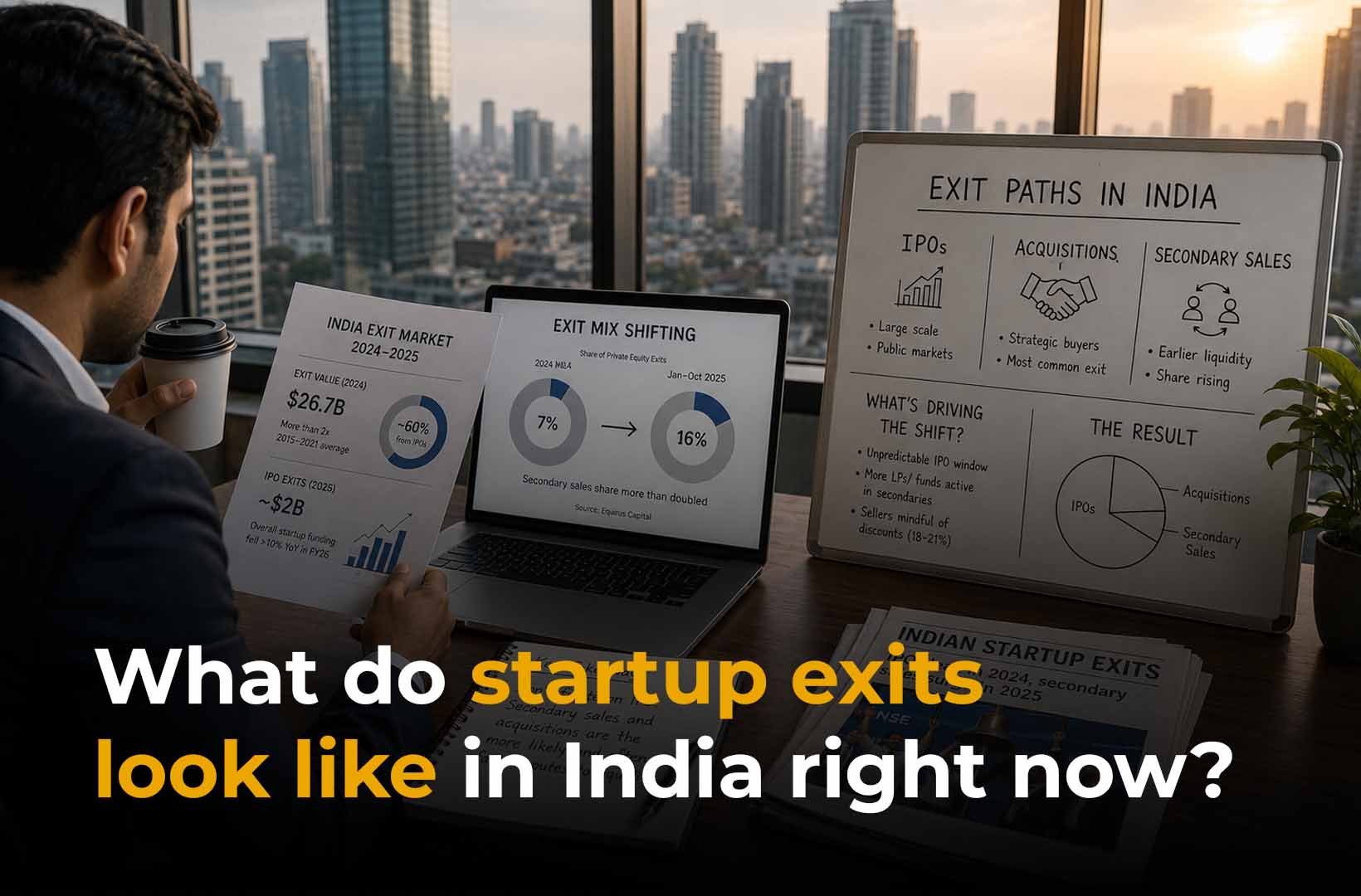
India’s exit market rebounded sharply in 2024 and stayed active through 2025. IPOs led at first, with secondary sales growing later. The mix is shifting as the IPO window becomes less predictable.
The scale of the rebound was real. Exit value hit $26.7 billion in 2024, more than twice the 2015 to 2021 average, with close to 60% of that coming from IPOs. In 2025, venture investors booked almost $2 billion from IPO exits, even as overall startup funding fell more than 10% year on year in FY26.
Secondary sales are the story to watch. Their share of private equity exits more than doubled. It rose from 7% in 2024 to 16% in the first ten months of 2025. This is according to Equirus Capital. A separate EY study of around 650 funding rounds found that secondary sales do not always happen at a steep discount, with average discounts sitting in the range of 18 to 21%, which makes them more attractive to sellers than many founders assume.
The takeaway for anyone planning an exit in India: do not fixate on the IPO. For early investors and employees, secondary sales and acquisitions are the more likely and often faster routes to liquidity.
Key takeaways
A startup exit strategy is a plan to turn equity into cash. This can happen through an IPO, acquisition, secondary sale, buyback, or write-off.
Acquisitions and secondary sales, not IPOs, account for most real-world exits.
The right choice depends on your stage, your goal, and the company's health. Early investors lean toward secondaries; founders and late investors lean toward IPOs and M&A.
India's exit value hit $26.7 billion in 2024, and secondary sales are the fastest-growing route to liquidity.
Plan for the downside too. A write-off is statistically the most common outcome for any single startup.
Frequently asked questions
What is the most common startup exit strategy? Acquisition. Globally, most venture-backed startups that exit successfully do so through acquisition, not an initial public offering. Counting all startups, the most common outcome is actually a write-off, since most do not survive.
How long does a startup exit take? It varies by route. The IPO process alone takes about 12 to 18 months, from the decision to the listing. The full journey, from first investment to exit, often takes 7 to 10 years. A secondary sale can happen much faster because it does not need a company-wide event.
What is a secondary sale in a startup? A secondary sale happens when an investor or employee sells private shares to another investor. This occurs before an IPO or acquisition. It provides partial liquidity without the company itself having to exit.
Can early investors exit before an IPO? Yes. Early investors, including angel investors, commonly exit through a secondary sale to a later-stage fund, or through a share buyback, well before any public listing.
What happens to my investment if the startup fails? The investment is written off in most cases. Any remaining assets are liquidated, and investors recover only the salvage value, which is often little or nothing. This is why exit planning includes preparing for the downside.