
The fastest way to get your first customers is to pick the smallest group of people you can serve unreasonably well, and go to them directly. Not a city. Not a segment. A specific set of people who already talk to each other.
Most advice on this points at Airbnb photographing apartments or Stripe onboarding users by hand. Useful stories, but distant ones. You are not a Silicon Valley company with a waiting press cycle. You are a founder in Bengaluru or Pune with a product, no budget, and nobody who has heard of you.
So this guide uses two Indian startups that crossed 100 paying customers recently, both from the PedalStart portfolio, and both without a marketing budget. Their playbooks are different. The underlying move is the same.
Key takeaways
Narrow the geography before you widen it. One dense cluster beats an entire city.
Aim for 10 delighted customers in one place, not 100 indifferent ones spread thin.
Iztri got its first 100 customers from four apartment buildings on one road.
UpKraft ran more than 150 free demo classes before selling anything, and now converts 31% of leads to paid.
Word of mouth only compounds where people already talk to each other.
How do startups get their first customers?
Startups get their first customers through direct, manual, founder-led effort in a tightly defined place, not through advertising or broad launches. At this stage, you are looking for evidence that a small group of people wants what you built enough to pay for it.
The work looks unscalable because it is. That is the point. You are buying information and trust, and both are expensive early.
Three things separate founders who get there from founders who stall:
They pick a specific group rather than a broad market. They go to those people in person or through a channel those people already trust. And they over-deliver on the first few customers, because those customers become the distribution.
Why is getting your first customer so hard?
The first customer is hard because you have no proof, and proof is what people buy on. This creates a loop: nobody trusts you because you have no customers, and you have no customers because nobody trusts you.
That loop is real, and it is not a reflection of your product.
Three other reasons come up repeatedly in founder communities:
Building feels safer than selling. Shipping in silence is comfortable. Asking someone to pay is not. So founders add features and postpone the conversation that would tell them if any of it matters.
The product does not sell itself. A better product does not generate its own demand. Someone still has to find out it exists, understand it, and be convinced to switch.
The question is often wrong. Founders ask where to find customers before they have decided who those customers are. The where becomes obvious once the who is specific.
How did Iztri get its first 100 customers from four buildings?
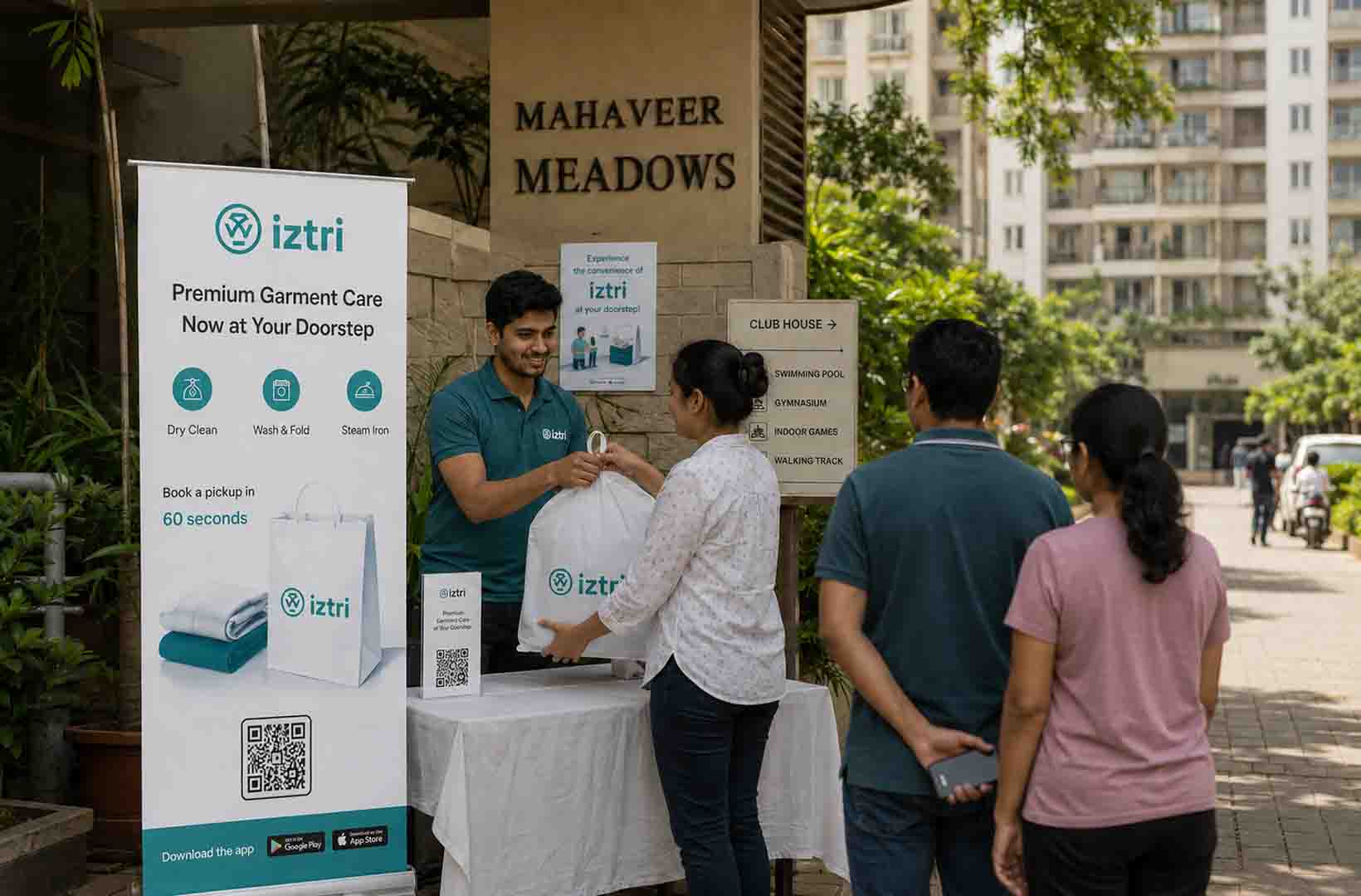
Iztri got its first 100 paying customers from four apartment societies on a single stretch of Bannerghatta Road in Bengaluru, by targeting density instead of coverage.
Iztri runs doorstep garment care. Founder Rohit Ramesh had the option to launch across the city. He did the opposite and shrank the map to a 3.5-kilometre stretch, then looked for apartment societies with 400 to 500 units each, the kind of buildings where residents share a WhatsApp group and talk to their neighbours.
The target was never 100 customers. It was 10 happy customers per building.
Pre-launch was deliberately simple: a stall and a standee inside each society, a day or two before going live. Day one brought a handful of orders.
What happened next is the part worth copying. Those first orders were prioritised and delivered in two to three hours.
That speed became the marketing. It started conversations in the society WhatsApp groups, and in a closed community, those conversations travel fast. Each building began sending 25 to 30 customers. The first 100 came from four apartments.
Only then did Iztri expand, first to more dense societies, and later to scattered demand across the city.
Today more than 90% of Iztri's orders are delivered same-day, and over 60% of orders each month come from repeat customers.
How did UpKraft get its first customers without pitching?

UpKraft got its early customers by running more than 150 free demo classes before selling anything, then letting parents in the same residential clusters recommend the service to each other.
UpKraft brings extracurricular classes to children at home. Founder Tejasvi Kushwah picked four Bengaluru clusters, Whitefield, Varthur, Hebbal, and Bannerghatta, and did something that reads as inefficient on a spreadsheet.
The logic holds up when you consider what is being sold. A parent does not hand over their child's time to an unknown teacher because of a well-written ad. They need to watch one class, see how the teacher handles their child, and hear from another parent who has already tried it.
So the demo did the selling, and the parent network did the distribution.
UpKraft onboarded 200+ paying learners in roughly two months, at a 31% lead-to-paid conversion rate.
That conversion number is unusually high for a consumer service, and it traces back to a simple sequence: demonstrate, earn trust, then ask
What do both playbooks have in common?
Both founders had the option to go broad and chose to go narrow. That is the whole pattern.
Iztri | UpKraft | |
Business | Doorstep garment care | Doorstep extracurricular classes |
Geography | One 3.5 km stretch, four societies | Four Bengaluru clusters |
The unreasonable thing | 2 to 3 hour delivery on first orders | 150+ free demo classes |
Distribution channel | Society WhatsApp groups | Parent networks |
What was earned first | Proof of speed | Proof of trust |
Three principles sit underneath both.
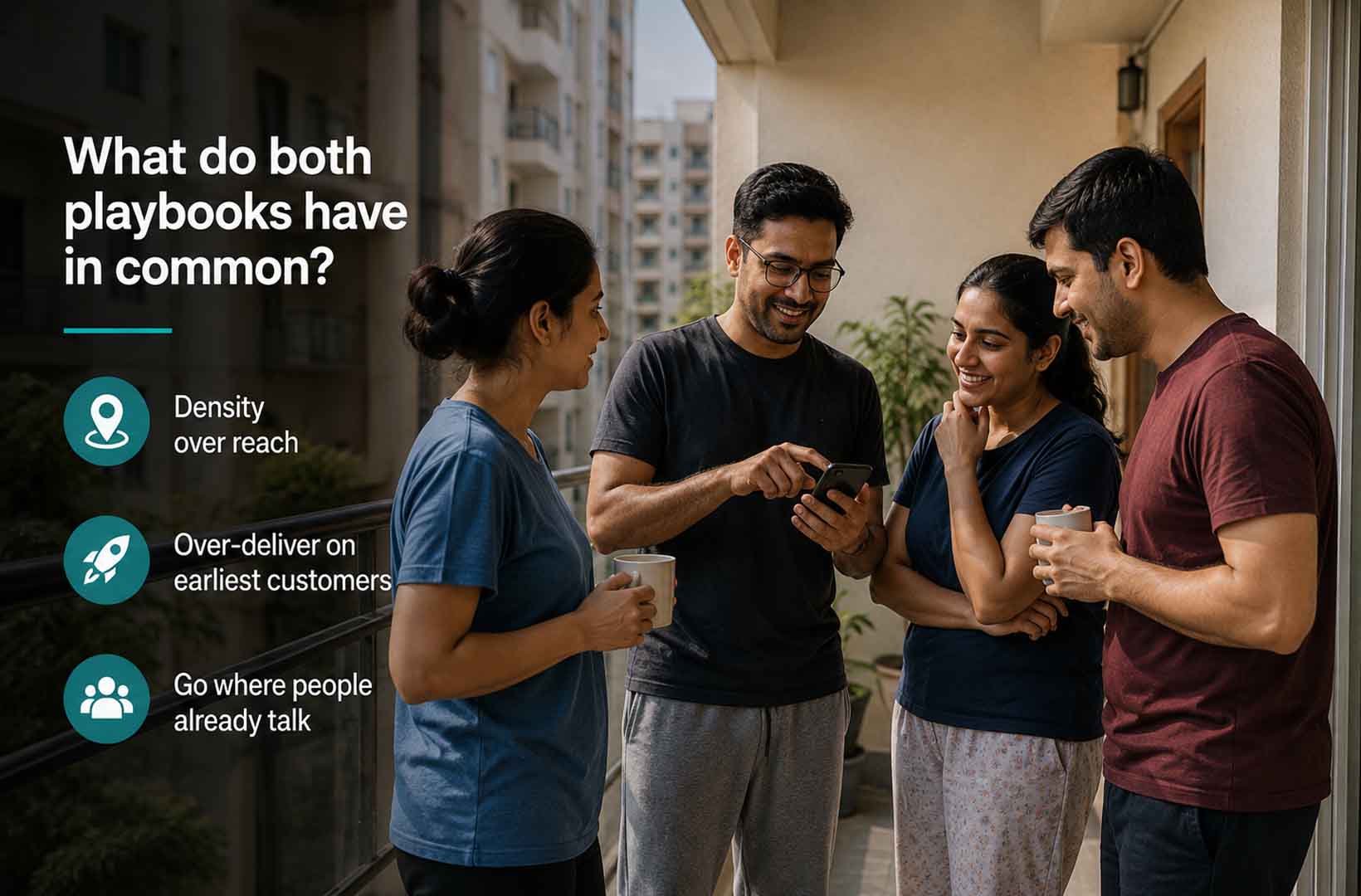
Density over reach. Both picked territory small enough to dominate rather than large enough to sound impressive. Ten customers in one building is a foothold. Ten customers scattered across a city is noise.
Over-deliver on the earliest customers. Iztri spent its effort on delivery speed. UpKraft spent it on free classes. Both understood that the first few customers are not revenue; they are marketing.
Go where people already talk. A society WhatsApp group and a parent network are closed communities with existing trust. One good experience travels on its own. The same effort spread across strangers produces nothing.
Where should you look for your first customers?
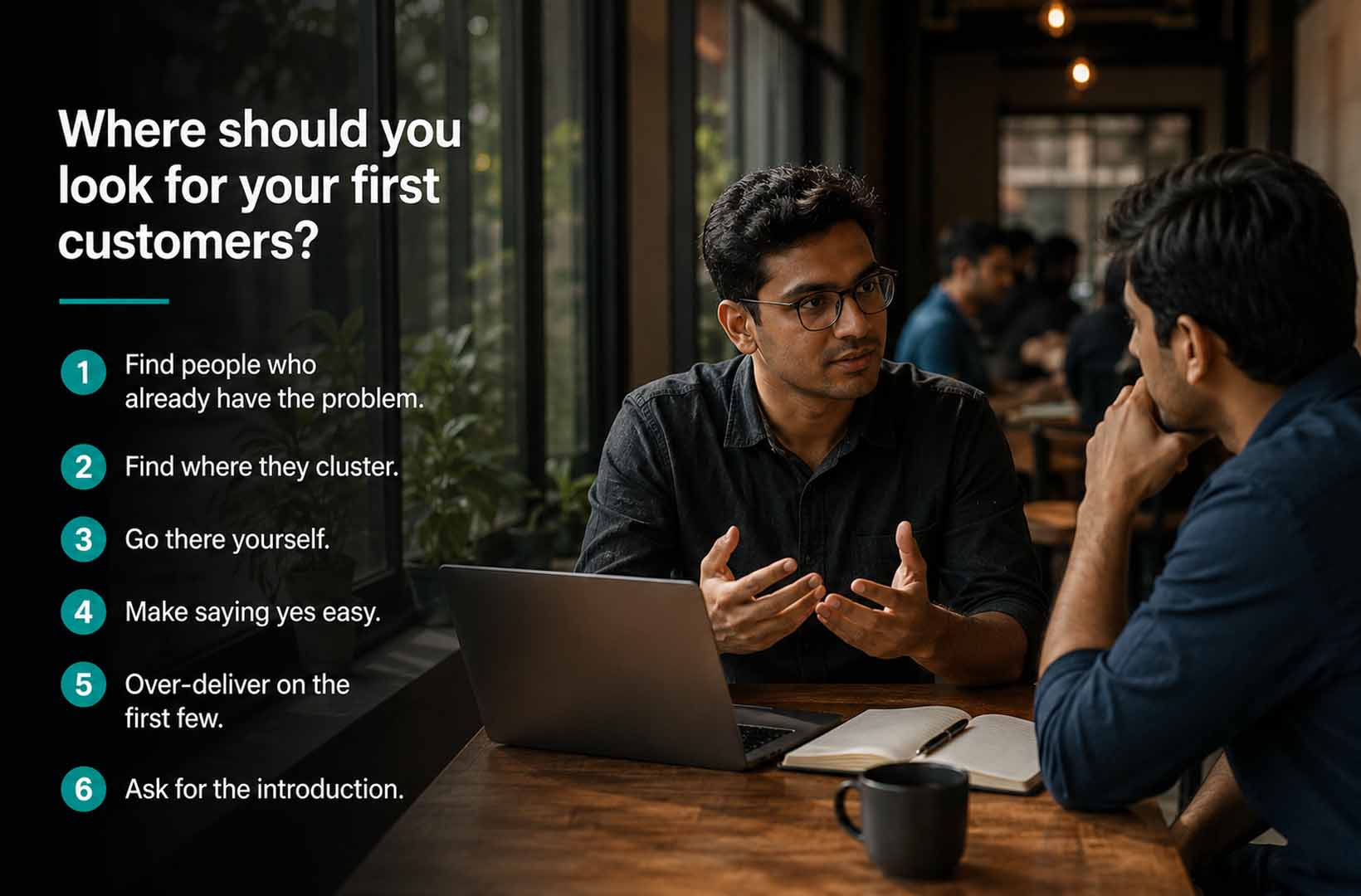
Start with people you can reach without permission or budget, then narrow until the group is small enough to serve properly.
List who already has the problem. Not who might benefit. Who is actively working around it right now, with a spreadsheet, a WhatsApp group, or a manual process.
Find where those people cluster. A physical location, an online community, a professional network, a building. Density matters more than size.
Go there yourself. Founder-led, in person or in conversation. Do not delegate this and do not run ads yet. You are gathering information as much as revenue.
Make saying yes easy. A free trial, a demo, a pilot, a first order at cost. Lower the risk of trying you.
Deliver beyond expectation on the first few. This is where your effort should be concentrated, not spread evenly across everyone.
Ask for the introduction. In a closed community, a satisfied customer is your cheapest and most credible channel.
How many customers do you need before you scale?
Enough to see the same behaviour repeat. In practice, that means around 10 customers who are genuinely happy, in one place, who came to you through a path you can describe and run again.
The number matters less than the repeatability. One hundred customers acquired through a hundred different accidents tells you nothing. Ten acquired the same way tells you what to do next.
Iztri did not expand to new areas until the four-building model was working. UpKraft did not add clusters until the demo-to-paid sequence held. Both scaled a proven motion rather than searching for one at scale.
What stops founders from getting their first customers?
Launching everywhere at once. Spreading thin across a city means nobody hears about you twice, and word of mouth never reaches critical mass.
Treating early customers like ordinary customers. The first ten deserve disproportionate effort. They are the ones who will tell other people.
Waiting for the product to be ready. The conversation that tells you if anyone wants this should happen before the product is finished, not after.
Delegating sales too early. Nobody understands the product like the founder, and nobody learns faster from a rejection.
Choosing a channel before choosing a customer. Deciding to "do Instagram" or "run ads" before knowing exactly who you are talking to leads to spending with nothing to show for it.
Frequently asked questions
How do you get your first customers with no money? Go to a small, dense group of people who already have the problem and reach them directly, in person or through a community they already trust. Iztri used a stall inside apartment societies. UpKraft used free demo classes. Neither required a marketing budget.
How long does it take to get your first 100 customers? It varies by business, though a concentrated approach moves faster than a broad one. UpKraft onboarded 200+ paying learners in roughly two months by focusing on four clusters. The speed came from the narrowness, not from spending more.
Should founders do sales themselves in the beginning? Yes. Founder-led sales is standard at the early stage because the founder understands the product best and learns fastest from every conversation, including the ones that end in no. Outsourcing this before the sales motion is proven removes the learning.
What is the difference between early adopters and regular customers? Early adopters are people with urgent, unsolved versions of the problem. They tolerate rough edges because the pain is real. Feedback from someone who is not an early adopter tells you little, since they were never going to buy.
How many happy customers do you need before scaling? Around ten, in one place, acquired the same way. Repeatability is the signal to scale, not volume.