
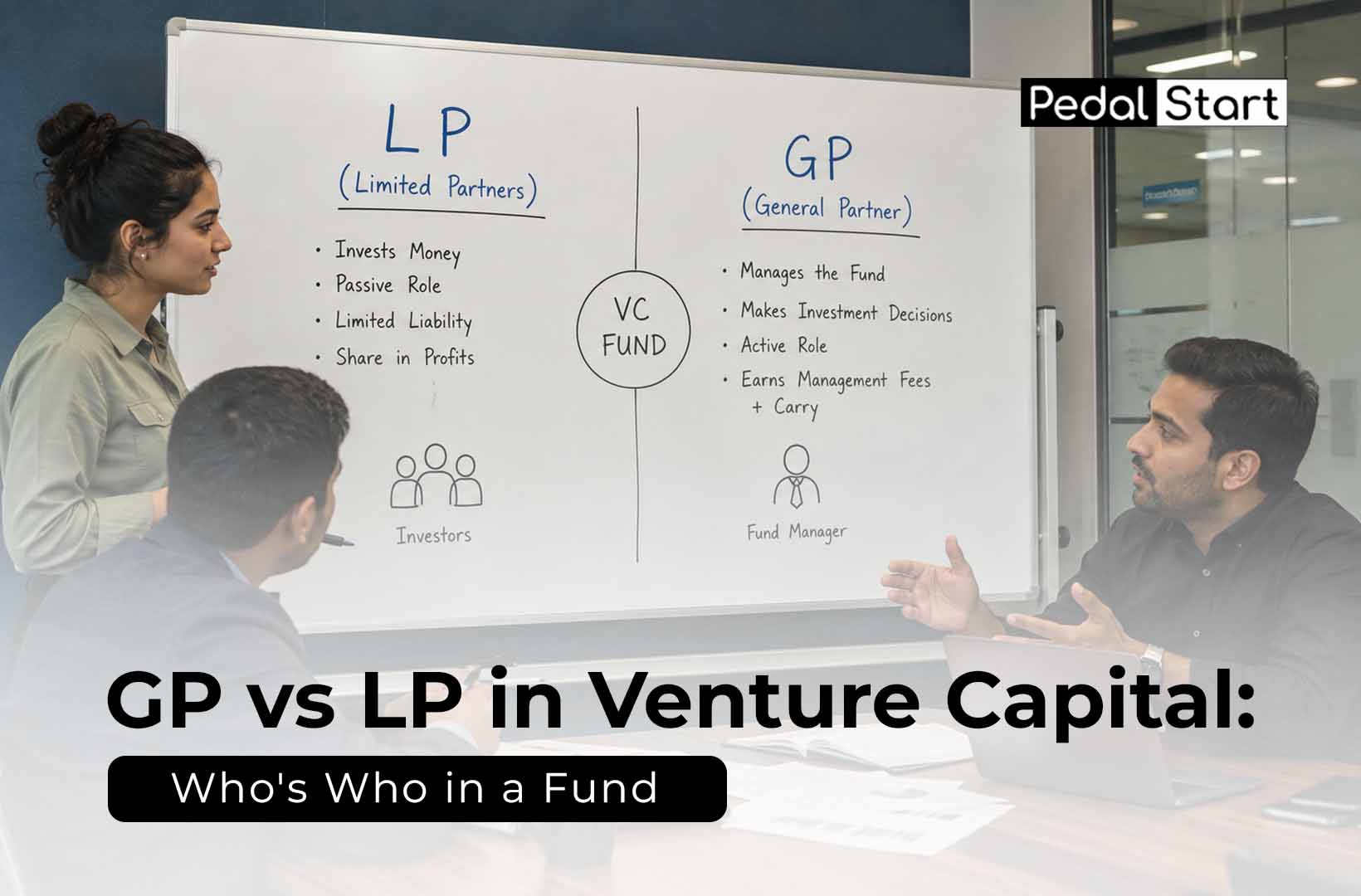
Every venture capital fund has two sides.
There are the people who put the money in. And the people who decide where it goes.
In fund language, those are the LPs and the GP: limited partners and the general partner.
If you invest in startups, or you are raising from a VC, the difference matters. It tells you who is taking the risk, who is making the calls, and how everyone gets paid.
Here is the difference, in plain terms.
What is a general partner (GP)?
The general partner, or GP, is the firm that runs the fund.
The GP raises the money, chooses which startups to back, sits on boards, and manages the portfolio until exit. In short, the firm does the work and makes the decisions.
In India, a VC fund is set up as an Alternative Investment Fund (AIF). Inside that structure, the GP role is played by the fund's sponsor and investment manager, often the same team.
The general partner also carries the liability. If something goes wrong at the fund level, the general partner is on the hook.
What is a limited partner (LP)?
A limited partner, or LP, is an investor who puts money into the fund but does not run it.
LPs commit capital and then step back. They do not pick the startups or manage the deals. That is the GP's job.
The word "limited" means two things. Their involvement is limited, and so is their liability. An LP can only lose the money they committed, nothing more.
So who are the LPs? Pension funds, endowments, insurance companies, family offices, and wealthy individuals. In India, the minimum an LP can commit to a fund is ₹1 crore.
GP vs LP: the key differences
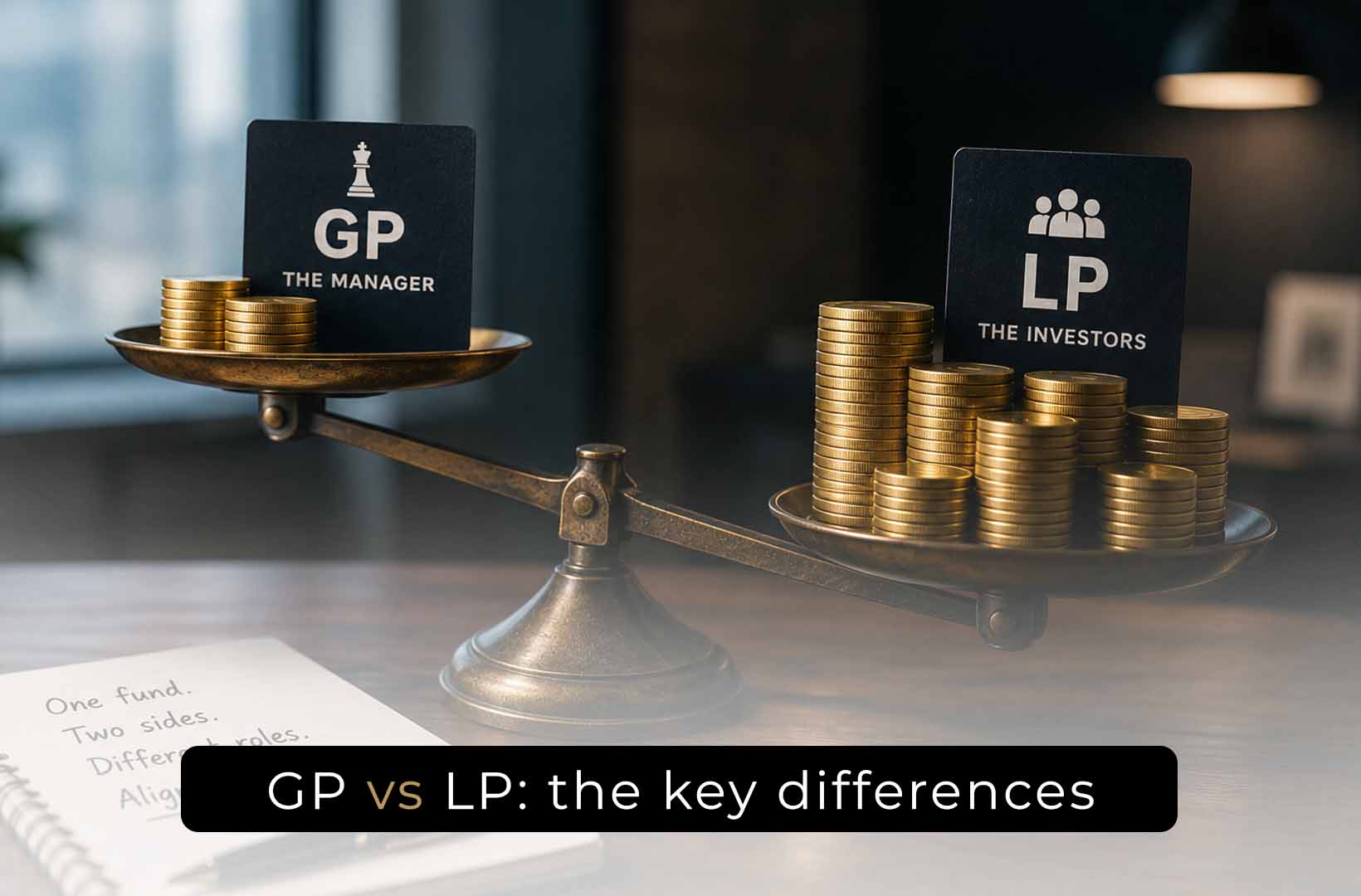
The simplest way to see it: the GP manages, the LP funds.
The manager runs the fund and takes a share of the profits. The LP provides most of the money and takes most of the returns.
General partner (GP) | Limited partner (LP) | |
Role | Runs the fund, picks and manages investments | Provides capital, stays hands-off |
Money in | A small slice, as skin in the game | The large majority of the fund |
Liability | Full | Limited to what they committed |
How they earn | A fee, plus a share of profits (carry) | Returns on their invested capital |
Who they are | The VC firm and its partners | Family offices, institutions, HNIs |
How do GPs make money?
GPs earn in two ways: a management fee and a share of the profits.
The industry shorthand is "two and twenty."
The management fee is around 2% of the fund each year. It pays salaries, diligence, and the cost of running the fund. It steps down in the later years, once the fund stops making new investments.
The carry is the GP's share of the profits. It is commonly in the 15 to 20% range in India.
But there is a catch. The GP only earns carry after LPs get their money back, plus a minimum return called the hurdle, often around 8%.
So the carry is the real payday, and the manager only gets it if the fund does well. That is the whole point. It ties the manager's reward to the investor's success.
How carry works: a simple example
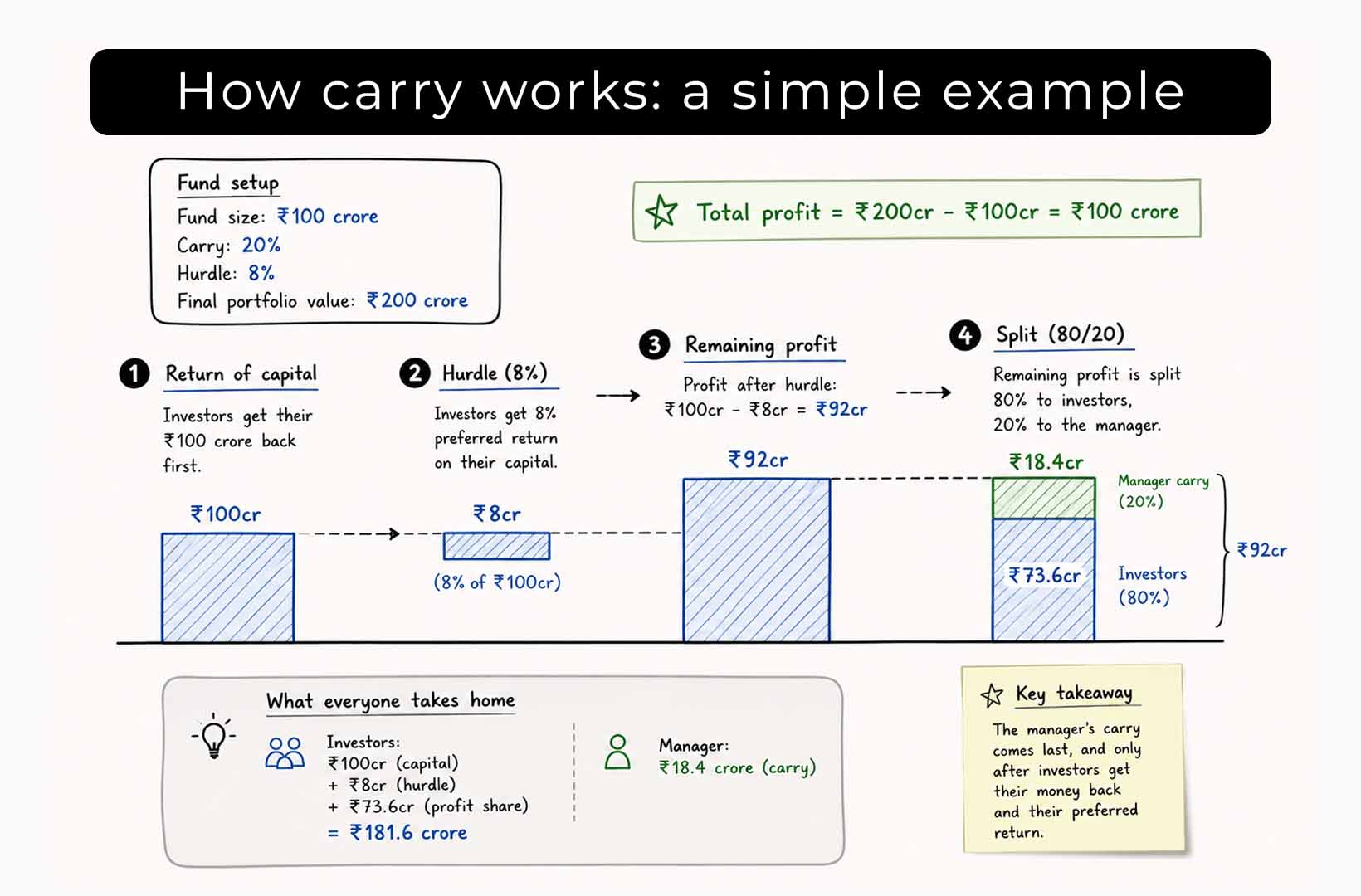
Carry sounds abstract until you put numbers on it. So here is a simple version.
Say a fund raises ₹100 crore from its investors, with a 20% carry and an 8% hurdle.
The fund invests, and years later the portfolio is worth ₹200 crore. Here is the order in which that money gets paid out:
First, investors get their ₹100 crore back. Their capital is returned before anyone earns a share of the profit.
Next, they get the hurdle, the 8% preferred return. Only after that does the manager's profit share begin.
Then the remaining profit is split, commonly 80% to the investors and 20% to the manager.
Some funds add a "catch-up" step in between, but the principle holds: investors first, manager last.
So on a large gain, the manager's 20% carry can be worth a lot. But only after the investors have their money back and their preferred return.
This is why carry is powerful and patient at the same time. The fund has to genuinely succeed before the manager sees the big money.
Do GPs invest their own money?
Yes, and in India they are required to.
SEBI rules say the manager must put its own money into the fund. The commitment is 2.5% of the fund or ₹5 crore, whichever is lower, and it has to come from the manager's own pocket, not from fees.
This is called skin in the game.
It means the people managing your money stand to lose their own if they get it wrong. For an LP, that alignment is one of the first things worth checking.
Where do angels and family offices fit?
Most individual investors are not classic LPs. And they are not GPs either. They sit a little to the side.
A family office with deep pockets can be an LP. It commits ₹1 crore or more to a fund and lets the GP invest it.
An angel investor does something different. They back specific startups directly, with their own money, and often co-invest alongside others rather than through a fund.
This is where a network matters. Most people in the PedalInvest world act more like angels than passive LPs. They see vetted deals, back the ones they like, and co-invest with experienced investors, without locking ₹1 crore into a single fund.
If you want to understand the routes, our guide on how to invest in startups in India walks through each one.
GP vs LP vs Angel Investor: how they differ
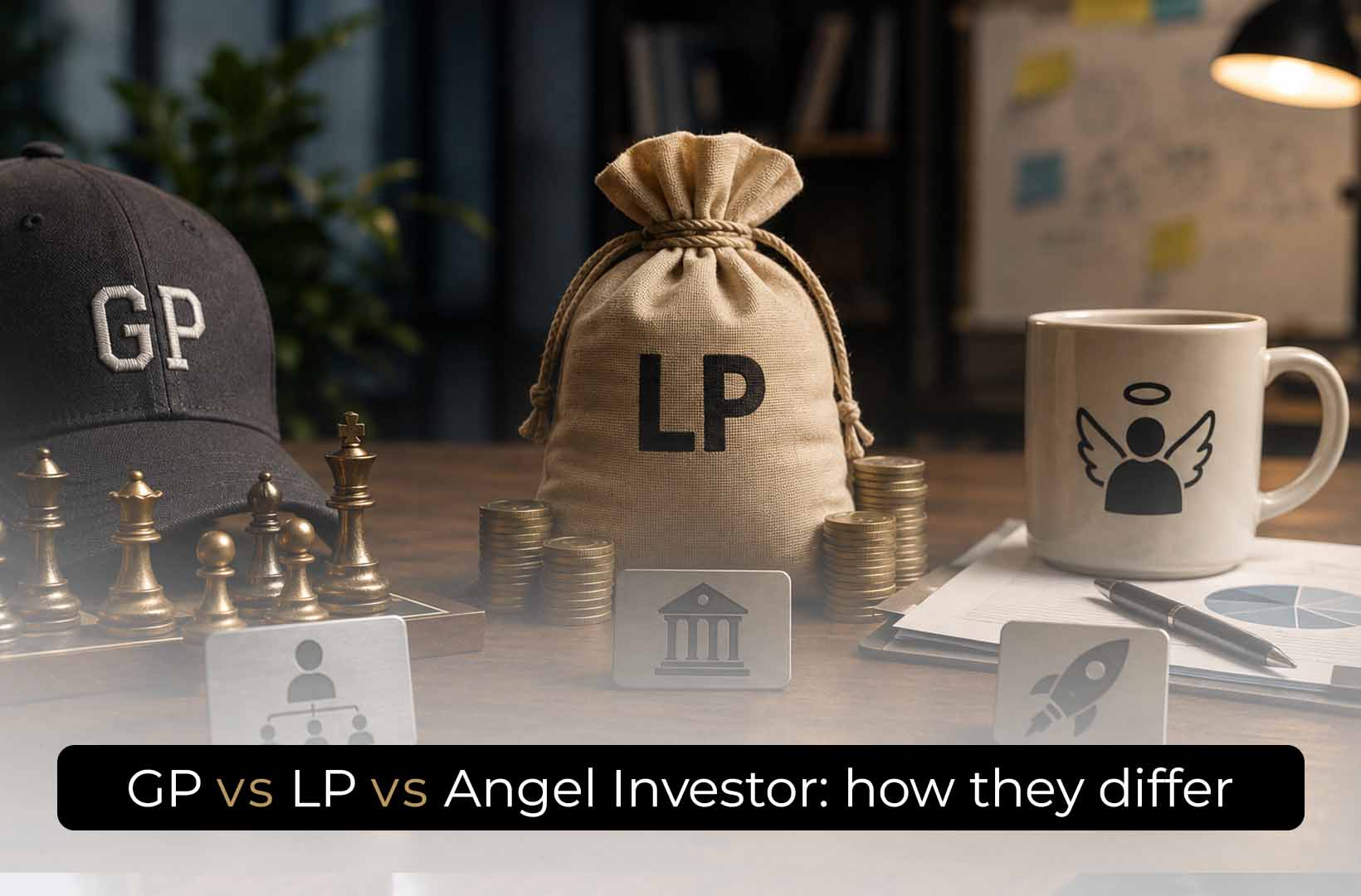
It helps to place all three side by side, because in the startup world people mix them up.
Role | What they do | Whose money |
General partner (GP) | Runs a fund and makes the calls | Mostly other people's, plus a small stake of their own |
Limited partner (LP) | Backs a fund, then stays hands-off | Their own, committed to the fund |
Angel investor | Backs startups directly, deal by deal | Their own, straight into the company |
The clean way to remember it: a GP manages a fund, an LP funds a fund, and an angel skips the fund and backs the startup directly.
If you invest through a fund, what should you check?
If you ever commit money as a fund investor, a few things separate a good allocation from an expensive one.
The manager's track record. Have they returned money to investors before, not just raised it?
Their own commitment. How much of their own money is in the fund? More skin in the game means better alignment.
The fees. A 2% fee and 20% carry is the standard. Anything well above that needs a reason.
The timeline. Your money can be locked for the full fund life, often ten years. Make sure that fits your plans.
The same instincts apply if you back startups directly as an angel. Judge the people, understand the terms, and know how long your money is committed
Why this matters if you raise from a VC
If you are a founder, the VC across the table is a GP managing other people's money.
That explains a lot of their behavior. The fund has a life, often ten years. The manager has to return capital to its investors and earn its carry inside that window.
So the push to grow fast, raise the next round, and exit is not personal. It is built into the structure.
Knowing that helps you read the room and pick investors whose fund timeline actually fits your plan.
The simple version
Strip away the jargon, and it is a simple split. One side runs the fund and makes the decisions. The other side puts up most of the money and stays out of the way.
The GP earns a fee to operate and a share of the profits if the fund does well. The LP takes most of the returns, and most of the money is theirs to begin with.
For anyone investing in or around startups, knowing which side you are on, or which side is managing your money, is the starting point. It tells you who carries the risk, who makes the calls, and how the incentives are set. Most people in early-stage investing are closer to angels than LPs. They back companies directly, not through a fund. The same logic still applies. Understand the terms, judge the people, and know how long your money is committed.
Key takeaways
A GP (general partner) runs a venture fund. An LP (limited partner) funds it.
The GP makes the decisions and carries the liability. The LP provides most of the money and stays hands-off.
GPs earn a management fee, around 2% a year, plus carried interest, commonly 15 to 20% of profits above a hurdle.
In India, GPs must invest their own money too, at least 2.5% of the fund or ₹5 crore, as skin in the game.
Most angels and family offices act as direct investors or co-investors, not as classic LPs.
Frequently asked questions
What do GP and LP stand for? GP is general partner, the firm that manages the fund. LP is limited partner, an investor who commits money to it.
What is the main difference between a GP and an LP? The GP runs the fund and makes the investment decisions. The LP provides capital and stays hands-off, with liability limited to what they committed.
How do GPs get paid? Through a management fee, around 2% of the fund a year, and carried interest, commonly 15 to 20% of the profits above a minimum return to LPs.
Is an angel investor a GP or an LP? Neither, in the strict sense. An angel invests their own money directly into startups, rather than running a fund or committing to one as an LP.
Can an individual be an LP in a VC fund? Yes, if they meet the minimum. In India that is ₹1 crore per fund, which is why LPs tend to be family offices and high-net-worth individuals.