

If you want to invest beyond stocks and mutual funds, into startups, private companies, or private credit, you end up in the world of Alternative Investment Funds. AIFs are the regulated vehicle through which most private-market and startup investing in India actually happens.
The category has grown into a serious asset class. India's AIF industry now holds about ₹15.7 lakh crore in commitments across more than 1,700 registered funds, compounding at nearly 30% a year over the last five years, as the SEBI Chairman noted in early 2026. Increasingly, high-net-worth investors are looking past public markets for this kind of growth.
This guide covers what an AIF is, the three categories and which ones fund startups, the SEBI rules that govern them, who can invest, and how to choose one. It is written for investors who want private-market and early-stage exposure, not for fund managers setting one up.
What is an alternative investment fund (AIF)?
An Alternative Investment Fund is a privately pooled investment vehicle registered with SEBI. It raises money from sophisticated investors and invests it using a defined strategy.
It includes assets beyond traditional stocks, bonds, and mutual funds. These include startups, private equity, private credit, real estate, and hedge funds.
Three features define an AIF. It is private, raised through private placement rather than offered to the retail public.
It is pooled, meaning many investors commit to a fund run by a professional manager. It also has a high minimum, with a SEBI floor of ₹1 crore per investor. In short, it is how serious private capital is organised and regulated in India.
The three categories of AIFs
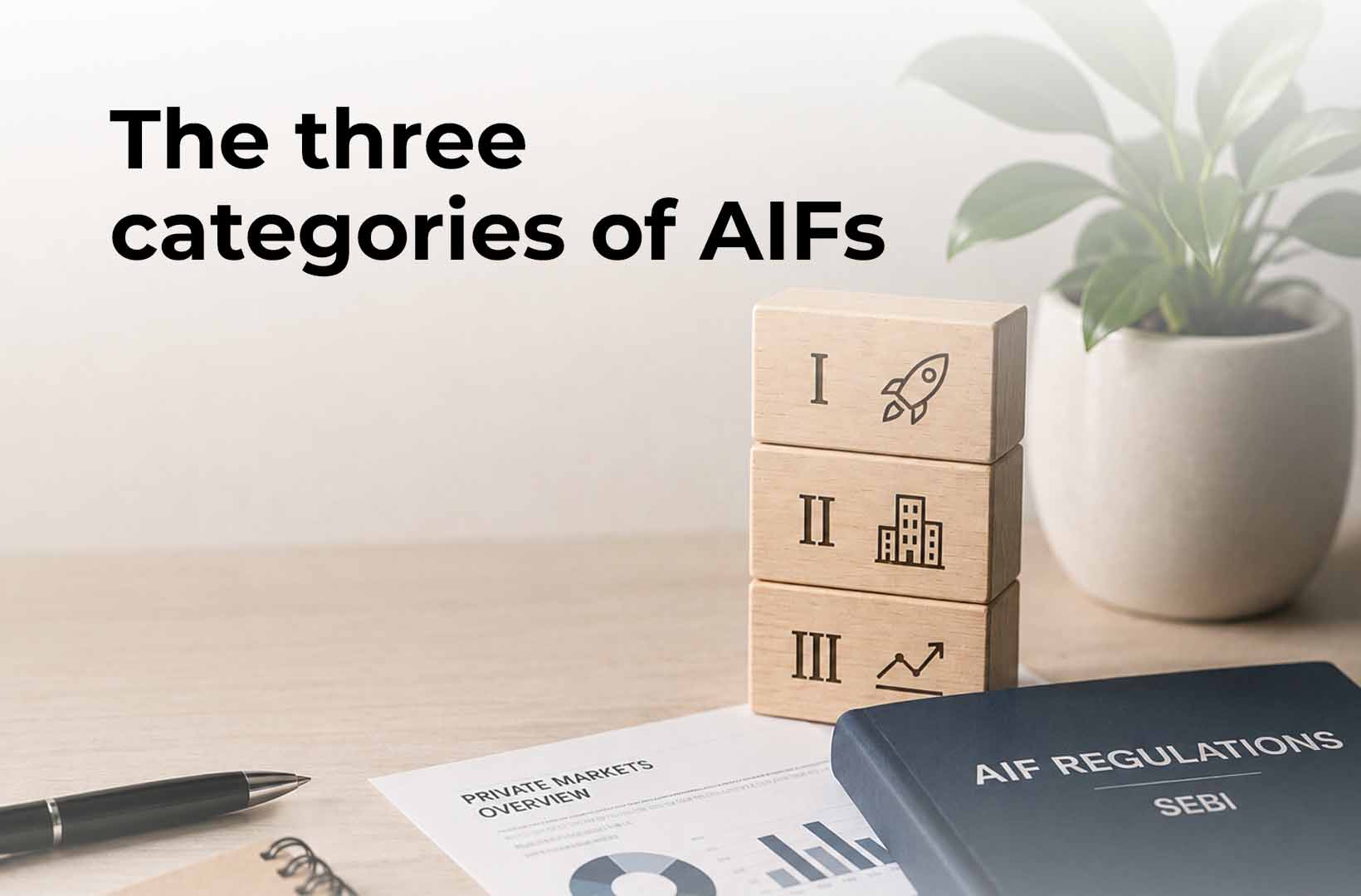
SEBI sorts every alternative investment fund into one of three categories, based on what it invests in and how much risk it takes. For anyone interested in startups, Category I and Category II are the ones that matter.
Category | What it invests in | Relevance to startups |
Category I | Startups, SMEs, infrastructure, social ventures. Includes venture capital funds, angel funds, and SME funds. | Highest. This is where VC and angel funds sit. |
Category II | Private equity, private credit, venture debt, real estate. The largest segment, close to three-quarters of all commitments. | High. Funds later-stage startups through equity and debt. |
Category III | Hedge funds, long-short equity, derivatives. Can use leverage. | Low. Mostly public-market strategies. |
Category I is the startup category. Venture capital funds and angel funds, the vehicles that back early-stage companies, are Category I AIFs. SEBI gives this category tax pass-through and no-leverage rules. It does this because the category sends capital to sectors the government supports.
Category II is the largest, at close to three-quarters of all AIF commitments. It houses private equity and private credit, including the venture debt funds that lend to startups between rounds. It also gets pass-through tax treatment.
Category III is the odd one out for a startup audience. It covers hedge funds and complex public-market strategies. It uses leverage. It is taxed at the fund level, not passed to investors. Most founders and angel investors will never touch it.
How AIFs power the startup ecosystem

Here is why AIFs matter if you care about startups: almost every institutional rupee that reaches an Indian startup flows through one.
When a VC fund backs a seed round, that fund is a Category I AIF. When an angel fund co-invests, same structure. When a venture debt provider lends between rounds, that is a Category II AIF.
So AIFs are not a side topic for the startup world. They are the plumbing. Knowing the categories tells you exactly what kind of capital you are dealing with, both as a founder raising it and as an investor deploying it.
What the SEBI rules say
AIFs are governed by the SEBI (Alternative Investment Funds) Regulations, 2012, which have been amended several times since. The rules set who can invest, how much, and how the fund must behave.
The ones worth knowing as an investor:
Minimum investment: ₹1 crore per investor, or ₹25 lakh for the fund's own employees and directors.
Minimum corpus: ₹20 crore per scheme, reduced to ₹10 crore for angel funds.
Investor cap: up to 1,000 investors per scheme, and only 49 for angel funds.
Tax: Category I and II get pass-through status, so investors pay tax on gains at their own rates. Category III is taxed at the fund level.
The 2025 reform: since September 2025, angel funds can raise only from accredited investors, verified by an agency rather than self-declared, with existing funds transitioning by September 2026.
Who can invest in an AIF, and how
AIFs are for sophisticated, high-net-worth investors, not retail. The ₹1 crore minimum is the gate. Resident Indians, NRIs, and foreign investors can all participate, subject to the fund's terms and cross-border rules.
The process is simple once you qualify. You pick a fund whose strategy fits your goal, complete KYC and accreditation, sign the subscription agreement, and commit your capital, which the fund draws down over time rather than all at once.
One thing to know if your interest is specifically startups: the ₹1 crore minimum puts a full VC or angel fund out of reach for many investors.
The more accessible route to startup exposure is an angel network or syndicate, where per-deal tickets start far lower.
PedalInvest, PedalStart's invite-only angel network, is one such route, giving members access to vetted early-stage deals and the option to co-invest alongside experienced angels without committing to a full fund.
If you are weighing your options, our guide on how to invest in startups in India walks through every route and its real minimum.
How to choose an AIF
There is no single best AIF. The right one depends on the exposure you want and how much risk and lock-in you can handle. Match the category to your goal first.
For startup growth and early-stage upside, look at Category I venture capital or angel funds.
For steadier private-credit income, Category II debt funds are the common choice.
For public-market and hedge strategies, Category III, with its higher risk and fund-level tax.
Once the category is right, evaluate the fund itself: the manager's track record, the strategy and where it actually deploys capital, the fees and carry, the lock-in and expected timeline, and how transparently the fund reports to investors. A strong manager in the right category matters far more than chasing a headline return.
AIF vs mutual fund vs PMS
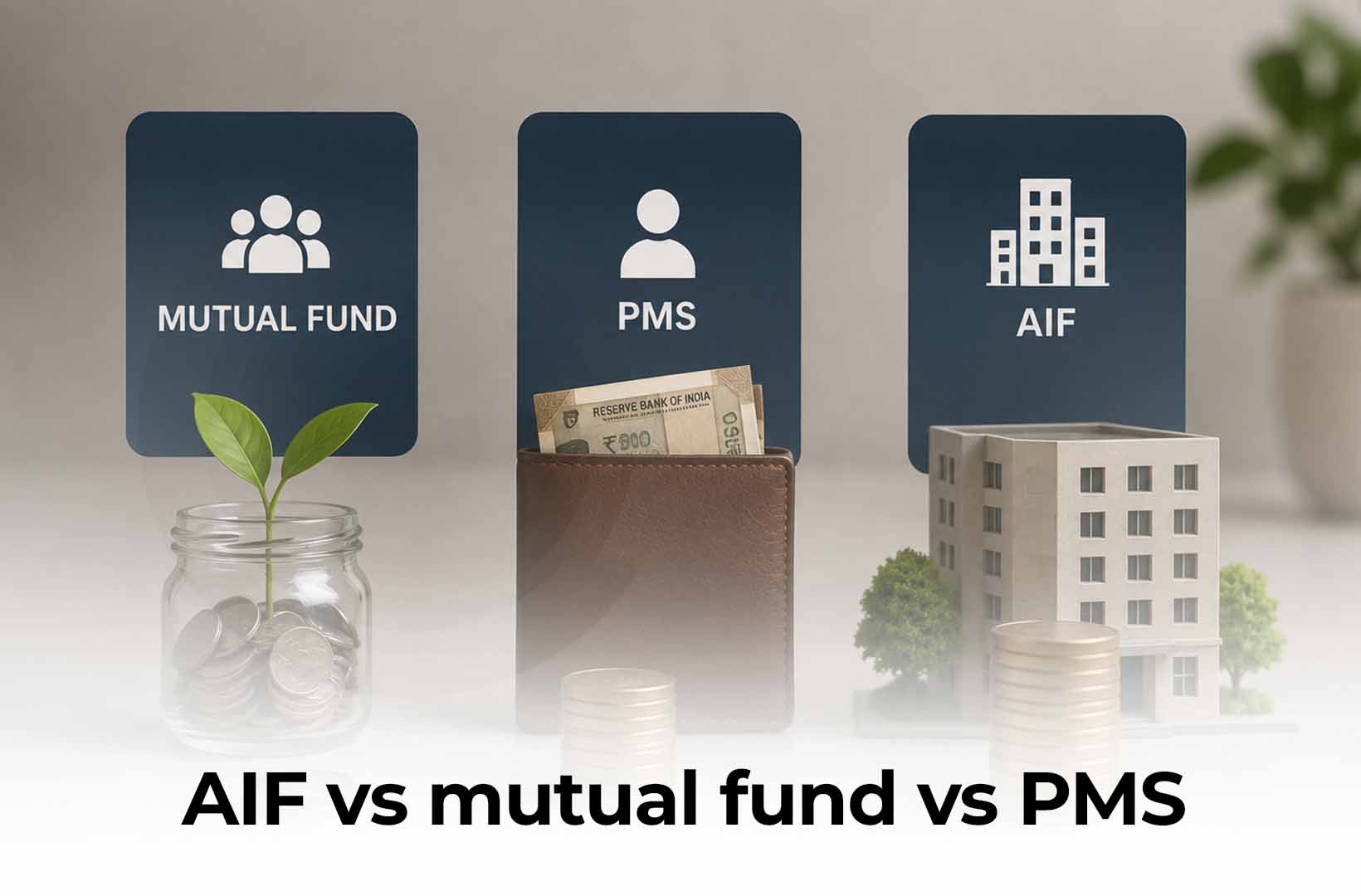
Investors often confuse AIFs with mutual funds and portfolio management services (PMS). The clearest way to tell them apart is by who they are for and how much you need.
Mutual fund | PMS | AIF | |
Minimum investment | A few hundred rupees | ₹50 lakh | ₹1 crore |
Open to | Retail investors | HNIs | HNIs and sophisticated investors |
Invests in | Mostly listed securities | Listed securities | Private and alternative assets |
What you hold | Fund units | Individual securities | Fund units |
The short version: mutual funds are for everyone and stay in public markets. AIFs are for high-net-worth investors who want the private-market and startup exposure that mutual funds cannot offer.
Closing Note
AIFs are how serious private capital moves in India, and if your interest is startups, they are worth understanding, as an investor putting money through one or a founder raising from one. The category has grown fast for a reason: it opens doors that public markets cannot, from early-stage venture bets to private credit. But that access comes with a ₹1 crore floor, long lock-ins, and real risk, so it rewards investors who match the right category to their goal and do the diligence rather than chasing a headline return. For most people who simply want a slice of the startup upside without a full fund commitment, an angel network is the more practical first step, and the AIF route is there when you are ready to scale into it.
Key takeaways
An AIF is a SEBI-regulated private fund with a ₹1 crore minimum, and the main vehicle for private-market and startup investing in India.
There are three categories: Category I (VC, angel, and startup funds), Category II (private equity, private credit, and venture debt, the largest), and Category III (hedge funds).
Category I and II get pass-through tax treatment; Category III is taxed at the fund level.
Since September 2025, angel funds can raise only from accredited investors.
If you want startup exposure without a ₹1 crore commitment, an angel network or syndicate is the more accessible route.
Frequently asked questions
What is an AIF in simple terms? A SEBI-registered private fund that pools money from wealthy investors to invest in startups, private companies, private credit, or other alternative assets outside the stock market.
What is the minimum investment in an AIF? ₹1 crore per investor. The only exception is the fund's own employees and directors, who can invest a minimum of ₹25 lakh.
What are the three categories of AIF? Category I (venture capital, angel, SME, infrastructure, and social venture funds), Category II (private equity, private credit, and real estate), and Category III (hedge funds and complex trading strategies).
Which AIF category invests in startups? Mainly Category I, which holds venture capital and angel funds, and Category II, which includes private equity and venture debt funds that back later-stage startups.
Can NRIs invest in AIFs? Yes. NRIs and foreign investors can invest in Indian AIFs, subject to the fund's terms and applicable FEMA rules.
Are AIFs open to retail investors? No. The ₹1 crore minimum and private-placement structure keep AIFs limited to high-net-worth and sophisticated investors.